Republican infighting between two important constituencies — the agriculture sector and the MAHA coalition — is threatening passage of a bill leaders are counting on to help woo rural voters ahead of the midterms.
House GOP leaders hope this week to advance a long-stalled farm bill that would secure a slew of industry and rural investments. They see a political incentive to move quickly now to shore up farm country support in advance of the November elections, plus heed calls from President Donald Trump to “PASS THE FARM BILL, NOW!”
The farm bill traditionally comes to the floor with bipartisan support. But House Democrats this time are largely opposed to the package because it does not reverse the massive cuts to the country’s largest food aid program enacted by last year’s GOP megabill. That's putting extra under pressure on Republicans to see it over the finish line amid intraparty disagreements over provisions related to pesticides, livestock laws and ethanol sales.
The biggest source of conflict is over a provision that would shield pesticide makers — a powerful lobbying force with agriculture state Republicans — from lawsuits. It comes as the Trump administration has also moved to protect access to a key pesticide after chemical manufacturers told the White House they were concerned about regulatory uncertainty or MAHA-driven crackdowns. Removing the measure would stoke backlash from Trump officials and farm state Republicans.
MAHA activists feel betrayed after voting for Trump in hopes that his administration would crack down on chemical exposure they blame for driving up chronic illness and disease. And now these activists are so fed up that they’ve turned to working with a group of House Democrats to strip out the language, according to four people granted anonymity to share private discussions.
Several Republicans who wield enormous power in Speaker Mike Johnson’s razor-thin majority could try to tank the entire bill If the provision isn’t removed.
Rep. Anna Paulina Luna (R-Fla.), one of the main Republicans opposed to the pesticide provision, said she opposes the farm bill in its current form. Her biggest concern? “Glyphosate,” she said, referring to the widely used chemical weed killer targeted by MAHA.
Most Republicans don’t think the pocket of bipartisan opposition to the pesticide provision will be successful, arguing that the bill clarifies labeling rules and national standards for pesticides and herbicides used by farmers.
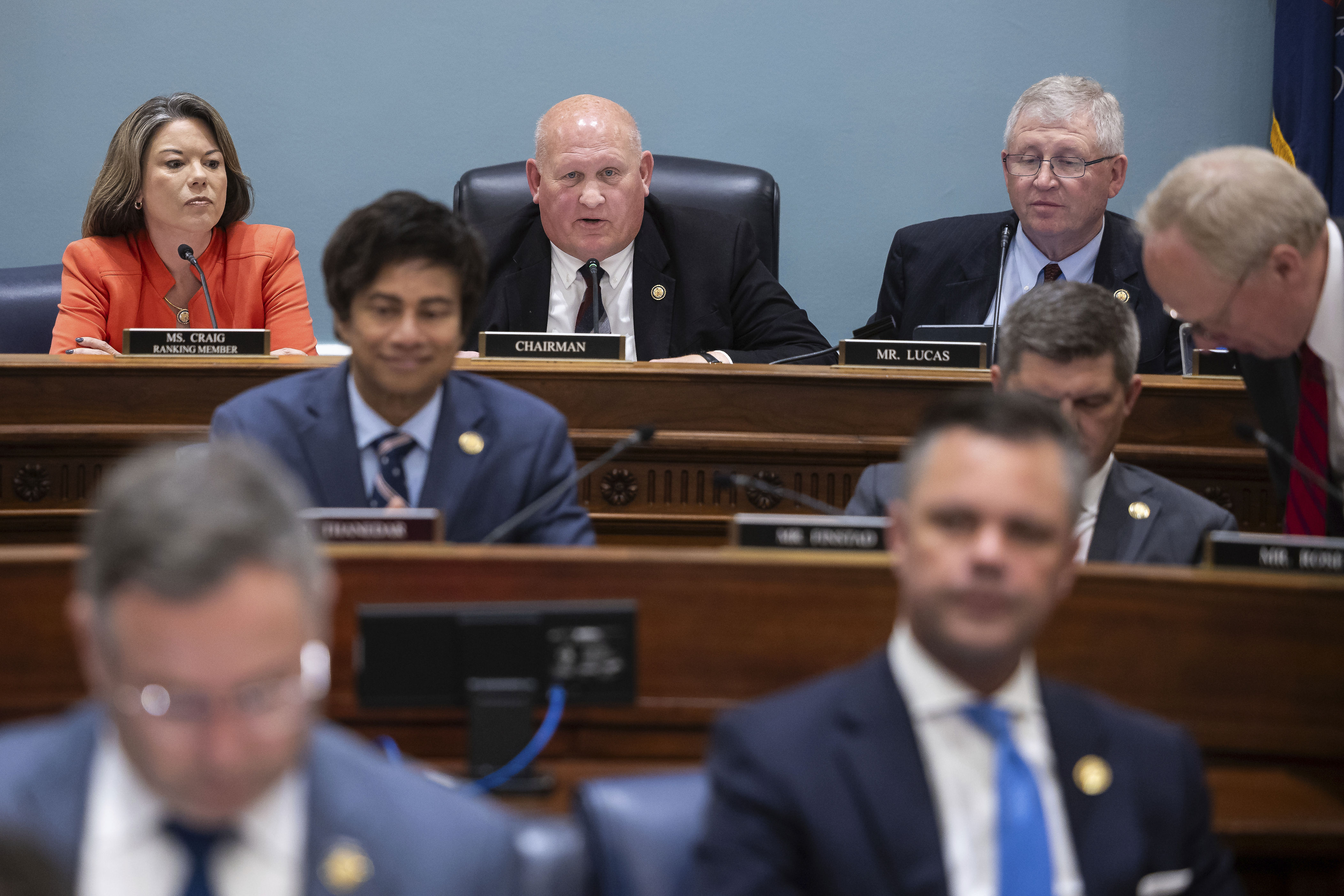
House Agriculture Chair G.T. Thompson (R-Pa.) said during the bill’s markup the provision is “critical for securing access to the well-regulated pesticide tools” in line with Republicans’ focus on food affordability ahead of the midterms.
Even Rep. Thomas Massie (R-Ky.) said in an interview that he plans to vote for the final bill despite his concerns about the pesticide language, because it includes a pilot project allowing small meat processors to bypass federal USDA inspections and sell directly to consumers.
But the Kentucky Republican is still pushing to strip out the pesticide measure, arguing that the “government is under siege” by chemical company lobbyists. And further inflaming tensions and drawing attention to divisions is that the farm bill will hit the floor the same week the Supreme Court is set to hear oral arguments in a high-profile case on whether the maker of glyphosate-based Roundup should be preempted from failure-to-warn claims for cancer risks from pesticide use.
Massie and Rep. Chellie Pingree (D-Maine) are scheduled to be among a group of speakers at a MAHA-organized rally — advertised as “The People vs. Poison” — outside the Supreme Court Monday morning.
Pingree, who has fought for years against Republicans efforts to pass similar language, has co-sponsored a bipartisan amendment to remove the pesticide language from this year’s farm bill.
“It's good that there are Republicans on there, and one of the reasons we wanted to be sure it was bipartisan is because they're more likely to be in a position to pressure the Rules Committee members and the chair,” Pingree said of her amendment.
Pingree’s is among hundreds of amendments House Republican leaders will need to wade through when the Rules Committee meets Monday afternoon to pave the way for floor consideration of the farm bill. Johnson and his leadership team have been working to stave off amendment votes in relation to other bills. But they may need to allow some on the farm package to, at the very least, guarantee adoption of a party-line procedural rule vote necessary to get onto the underlying measure.
Luna, the MAHA-aligned Republican, said in an interview that leaders haven’t committed to allowing a floor vote on her amendment to strip out the pesticide measure.
Pennsylvania GOP Reps. Brian Fitzpatrick and Ryan Mackenzie, and Reps. Lauren Boebert of Colorado and Nancy Mace of South Carolina have all introduced amendments to strip parts of or all pesticide provisions in the bill.
The farm bill is also in peril over a provision that would undo state-level guidelines on livestock sales — specifically a California ballot initiative governing pig confinement that pork producers have argued hurts their bottom lines and created regulatory inconsistencies across states.
Luna and other Republican supporters, including Mace and Reps. Jeff Van Drew of New Jersey and Andrew Garbarino and Mike Lawler of New York, say reversing the referendum would undermine states’ abilities to govern agricultural practices within their own borders.
Another policy fight — allowing year-round sales of higher blends of ethanol at the gas pump — could throw a wrench into farm bill passage plans, too. Biofuels backers and agriculture groups are lobbying members to include a bipartisan E15 amendment in the legislation, with fuel prices spike from the Iran war adding further pressure to find a solution that might bring down prices for consumers.
But GOP leaders would need to grant a waiver to be able to include such an amendment in the bill, since the issue falls outside the House Agriculture Committee’s jurisdiction. And lawmakers who represent small, independent refiners would also oppose the proposal and may vote against the whole package over it.
In the meantime, Thompson is doing a hard sell, saying in an interview that the legislation would be a “real morale boost” that would increase farmers’ borrowing capabilities and modernize programs through the Agriculture Department that haven’t been updated since 2018.
During a closed-door meeting last week, Thompson also pitched GOP hard-liners who regularly oppose the farm bill to support it this time, arguing that the direct farm subsidies they are most opposed to are not included because Republicans approved billions of dollars in new spending to bolster the so-called farm safety net as part of last year's megabill.
Rep. Frank Lucas (R-Okla.), who was the chair of the Agriculture Committee when Congress passed the 2014 farm bill, told reporters recently that lawmakers should avoid delaying the farm bill another year: The legislation hasn’t been updated since 2018 and was due to be reauthorized in 2023.
“You don't want to roll this over into a brand new Congress,” Lucas warned “The issues that are entailed here are not that complicated. There's some controversial things … many of those things, ultimately, in this process, fall out. That's just the nature of the way things happen.”