
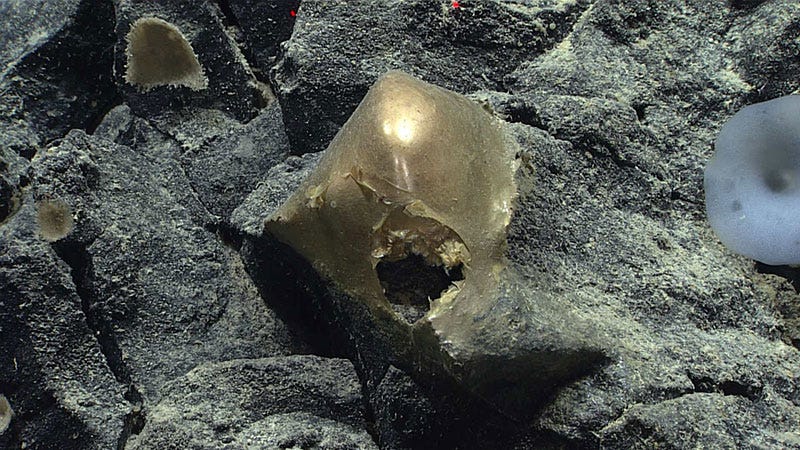
The nearly 3-year-old mystery of the golden orb has been solved.
The object is not an egg, a sponge or remnants of a space alien but a relic of a deep-sea anemone, the National Oceanic and Atmospheric Administration concluded.
Scientists have determined that the golden mass, discovered at a depth of more than 2 miles in the Gulf of Alaska in 2023, is a remnant of dead cells that formed at the base of a giant deep-sea anemone, known as Relicanthus daphneae. It was the part of the anemone that attached to rock.
Start the day smarter. Get all the news you need in your inbox each morning.
When was it discovered?
In 2023, researchers at the National Oceanic and Atmospheric Administration (NOAA) discovered an unidentified object – later described as a golden orb – while using remotely operated vehicles to scour the seafloor as part of a larger expedition to record and study areas never before been seen by humans.
While gliding the device over a rocky outcrop 2 miles underwater, team members aboard a NOAA ship came across what one of them initially described as a "yellow hat." But upon closer inspection, the object attached to a rock appeared "smooth, gold (and) dome-shaped," NOAA said in a news release.
Scientists were puzzled. Was it an egg case? A dead sponge? Had something crawled into it … or out of it?
The mysterious finding attracted a significant amount of speculation and public interest, according to NOAA. Aiming to find answers, the team collected the orb and shipped it to the Smithsonian Institution's National Museum of Natural History for additional examination and study.
Unraveling a mystery
Identifying the "golden orb" was a multiyear effort, NOAA said.
“We work on hundreds of different samples and I suspected that our routine processes would clarify the mystery,” explained Allen Collins, a zoologist and director of NOAA Fisheries’ National Systematics Laboratory, according to a news release.
“But this turned into a special case that required focused efforts and expertise of several different individuals," Collins said. "This was a complex mystery that required morphological, genetic, deep-sea and bioinformatics expertise to solve.”
The first DNA barcoding was not conclusive, NOAA said. Going even deeper, whole-genome sequencing confirmed it included animal DNA and featured a significant amount of genetic material from the giant deep-sea anemone.
By sequencing the mitochondrial genomes of both specimens, scientists confirmed they were genetically nearly identical to a known Relicanthus daphneae reference genome.
More mysteries await
Though the discovery confirms the identity of the previously unknown specimen, the Earth’s deep ocean still holds many secrets.
“This is why we keep exploring – to unlock the secrets of the deep and better understand how the ocean and its resources can drive economic growth, strengthen our national security, and sustain our planet,” Capt. William Mowitt, acting director of NOAA Ocean Exploration, said in a statement.
Doyle Rice is a national correspondent for USA TODAY, focusing on weather and climate.
This article originally appeared on USA TODAY: Scientists identify mysterious 'golden orb' found in ocean