Here’s what you’ll learn when you read this story:
- Oceanographers explored an area around the Pacific Ocean’s Nazca Ridge and found a massive underwater mountain.
- Using a sonar system, the researchers digitally mapped the seafloor of the area and observed the rare and largely unknown species of wildlife that make their homes on the underwater mountains’s ridges.
- Of the 71 percent of the Earth’s surface that is ocean floor, only 26 percent of it has been mapped with the level of resolution used on this expedition by the institute.
Summiting Greece’s towering Mount Olympus is an impressive feet for the 1-million-plus people who have accomplished the climb. But it would be even more impressive if they could do it underwater.
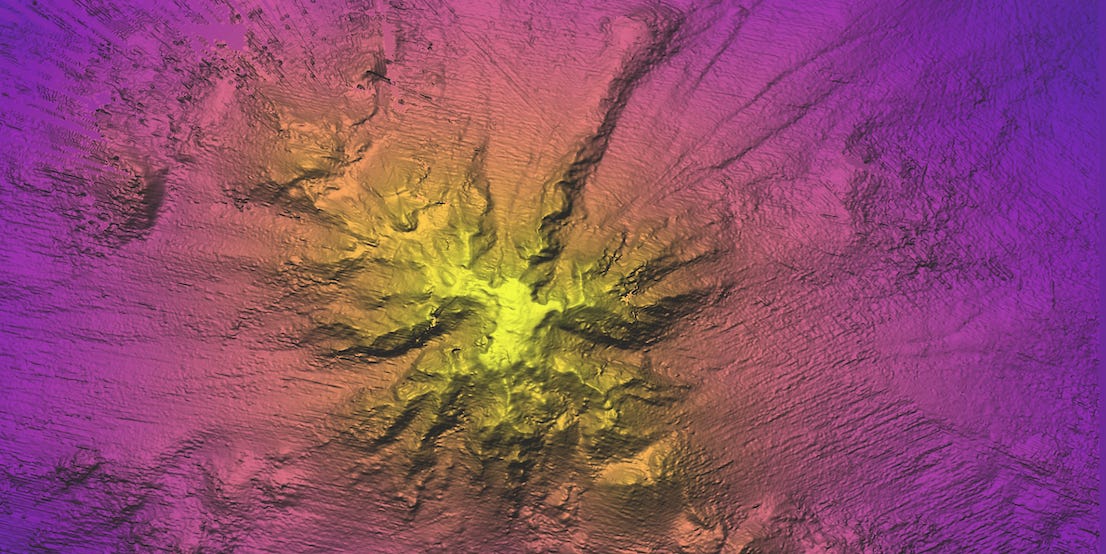
That’s impossible—for now. But in 2024, oceanographers led by the Schmidt Ocean Institute exploring the depths of the Pacific Ocean discovered a massive underwater mountain that at least presents the opportunity.
Regardless of climbability, the 3,109-meter seamount is a massive find. It’s one of many made during the oceanographers’ 28-day late-summer exploration in the research vessel Falkor (too), whimsically named for the famous luckdragon from The Neverending Story.
The team discovered the mountain along the Nazca Ridge, which is located about 900 miles west of the Chilean coast—a region that itself contains a chain of underwater mountains. But this particular peak was towering above the rest. The submerged mountain is about 200 meters taller from base to peak than Mount Olympus, and roughly four times the size of the tallest building in the world (Dubai’s Burj Khalifa), according to a press release from the institute.
The Falkor (too) crew mapped the mountain and the surrounding area using a sonar system on the bottom of the vessel’s hull. “Sound waves go down and they bounce back off the surface, and we measure the time it takes to come back and get measured. From that we get a really good idea (of the seabed topography),” Jyotika Virmani, the institute’s executive director, told CNN.
The area plotted by the expedition is a drop in the ocean (pun intended), but every drop counts. Just under three-quarters of the Earth’s surface (about 71 percent) is ocean floor, but of that expanse, we’ve only mapped about 26 percent in high resolution—including this recent Nazca Ridge mission. The oceanographers also studied nine other features of the area, including a smaller, neighboring mountain’s sprawling coral garden that stretches the size of three tennis courts.
The rocky slopes on the Nazca Ridge mountains, and other mountains like them across the ocean, are perfect homes for ancient coral and sponge gardens in which some sea life can live largely undisturbed. In addition to mapping the mountains, the researchers used a robot to explore the region and made some pretty major wildlife discoveries. This includes the thePromachoteuthis squid, which is so rare that everything we previously knew about it came from the small handful of specimens that were collected as long ago as the late 1800s.
“The seamounts of the Southeastern Pacific host remarkable biological diversity,” Alex David Rogers, Science Director of Ocean Census, said in a press release from the Schmidt Ocean Institute.
The researchers also spotted a Caspar octopus—the first confirmed appearance of the cephalopod in the southern Pacific Ocean—and Bathyphysa siphonophores, which are more commonly and ridiculously known as “flying spaghetti monsters” (an apt description).
This was the institute’s third expedition of 2024 to that region of the ocean floor. During the previous two, researchers documented over 150 previously unknown species.
Scientists hope the results of these Nazca Ridge expeditions will help push forward policies to safeguard these areas of the natural world that—despite the fact that we don’t often see them—are no less worth protecting than what we can see.
“We’ve explored around 25 seamounts on the Nazca and Salas y Gómez Ridges,” Co-Chief Scientist and Schmidt Ocean Institute Marine Technician Tomer Ketter said in the press release. “Our findings highlight the remarkable diversity of these ecosystems, while simultaneously revealing the gaps in our understanding of how the seamount ecosystems are interconnected. We hope the data gathered from these expeditions will help inform future policies, safeguarding these pristine environments for future generations.”