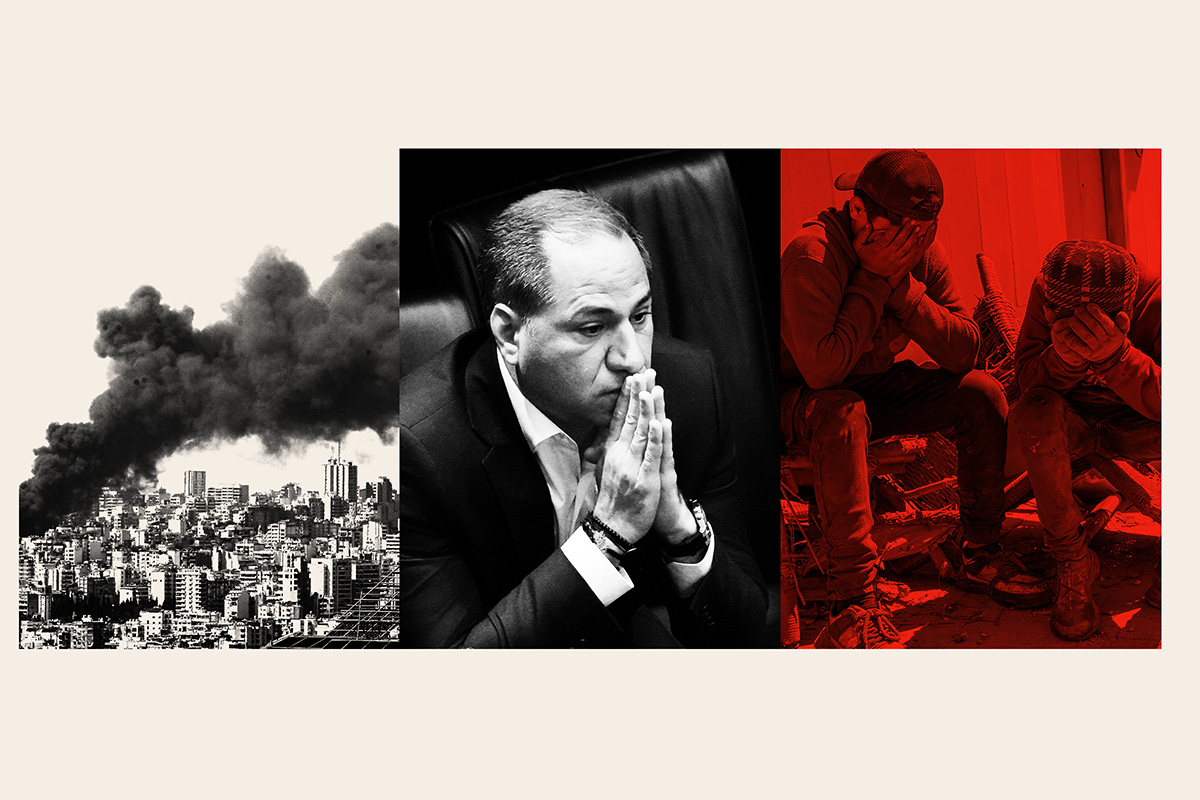
“You will not have peace if the Israelis are still occupying Lebanon, and you will not have peace if Hezbollah is still armed,” Samy Gemayel, the leader of Kataeb, a Christian political party in Lebanon, told Newsweek on Wednesday.
Although a fragile ceasefire is now in place, and was just extended on Thursday, Lebanon’s future remains deeply uncertain after more than a month-and-a-half of fighting between Hezbollah and Israel.
Hezbollah launched attacks on Israel on March 2, after coordinated U.S. and Israeli strikes on Iran killed Iranian Supreme Leader Ayatollah Ali Khamenei, pulling Lebanon more deeply into the widening regional war.
Israel’s military response has led to destruction far beyond the areas it identifies as Hezbollah bastions, with Lebanon’s health ministry reporting that around 2,300 people have been killed since the start of the war, not distinguishing between civilians and combatants. That death toll includes 177 children and 274 women, with more than 7,000 reported injured.
In addition to deaths and injuries, the United Nations (U.N.) reports around 1.2 million people in Lebanon have been displaced, with mass disruptions to the education and medical sectors, among others.
Gemayel called Israel’s military operation in southern Lebanon an “invasion,” and noted it is “destroying entire villages,” making these regions “not inhabitable anymore.” He said the action is “not acceptable.”
The IDF said in a Saturday statement to Newsweek, “The IDF operates in accordance with international law and does not target civilians, but rather the military infrastructure of the Hezbollah terrorist organization, taking all feasible precautions to mitigate harm to civilians.”
Israel’s Military Offensive in Lebanon
The IDF has repeatedly stated it’s striking Hezbollah targets or infrastructure that supports the Iranian militia, frequently noting that “terrorists were eliminated in order to remove the threat.” Israel says Hezbollah attacks have killed two civilians in Israel since the reignition of fighting as well as 15 Israeli soldiers.
In a Saturday statement to Newsweek, an IDF spokesperson said, “As part of the effort to remove the pressing threat to residents of northern Israel and to prevent the re entrenchment of Hezbollah, the IDF is operating against the terror organization in accordance with the ceasefire and in response to immediate threats in the Forward Defense Area.”
The statement continued, “It should be emphasized that Hezbollah systematically embeds military infrastructure and assets within civilian population centers, including near sensitive sites, for terrorist purposes, while using Lebanese civilians as human shields, as has been well documented in the past and during the current operation.”
Israel has said it will occupy swaths of southern Lebanon after fighting halts, with Defense Minister Israel Katz saying in March: “At the end of the operation, the IDF would control the area up to the Litani River, including the remaining Litani bridges, while eliminating Radwan [Hezbollah] forces that infiltrated the area and destroying all weapons there.”
He also said all homes near the villages would be destroyed “in accordance with the Rafah and Beit Hanoun model in Gaza,” referencing the scale of devastation seen in those areas during the IDF’s campaign in the Gaza Strip following Hamas’ October 7, 2023, attack.
“What we don’t understand is the actions of Israel by destroying entire villages and making sure that these regions are not inhabitable anymore.” Gemayel told Newsweek. “This is not acceptable because at the end of the day we want to reach a place where people can return to their homes and where Lebanon can live again peacefully.”
He added he fears the mass destruction will make it more difficult to reach a peace deal or diplomatic agreement because “we will have to rebuild all these houses,” an expensive and timely endeavor.
“Our problem with Israel is the invasion. It’s the fact that Israel is violating the airspace and violating the borders of Lebanon,” Gemayel continued.
Lebanon officially recognizes 18 religious sects, and its politics are built around a delicate power-sharing system that divides authority among the country’s main communities, with the largest factions being Shia and Sunni Muslims, as well as Maronite and Greek Orthodox Christians, and a sizable Druze population. Power is formally divided among Lebanon’s main sects, with the presidency reserved by convention for a Maronite Christian, the prime minister’s office for a Sunni Muslim and the speakership of Parliament for a Shia Muslim.
The Kataeb party, which was founded by his grandfather, Pierre Gemayel, in 1936, currently holds four seats in Lebanon’s 128-member parliament.
While many Lebanese parties distance themselves from Israel, the Kataeb Party’s history is more complicated. During Lebanon’s civil war, Bachir Gemayel—Samy’s uncle and then a militia commander tied to Kataeb, aligned with Israel as his forces fought Palestinian and Syrian groups. He was assassinated as president-elect in 1982.
“War should never be eternal. It’s not destiny. Destiny should be stability and peace,” Gemayel told Newsweek.
Lebanon has a relatively large number of Christians, with a 2019 State Department report estimating them to make up north of 32 percent of the country’s population. Historically, Lebanon was more evenly split between Christian and Muslim sects, with Christians long having held significant political and economic power.
There are several small Christian villages in southern Lebanon, including Debel, which is about 3 miles north of the border, where two Israeli soldiers were jailed for defacing a statue of a crucified Jesus Christ. A photograph showing a uniformed Israeli soldier in military fatigues using a sledgehammer to attack the statue in Debel had widely circulated, the IDF later confirming the image was real. The Israeli military said on Tuesday it had replaced the statue “in full coordination with the local community.”
During his Easter message, Pope Leo XIV shared his consolation “to all Christians of southern Lebanon.” On Easter, Pierre Mouawad, a local official with the anti-Hezbollah Lebanese Forces party, was killed, along with his wife and a visiting woman, in an Israeli strike near Beirut. The Israeli military said it intended to target a Hezbollah militant.
Disarming Hezbollah and Its Future
Gemayel believes Hezbollah’s disarmament and the rollback of Iran’s influence in Lebanon as essential to reclaiming the country’s sovereignty, identity, and securing its future. The group was significantly weakened during Israel’s 2024 war, including the assassination of longtime leader Hassan Nasrallah, but continues to maintain a presence in Lebanon. The group deeply opposes Israel.
While Hezbollah continues to enjoy substantial support in Lebanon, it also faces significant opposition. Lebanon’s current government has taken a more openly critical line toward Hezbollah than some of its predecessors, with Prime Minister Nawaf Salam saying in early March, “We announce a ban on Hezbollah’s military activities and restrict its role to the political sphere.”
The leader of the Kataeb party laid out two possible paths to Hezbollah’s disarmament. The first, he said, would be a diplomatic breakthrough in which Iran agrees—through negotiations or other diplomatic channels—to disarm its regional proxies, including Hezbollah. That, Gemayel said, would be the “best-case scenario,” because “Hezbollah will have absolutely no other choice but to totally disarm. And it will happen very quickly. It will happen very peacefully.”
The second option may translate into wider conflict. “Hezbollah will fight back. And in that sense, we believe that we will not have any other choice but to face this threat. Because we cannot continue to live in hostage mode. We are hostages, and no one can accept to live as hostages,” he said.
In this situation, he said the Lebanese Army would have to step in. However, the Lebanese Army is widely viewed as overstretched with limited funding and older capabilities.
While a fierce critic of Hezbollah, Gemayel believes the group could still have a political future in Lebanon, but only if it lays down its arms and undergoes what he called a “rebrand.”
“They will disarm, and they will transform into a political party. I think that they will have to change the name and rebrand in terms of politics, because you know, Hezbollah was created to be an armed group, not a political group.”
He continued: “So I think they will have to recreate a new structure with new name that will enable them to be part of the political life in Lebanon.”
On Lebanon’s Future
Gemayel said Kataeb broadly supports President Joseph Aoun and Salam’s approach to negotiations and conflict resolution. But he said the government must move faster and with more force. “We certainly want them to do much more than what they’re doing, but they are in the right place” he said.
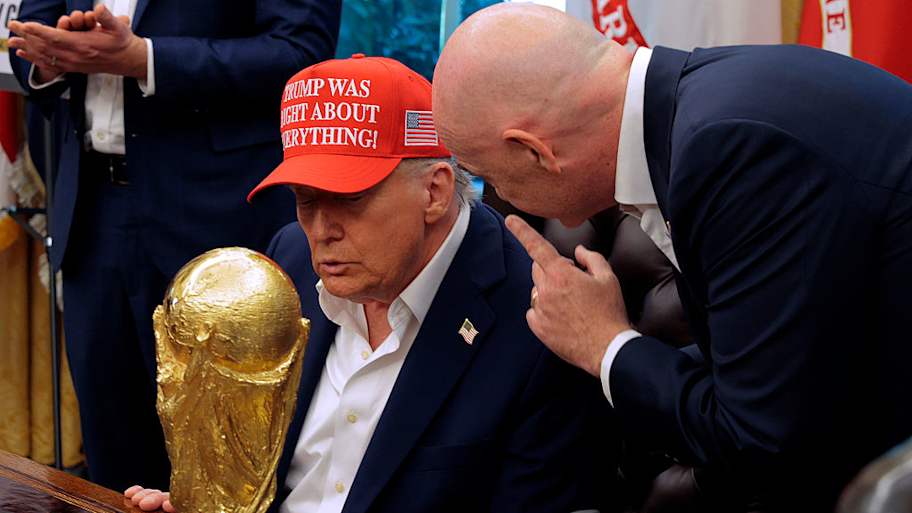
U.S.-brokered talks between Lebanese and Israeli officials in Washington helped secure the April 16 ceasefire, which President Donald Trump said Thursday would be extended by three weeks. Hezbollah, however, was not a party to the discussions.
He continued: “They are in a slow-motion mode, which we don’t agree with. We want the government to be able to do more and the army to be much more engaging, but they are in the right place, and they are pushing in the direction. It’s just a matter of speed. And our difference between us and the prime minister and the president, it’s a matter of speed, not a matter of principle.”
Asked how the Lebanese public might receive normalization with Israel or a potential peace deal, Gemayel said “it depends on how it is done, and it depends on how the Israelis are willing to actually be true to what they are saying.” If Israel is serious about withdrawing and limiting its aims to securing the border, he added, then “I think we can reach this.”
“We need to end the state of war,” he concluded. Gemayel applauded Trump’s war with Iran, saying, “I hope that once and for all this administration will be able to achieve something,” with regards to Iran and its proxies, like Hezbollah.
While the ceasefire has been extended, fighting continued Friday, with Israel striking Hezbollah sites inside Lebanon after accusing the group of violating the truce the day prior. Hezbollah lawmaker Ali Fayyad responded to the ceasefire extension, saying “it is essential to point out that the ceasefire is meaningless in light of Israel’s insistence on hostile acts, including assassinations, shelling, and gunfire” and its demolition of villages and towns in the south.”
Related Articles