The Iran war has offered China, Russia and North Korea—the U.S.’s biggest security threats—a rare opportunity to learn about the capabilities and limitations of the U.S. military.
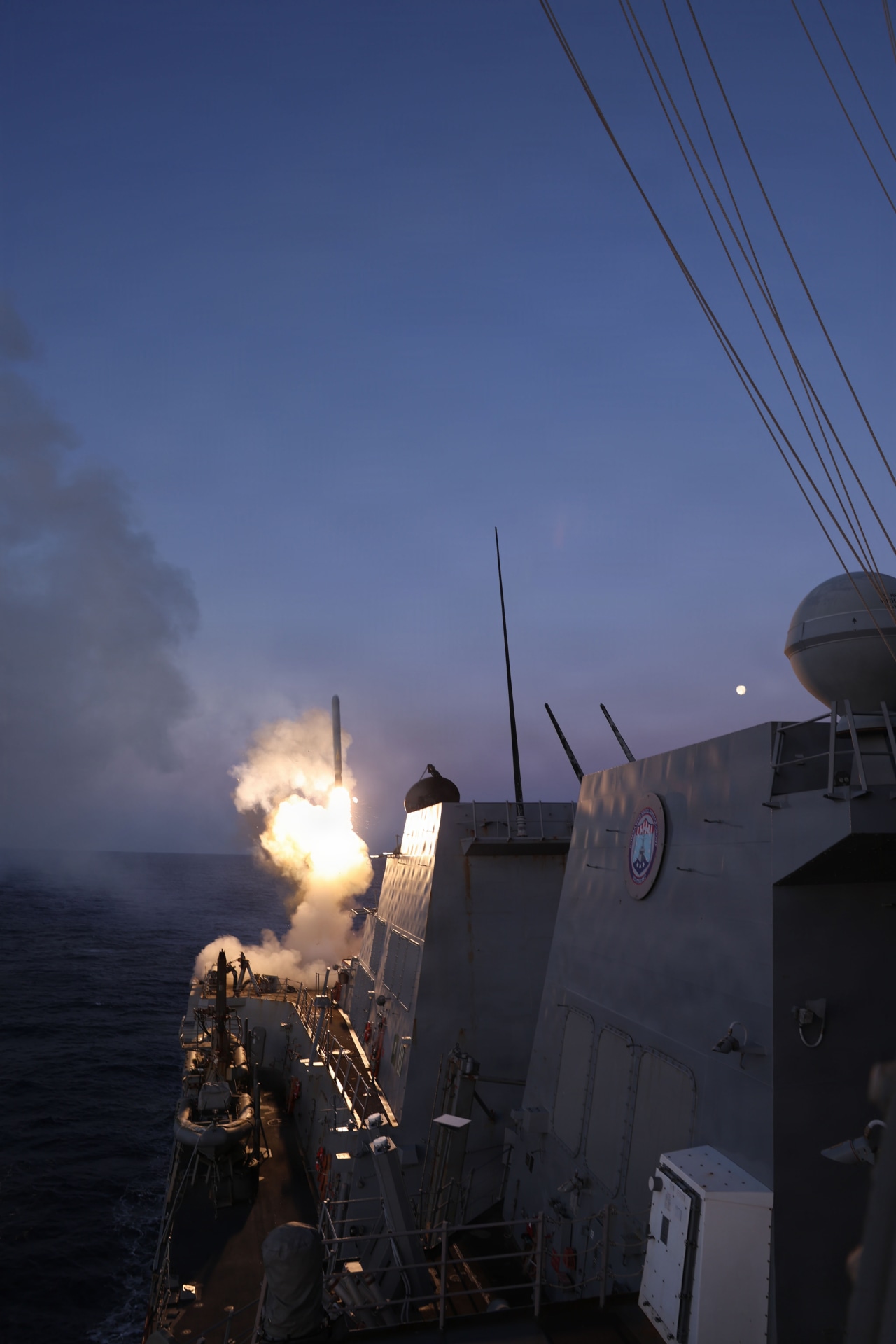
The three powers have witnessed certain new American weapons in combat for the first time, including lightning-fast precision airstrikes assisted by artificial intelligence. But they have also seen how quickly the U.S. depleted key munitions, especially stockpiles of long-range Tomahawk missiles and Patriot interceptors.
And they have watched how Iran’s low-cost drones have been able to threaten the U.S.’s heavily fortified Gulf allies—a potential advantage for China in a Taiwan contingency.
Asked what China is taking away from the Iran conflict, Adm. Samuel Paparo, the commander of American troops in the Pacific, told Congress: “I think they see the power of small, low-cost munitions.”
Some of Iran’s military hardware is reverse-engineered from Chinese technology or relies on Chinese components. That means Beijing would be eager to access certain operational data or understand, for instance, how Iran managed to strike U.S. military bases in the Gulf region, said Nadia Helmy, a China expert at Egypt’s Beni Suef University.
“The Iranian arena serves as a living laboratory to test the effectiveness and efficiency of Chinese technology and data against advanced Western and American weapons,” she said.
Russia gets a deeper look at how American weapons are faring against Iranian arms with overlapping drone technology. Such insight is valuable to Russia in its war against Ukraine, which has been heavily reliant on U.S. arms, or in a future conflict against the U.S.’s NATO allies in Europe.
But the munitions strains placed on the U.S. and Iran underscore the importance of cranking out more weaponry. Russia, despite years of war, has been able to maintain high levels of output for missiles and drones, said Gen. Alexus Grynkewich, the head of U.S. forces in Europe and NATO’s top military commander, in congressional testimony in March.
“The Russian war economy is in high gear,” Grynkewich said.
Iran also drives home to North Korea the power of nuclear weapons to deter an outside attack. In recent days, South Korea’s top nuclear envoy called for more global urgency in the push to dismantle the Kim Jong Un regime’s atomic bombs, calling it the world’s “most pressing” nonproliferation challenge.
At a Wednesday congressional hearing, Secretary of Defense Pete Hegseth drew parallels between Iran and North Korea, including using a “conventional shield” of missiles to buy time for nuclear advances. He pointed to Pyongyang as justification to have taken military action against Tehran.
“North Korea is the lesson,” Hegseth said. “Everybody thought North Korea shouldn’t have a weapon.”
The U.S. has struck more than 13,000 targets in Iran since the start of Operation Epic Fury on Feb. 28. The attacks wiped out Tehran’s top leadership, key military infrastructure and more than 150 vessels, according to U.S. Central Command, which is responsible for American military activities in the Middle East.
Among the new weapons seeing combat for the first time are the U.S.’s precision-strike missile, or PrSM, fired from mobile launchers. America also rolled out a new low-cost, one-way attack drone called Lucas.
To be sure, there are limits as to the lessons Russia, North Korea and China can draw from the Iran conflict. Like the U.S., those three powers possess nuclear weapons, while Iran doesn’t.
But Chinese leader Xi Jinping, Russian President Vladimir Putin and Kim can envision what they need to stockpile, develop and build themselves for any future conflict with the U.S. or its allies.
Russia—which has been providing satellite imagery, technical support and other intelligence to help Tehran target U.S. forces in the Mideast—bought thousands of Iran’s Shahed drones after invading Ukraine in 2022 and has since started its own production of the unmanned weapon. In Ukraine, Russia has used drones to overwhelm Patriot interceptors, combining swarms of the unmanned aerial vehicles with some of Russia’s hypersonic missiles that have proven effective in taking out Patriot units.
In the current Middle East conflict, Iranian drones have likewise proven effective against the Terminal High Altitude Area Defense system, or Thaad, another high-end American interceptor, likely catching Moscow’s attention. Thaad radars have already been lost to Iranian drones in Jordan and the United Arab Emirates, said two people with knowledge of the situation.
“A lot of the stuff that the Russians may be preparing for a war in Europe they can learn right now in the Middle East,” said Nicole Grajewski, an expert on Russia-Iran relations at Sciences Po, a research university in Paris.
China Military Bugle, an X account affiliated with the Chinese armed forces, published a post on March 3 in English and Chinese that listed what it called “Five Lessons from U.S.-Israel Strikes on Iran.”
The lessons included “Coldest Reality: The Logic of Superior Firepower” and “Ultimate Reliance: Self-Reliance,” nodding to U.S. pre-eminence in military power and the need for China to catch up and ensure it can defend its own interests.
Meanwhile, North Korea’s Kim has reiterated that he is unwilling to surrender his nuclear weapons, stating that they have kept his country safer. Pyongyang and Washington haven’t held formal disarmament talks since 2019.
“The present situation clearly proves,” Kim said in a March speech, “how just the strategic options and decisions of our state were in rejecting the enemy’s cajolery and perpetuating our nuclear possession.”
North Korea has recently carried out tests of the types of weapons being used in the Middle East. Kim oversaw a recent test of a missile fitted with a cluster bomb that can spray hundreds of submunitions across a large area. The dictator also recently boarded a warship to observe sea-to-surface cruise missiles. Suicide attack drones also remain at the top of Kim’s military wish list.
“Kim Jong Un has learned his new weapons can actually be effective,” said James Park, a former South Korean security official.
The war has also showed the challenges facing the U.S. in replenishing the huge stocks it has run through in just weeks of fighting.
Before the April 8 cease-fire, the U.S. and Israel were typically hitting more than 600 targets daily, compared with about 20 strikes from Iran a day, said Mark F. Cancian, a co-author of a new report on U.S. munition use in Iran by the Center for Strategic and International Studies, a Washington, D.C.-based think tank. The Pentagon had to shift key military assets and Marines from Asia to the Middle East.
Of seven key U.S. munitions used in the Iran conflict, four may have expended more than half of their prewar inventories, according to the report.
“The war is exposing a lot of big problems for the U.S. military,” said Chris H. Park, a co-author of the report. “We just need a lot of stuff.”
Despite the wave of strikes, Iran still has thousands of missiles in its arsenal, The Wall Street Journal reported last month. Fully replacing the U.S.’s offensive and defensive missiles could take up to six years, the Journal reported separately last month.
Pentagon spokesman Sean Parnell said the U.S. has carried out multiple successful operations during Trump’s second term and has sufficient stocks of munitions.
“America’s military is the most powerful in the world and has everything it needs to execute at the time and place of the president’s choosing,” Parnell said.
The U.S. isn’t at risk of running out of munitions in the event the cease-fire breaks down and fighting resumes, according to the CSIS report. But the risk exists for future wars, given how long it will take to replace thousands of missiles.
Based on the huge losses the U.S. inflicted on Iran from the start of the war, China, Russia and North Korea are likely to seek ways to ensure their nuclear forces and command-and-control assets can survive the start of any conflict with the U.S., said Ankit Panda, the Stanton senior fellow in the nuclear-policy program at the Carnegie Endowment for International Peace.
“The Iran war will prompt U.S. adversaries to react in some pretty interesting ways,” Panda said.
Write to Timothy W. Martin at Timothy.Martin@wsj.com, Thomas Grove at thomas.grove@wsj.com and Chun Han Wong at chunhan.wong@wsj.com