It’s time for that annual labor of love – or maybe indulgence, or maybe simply a fool's errand given the nature of our instant gratification culture. Nevertheless, I’m breaking out that digital red pen − at least three years before it’s remotely fair to evaluate any of the players taken in the 2026 NFL Draft or the teams that picked them − and issuing post-draft report cards, which aren’t even informed by progress reports, because I know you want and demand them. Furthermore, all 32 are (prematurely) ranked for your added enjoyment.
One note about the methodology: As I grade each team, the goal is to pull back for a bigger-picture look at its performance holistically rather than judging from a narrow perspective that doesn't include trades and other considerations that more accurately frame its draft decisions.
With that in mind, here are your ridiculously hasty 2026 NFL draft grades, the individual classes ranked best to worst:
From NFL plays to college sports scores, all the top sports news you need to know every day.
1. New York Jets: A+
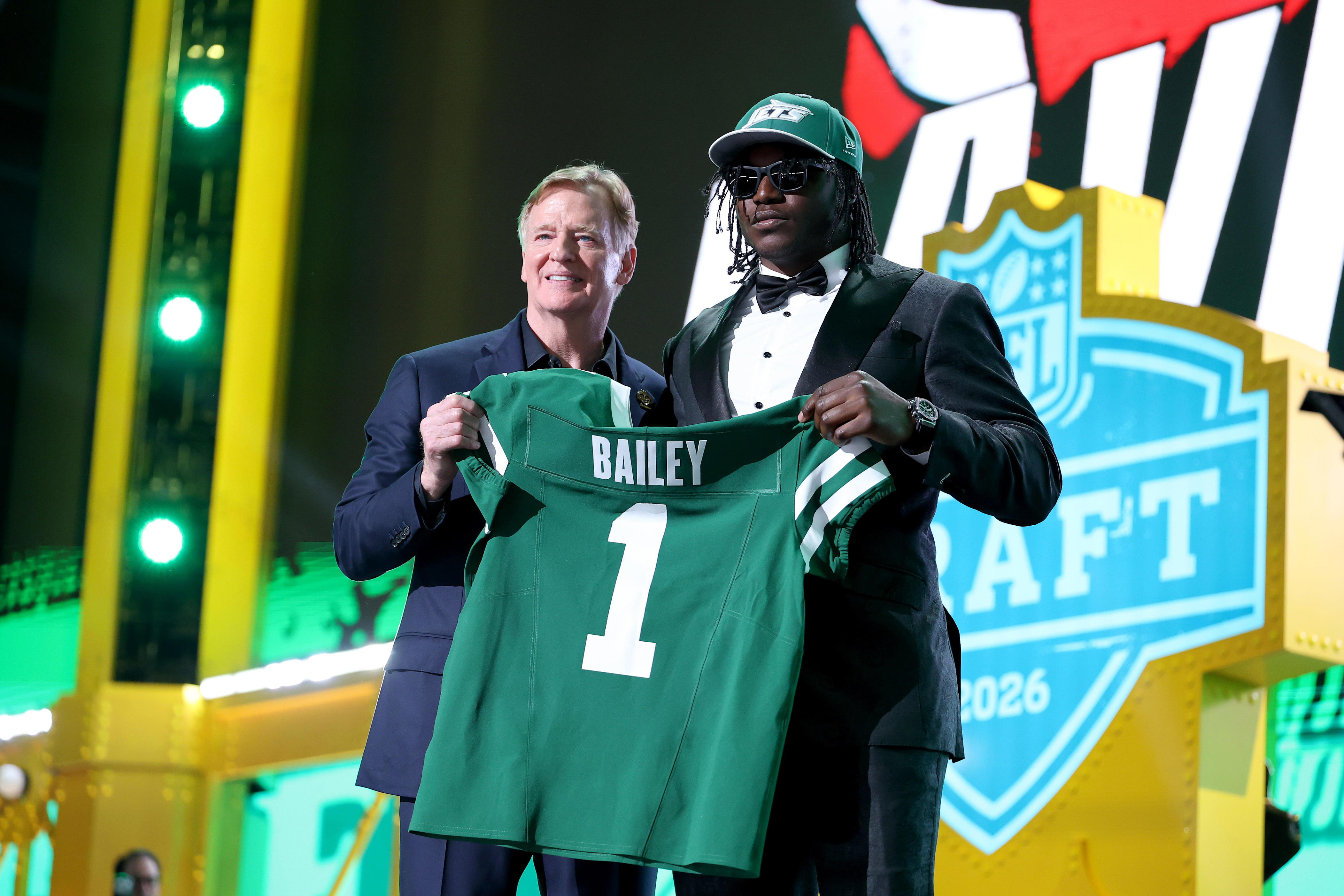
It felt like Part 1 of a summer blockbuster, the highly anticipated draft sequel – generally and specifically to the NYJ – still a year away. But if things unfold as nicely in 2027 as well as Gang Green’s haul seemed to go this year, then New York should actually be a legitimate playoff contender by 2028 … or so. But OLB David Bailey, the second overall pick, TE Kenyon Sadiq, WR Omar Cooper and CB D’Angelo Ponds all project as immediate starters – Ponds and Sadiq both arriving courtesy of trades GM Darren Mougey made at last year’s November deadline. Even fourth-round QB Cade Klubnik could get an extended audition at some point this season – think Davis Mills in Houston. A team that also needs to progress with a significant cultural shift, was also probably wise to bring in Cooper and Ponds fresh off their championship run at Indiana. Admittedly, the Jets have “won” offseasons before, but it's time to find out if potential starts translating to a much better product on the field.
2. Las Vegas Raiders: A
It didn’t take a genius to pick QB Fernando Mendoza No. 1 overall (sorry, Spytek), but he will obviously define this draft through his ability to lift – or not – this long-suffering franchise out of a decades-long quagmire. But getting players like DB Treydan Stukes (second round), CB Jermod McCoy (fourth) and RB Mike Washington Jr. (fifth) is quite the needed talent infusion – the gamble on McCoy and his highly scrutinized knee atop Round 4 a calculated risk with too much upside to bypass. It’s almost like getting the extra first-round pick the Silver and Black sought earlier this year while getting to keep DE Maxx Crosby.
3. New York Giants: A
Whether or not OLB Arvell Reese fell to fifth overall, he could eventually develop into this draft’s best overall player and one who justifies the widespread comparisons to Micah Parsons. Perhaps. Maybe. Acquiring the 10th pick from Cincinnati for Pro Bowl DL Dexter Lawrence (and his salary) last weekend, ultimately in exchange for OL Francis Mauigoa – arguably the draft’s best tackle – seems like another win for Big Blue. Getting CB Colton Hood (Round 2) and WR Malachi Fields (Round 3) on Day 2 project as relative value picks. New coach John Harbaugh could have this squad fighting for a playoff return in short order.
4. Cleveland Browns: A
The pre-draft perception – for whatever that’s ever worth – was that the Browns couldn't wait long to get more needed bodies for both the offensive line and the receiver room. Yet GM Andrew Berry, who seemingly hit last year’s draft out of the park, seemed to agree, getting two blockers and two WRs among this first five selections (the fifth guy in that cluster being second-round S Emmanuel McNeil-Warren, whom Berry aggressively moved up to rescue at No. 58). But first-round OL Spencer Fano, first-round WR KC Concepcion (obtained thanks to last year’s Travis Hunter deal) and second-round WR Denzel Boston all project as immediate starters for a team that seems similar to the Jets in some respects – amassing talent while determining who the franchise QB is (unless sixth-rounder Taylen Green proves Brady-esque, which he certainly isn’t physically given his size-speed quotient) – though Cleveland’s rebuild seems well ahead of New York’s. Your move, Shedeur.
5. Seattle Seahawks: A-
GM John Schneider, who loves to accrue draft capital (often at the expense of premium selections) entered the draft with a league-low four picks, then – somewhat stunningly – did the stick-and-pick thing in Rounds 1 and 2, taking RB Jadarian Price and S Bud Clark, respectively. Both players could and should play a lot as rookies, both due to their draft status and the players Seattle lost in free agency, namely Super Bowl MVP Kenneth Walker III and S Coby Bryant. Yet Schneider still managed to wheel and deal his way into doubling his crop into eight picks. This is how champions are built, two times over now in Schneider’s case with two completely different rosters, an NFL anomaly for a GM.
6. Philadelphia Eagles: A-
They jumped the Steelers for slot receiver extraordinaire Makai Lemon 20th overall. Second-round TE Eli Stowers projects as quite a weapon, even if he’s ultimately a plus-sized receiver. Mammoth fourth-round OT Markel Bell might inherit RT Lane Johnson’s job one day − soon. And leave it to EVP/GM Howie Roseman to also acquire a Pro Bowl pass rusher (Jonathan Greenard) at the cost of two third-rounders. WR A.J. Brown is almost certainly soon be a goner, while presumably fetching prized 2027 draft assets, but Philly seems pretty well positioned to evolve effectively without him.
7. Green Bay Packers: A-
Why this high? Because their first-round pick was used last year as part of the blockbuster acquisition of Parsons. Enough said. But if you want us to say a little more, promising second-round CB Brandon Cisse might not need much time to work his way into the starting lineup.
8. Buffalo Bills: B+
For a team that’s admittedly in Super Bowl or bust mode for the remainder of QB Josh Allen’s tenure in Western New York, the Bills did a nice job of addressing needs – especially in Round 2 with CB Davison Igbinosun and OLB T.J. Parker, who could be a steal here as he goes to work opposite Bradley Chubb. And don’t forget that that Buffalo invested the 60th pick last month to pry WR DJ Moore out of Chicago. New Highmark Stadium, which opens later this year, could be rocking right through the AFC championship game.
9. Baltimore Ravens: B+
There may not be a better marriage of team and player this year than first-round G Vega Ioane, who projects as a prototypical Raven and one who more than stabilizes the middle of a line that lost C Tyler Linderbaum during free agency. Second-round OLB Zion Young also seemed to emanate from central casting Baltimore-style to help fortify a front that didn’t get the job done last year for a variety of reasons. Mid-rounders Ja’Kobi Lane and Elijah Sarratt could push the WRs behind Zay Flowers or might even be de facto stand-ins for departed TE Isaiah Likely, though that’s a loose presumption given the schematic overhaul that’s about to happen here offensively. This is another draft that will be better understood in a year when it becomes apparent whether the Ravens were better off with Ioane and next year’s first-rounder … or Crosby.
10. Denver Broncos: B+
Their draft was pretty much about – and will ultimately be defined – by the acquisition of WR Jaylen Waddle for multiple picks this year, including the 30th overall selection. A reasonable gamble given how close the Broncos got to Super Bowl 60 as well as the defensible opportunity cost of largely bypassing this year’s middling prospects. Third-round DL Tyler Onyedim could soften the loss of John Franklin-Myers in free agency, and fourth-round RB Jonah Coleman should get some touches. Yet maybe the most fascinating aspect of Denver's draft ... was their decision-making into who wound up as "Mr. Irrelevant" given the Broncos made the final two selections in Round 7.
11. Carolina Panthers: B
GM Dan Morgan continues to fortify the roster of the 2025 NFC South champs, first-round OT Monroe Freeling (19th overall), second-round DL Lee Hunter (49th overall) and third-round WR Chris Brazzell II (83rd overall) all perhaps low-key bargains relative to their individual slotting. Brazzell’s 6-foot-4 frame and sub-4.4 speed should be a dynamic element to this offense, even if he does nothing but run go routes as a rookie.
12. Detroit Lions: B
First-round OT Blake Miller and second-round DE Derrick Moore, a Michigan alum whom the Lion traded up to get, project as Week 1 starters at crucial positions of need. Moore may be a long-term wingman off the edge opposite fellow ex-Wolverine Aidan Hutchinson. This year’s third-rounder was invested in a 2025 trade that netted promising WR3 Isaac TeSlaa. In totality, it might be enough to get a team that will benefit from a last-place schedule in 2026 back to the postseason.
13. Miami Dolphins: B
They wound up picking 13 players, and perhaps as many as seven or eight of them could reasonably start in 2026 – testaments to both the quality of rookie GM Jon-Eric Sullivan’s choices but also how thin this stripped-down roster was entering the weekend. Sullivan’s first three selections – OL Kadyn Proctor (Round 1), CB Chris Johnson (Round 1) and LB Jacob Rodriguez (Round 2) – all have excellent college film, yet also had enough questions going into the pre-draft process that their stock didn’t seem to catch up to their highlights until later. Third-round WR Chris Bell, who’s recovering from a torn ACL suffered last November, has been compared to Brown from an ability standpoint. Fourth-rounder Trey Moore is another one to watch – an extremely productive player at UTSA but not so much at Texas, so it remains to be seen if he’s a gem at the next level or overmatched. Versatile fourth-round DB/LB Kyle Louis might also be a heist of a defensive weapon. Did the Fins get a talent comparable to Waddle, who was traded last month? Maybe not. Have they effectively found a replacement for LB Jordyn Brooks, a former Red Raider like Rodriguez and a player Sullivan claimed he wanted to build around five minutes ago? Yep. But the mission here was quantity and finding players who can immediately provide direct or indirect support for first-year QB Malik Willis. Check and check.
14. Washington Commanders: B
LB Sonny Styles, the seventh overall pick, is the headliner of a light class … and should be creating quite a few headlines for years into the future as the man in the middle and new face of this defense. A freakish athlete and multi-dimensional weapon who used to play safety, Styles’ mind might ultimately be his greatest asset, especially given the likelihood cerebral stud Bobby Wagner likely won’t return. Third-round WR Antonio Williams has a chance to crack the rotation early. And don’t forget that GM Adam Peters spent a package of picks, including this year’s second- and fourth-rounder, in 2025 in order to obtain Pro Bowl LT Laremy Tunsil … as much good as it did QB Jayden Daniels last season.
15. Cincinnati Bengals: B
We should know in a year or two if they chose the right course of action, shipping out the 10th pick for Lawrence, who definitively further upgrades a defense that has undermined this organization, QB Joe Burrow and Co. specifically, for years. But a win-now choice has to mean the Bengals literally win now and in 2027, especially since S Caleb Downs or pass rusher Rueben Bain Jr. could have been had for far less money than Lawrence and, likely, for several more years than the three-time Pro Bowler will ultimately provide. Undersized second-round DE Cashius Howell is a speedball who could help replace some of former DE Trey Hendrickson’s production off the edge in sub packages.
16. San Francisco 49ers: B
It may not be packed with star power, especially after GM John Lynch vacated the first round. But second-round WR De'Zhaun Stribling, third-round DE Romello Height, third-round RB Kaelon Black, fourth-round DT Gracen Halton, fourth-round OT Carver Willis and fourth-round CB Ephesians Prysock all provide valuable depth for a team that dealt with so many injuries last year and – certainly in Black’s case – need to help reduce the load on stars like RB Christian McCaffrey. And whether or not those injuries seem like a bad run of luck (or electrical substation exposure), this is a veteran roster that needs fallbacks. Stribling may not catch a ton of balls as a rookie, but if recently signed WR Mike Evans breaks down again…
17. Pittsburgh Steelers: B
The selection of Penn State QB Drew Allar in Round 3 alone is probably going to render this a polarizing draft in some respect. Yet as the Steelers continue to await white smoke from Aaron Rodgers’ camp, it’s also hard to fault them for diversifying their future options at the position beyond Will Howard given what a bad job they’ve done on that front for the better part of the last decade – meaning once Ben Roethlisberger’s decline became apparent. But let’s get past Allar. Rodgers or not, first-round OT Max Iheanachor, second-round WR Germie Bernard − hardly a consolation prize after GM Omar Khan lost out on Lemon − third-round CB Daylen Everette and G Gennings Dunker and fourth-round KR/WR Kaden Wetjen, whose impact will come on special teams, all seem to thread the needle as players who upgrade the reigning AFC North champs’ roster immediately. All of them should and could contribute straight away while also projecting as nice building blocks to place around Allar, Howard or whomever is taking the snaps down the road.
18. New Orleans Saints: B
GM Mickey Loomis, the league’s senior GM, probably doesn’t get sufficient credit for the job he’s done over the past quarter-century – and make no mistake, this team seems well positioned to take off in 2026. Loomis took the plunge on WR Jordyn Tyson and his checkered injury history in Round 1 – and that could be a home run pick … as long as he and WR1 Chris Olave stay in the lineup together. Day 2 Georgia Bulldogs Christen Miller, a nose tackle, and Oscar Delp, a tight end, should have immediate roles. Whether or not they’re impact players is another question. Fourth-round WR Bryce Lance, Trey’s brother, could be a steal who routinely takes the top off defenses. Fifth-round DB Lorenzo Styles Jr., Sonny’s brother, also has the benefit of a good gene pool – but the converted receiver still needs to prove he can survive as a nickel.
19. Tampa Bay Buccaneers: B
First-rounder Bain, short arms and all, second-round LB Josiah Trotter and fourth-round CB Keionte Scott could all be Week 1 starters for a club in an atypical state of transition. But don’t be surprised if explosive third-round WR Ted Hurst turns out to be the best of the bunch in the Bucs’ post-Evans world.
20. Houston Texans: B
Not sexy. But good teams invest in the trenches, where the Texans took G Keyland Rutledge at the back of Round 1 and DT Kayden McDonald at the top of Round 2. Hard to shade reinforcements for the league’s No. 1 defense in 2025 and a blocker who might add a charge to a perennially average (at best) running game that needs to do a lot more to support QB C.J. Stroud. (And, on that front, swapping a fourth-round pick as the primary currency in March’s trade for RB David Montgomery seems eminently wise.)
21. Kansas City Chiefs: B-
We’ve seen this movie before – four years ago, when K.C. surrendered a known commodity (WR Tyreek Hill) in order to get younger and address multiple positions through a draft youth movement. Ironically, CB Trent McDuffie, the first player the Chiefs chose in 2022 and later a key component of the dynasty, was spun off to the Rams this year for a second slot in Round 1. Also noteworthy, GM Brett Veach and HC Andy Reid did little in the draft to directly help QB Patrick Mahomes, who ended last season on injured reserve with a shredded knee after spending most of 2025 running for his life. Nevertheless, this year’s top four selections were all invested defensively, Mansoor Delane (6th overall) widely viewed as the draft’s top corner and an immediate replacement for McDuffie. Peter Woods (Round 1), R Mason Thomas (Round 2) and Jadon Canady (Round 4) add further juice and depth to the defense … though it remains to be seen if that means an immediate Lombardi Trophy, which McDuffie, George Karlaftis and others helped to deliver instantly in 2022.
22. New England Patriots: B-
There were bigger issues afoot in Foxborough in recent days, but the reigning AFC champs also picked some new players. And while this grade isn’t intended as a knock, particularly given the Pats were selecting near the end of most rounds due to their 2025 success, first-round OT Caleb Lomu, second-round OLB Gabe Jacas and third-round TE Eli Raridon all feel like succession plans as opposed to players ready to put this team over the Lombardi hump. Maybe the cherry on top will arrive in a few weeks in the form of Brown, a transaction that would better frame a forward-thinking draft, but that calculus will also involve parting with more valuable 2027 draft capital.
23. Dallas Cowboys: B-
They traded up in Round 1 (S Caleb Downs, 11th overall). They traded down in Round 1 (OLB Malachi Lawrence, 23rd overall). They spent three additional picks on a defense that gave up the most points in the league in 2025. They used their third-round pick as part of the trade for WR George Pickens last spring – a great move in the short run, but a tenuous situation that will apparently bleed over into 2027. As with most things Cowboys, it can be interpreted a number of ways. But good luck finding anyone who thinks Lawrence, essentially part of the package from Green Pay as part of the 2025 Parsons mega-deal, and others will ultimately be worth the ultimate cost.
24. Los Angeles Chargers: B-
A team that needs to be in the business of winning playoff games, rather than just getting to postseason with QB Justin Herbert, took 25-year-old pass rusher Akheem Mesidor with the 22nd overall pick. No qualms with the selection, even if Mesidor doesn’t turn out to be a long-term replacement for OLB Khalil Mack or even reach a second contract here. Second-round OL Jake Slaughter brings needed depth to the interior O-line. And let’s see if lightning fast fourth-round WR Brenen Thompson (4.26 40 at the scouting combine) is the rare player whom Herbert can’t actually overthrow.
25. Tennessee Titans: C+
First-round WR Carnell Tate and DE Keldric Faulk should play big snaps starting in Week 1. Second-round LB Anthony Hill might just make a push for Defensive Rookie of the Year given the way players at his position – to say nothing of Hill’s inherent ability – tend to thrive in HC Robert Saleh’s scheme. Yet second-year GM Mike Borgonzi’s selection of Tate at No. 4 was telling. He projects as a very good player, probably the cleanest wideout prospect in this draft. He’s not Calvin Johnson ... and maybe not even perennial Pro Bowl material. But picking him is a clear indication that the priority here was helping second-year QB Cam Ward, which Tate should absolutely do, and not giving Saleh more defensive shock troops off the top. Yet Titans fans will be left wondering for some time whether Borgonzi should have figured out a way to deal up one spot for Notre Dame RB Jeremiyah Love, who went No. 3 to Arizona … where he seems miscast at present.
26. Los Angeles Rams: C+
Their most notable accomplishments? Acquiring McDuffie for three 2026 picks, including No. 29 overall and a pair on Day 3. Also? Coach Sean McVay really, really, really appreciates QB Matthew Stafford, the league’s 2025 MVP, and would never want him to think otherwise. Maybe first-round QB Ty Simpson, chosen 13th overall as Stafford’s heir apparent – which may mean 2029? – and his four fellow draftees will all become key members of this operation. None are likely to do so in 2026, a year when the Rams are very much expected to be Super Bowl contenders … even if they didn’t get a rookie who might have put them over the top.
27. Chicago Bears: C
Meh? They’ve been working their board for weeks, including exporting DJ Moore to Buffalo for a second-rounder. GM Ryan Poles maneuvered around further through the weekend. Yet it doesn’t feel like the reigning NFC North champs came away with anyone aside from first-round S Dillon Thieneman who will make much of an impact in 2026. Second-round C Logan Jones is undersized (6-3, 299) but could get a redshirt year before he has to assume a starting role … and it is generally hard to quibble with Iowa O-linemen.
28. Indianapolis Colts: C
Second-round LB CJ Allen (53rd overall pick) and third-round S A.J. Haulcy (78th) seem like sweet value picks given where these talented defenders were selected – and both could start as rookies. They’re also the secondary story of this draft. In a win-now move made at least year’s trade deadline, Indy surrendered this year’s first-rounder (and next year’s even more valuable one) to the Jets for CB Sauce Gardner, who – through no fault of his own really – wasn’t able to help the cratering Colts win now in 2025. But if Gardner, who hasn’t been the same player the past few years that he was earlier in his career, doesn’t revert to All-Pro form – maybe even Deion Sanders form – history is not going to look kindly upon GM Chris Ballard’s very expensive gambit.
29. Arizona Cardinals: C-
It seems like they maybe filled appropriate positions? But perhaps in the wrong order? Love, arguably the draft’s player, arrived via the third overall pick. And while it feels wrong to ding GM Monti Ossenfort for adhering to the oft-trumpeted “draft the best player available” maxim, it also seems like he might have relegated Love to an existence similar to the one Saquon Barkley suffered for years while serving as the offensive focal point of the quarterback-hindered Giants. Second-round G Chase Bisontis was a solid choice … even if Ossenfort maybe should have taken a little less to trade down from No. 3 and get a right tackle in the first round. Third-round QB Carson Beck? He’ll doubtless get a shot to play here, so it’s a great landing spot for him. And, in fairness to Ossenfort, he was probably never going to take Simpson as highly as the Rams wound up doing it. Hard to envision Arizona remaining anything but buried in last place in the NFC West … though maybe that’s for the best if, like the Jets, they wait to launch a bona fide QB plan until 2027.
30. Minnesota Vikings: C-
They’re in a weird spot, especially with a substitute teacher in the GM’s chair – which isn’t intended as a shot at Rob Brzezinski. And this draft almost surely will be more productive than ousted predecessor Kwesi Adofo-Mensah’s hauls. Yet first-round DT Caleb Banks might have felt like something of a reach under optimal circumstances, but the broken left foot he suffered at the combine – which is a recurring injury for a very big man – is quite a red flag for a player taken 18th overall. Third-round S Jakobe Thomas could be this year’s most impactful rookie if S Harrison Smith doesn’t return. Yet it feels like Minnesota might not get a ton out of this class in 2026, even as the Vikes vie to get back in the thick of the NFC North race in what might be QB Kyler Murray’s only year in the great white north.
31. Atlanta Falcons: D+
Can’t blame a new regime led by former MVP Matt Ryan for the desperate sins of the previous one – namely the misguided decision to use this year’s first-rounder to get pass rusher James Pearce in Round 1 of the 2025 draft. And while Pearce played well as a rookie, he already faces serious legal issues – and his character raised some concerning questions throughout the pre-draft process a year ago. But credit Ryan and rookie GM Ian Cunningham for making lemonade, second-round CB Avieon Terrell, brother of Falcons CB A.J. Terrell Jr., and third-round KR/WR Zachariah Branch both likely to be immediate contributors – Branch a potential fixture on special teams and maybe also taking over for departed Darnell Mooney as a deep threat.
32. Jacksonville Jaguars: D
Is the bloom already off the rose after their surprising capture of the AFC South throne with a 13-win campaign in HC Liam Coen’s rookie year? They lost RB Travis Etienne and LB Devin Lloyd in free agency but didn’t seem compelled to replace either with a lofty pick this year, opting for a blocking tight end and D-line depth. Third-round G Emmanuel Pregnon is the most notable incoming rookie and the one likely to contribute significantly the earliest. But you can’t evaluate this draft, devoid of a first-round pick, without also considering last year’s decision to do a very expensive trade for Heisman Trophy-winning WR/CB Travis Hunter, who got hurt midway through his rookie year but never contributed much on either side of the ball despite his ballyhooed two-way skills. Hunter sold some jerseys, but it remains to be seen if the Jags vastly overpaid him going into this season, when he’s expected to play a lot more extensively on defense.
All NFL news on and off the field. Sign up for USA TODAY's 4th and Monday newsletter.
This article originally appeared on USA TODAY: NFL draft grades: Ranking all 32 teams' 2026 classes, with lowly Jets earning an A+