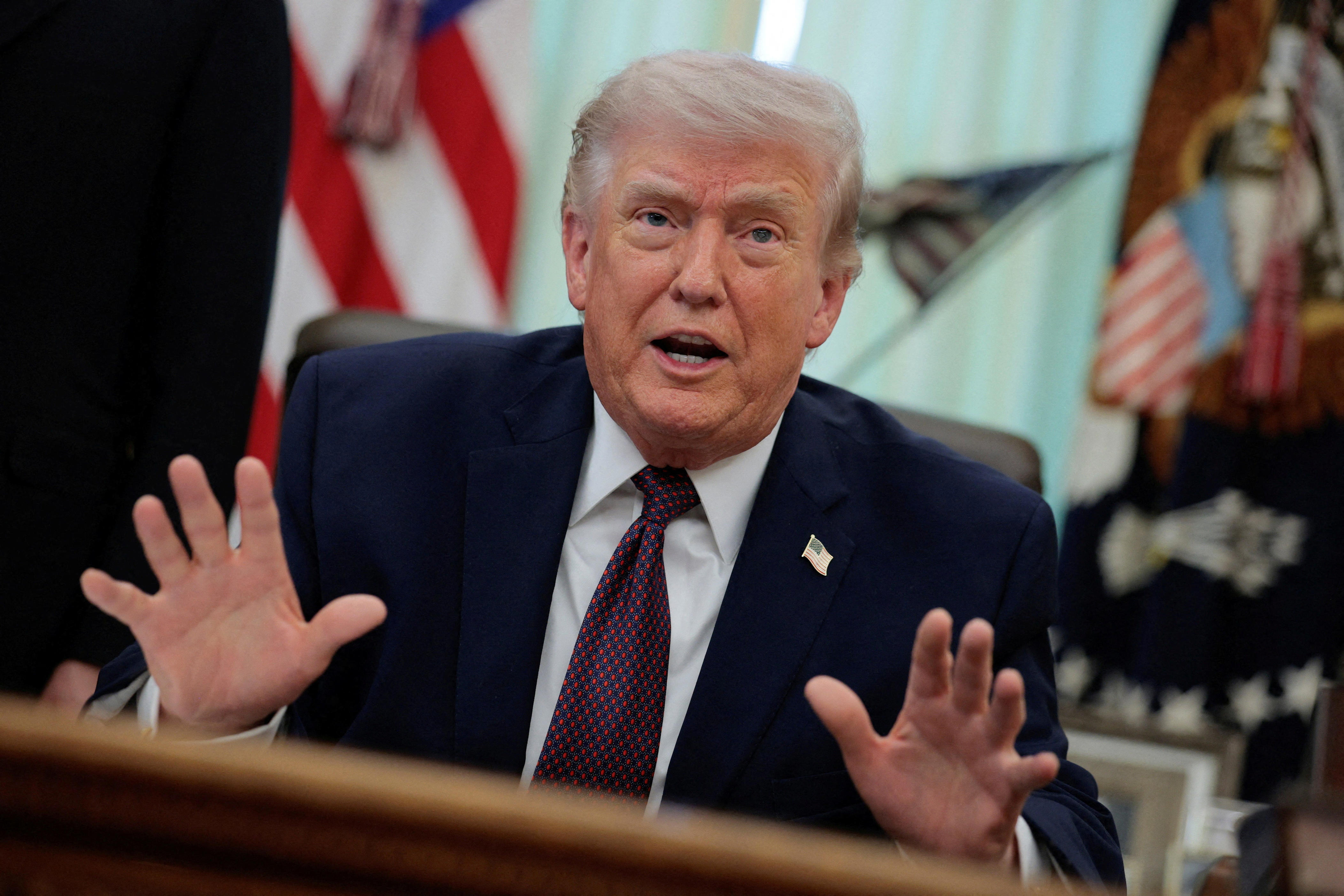
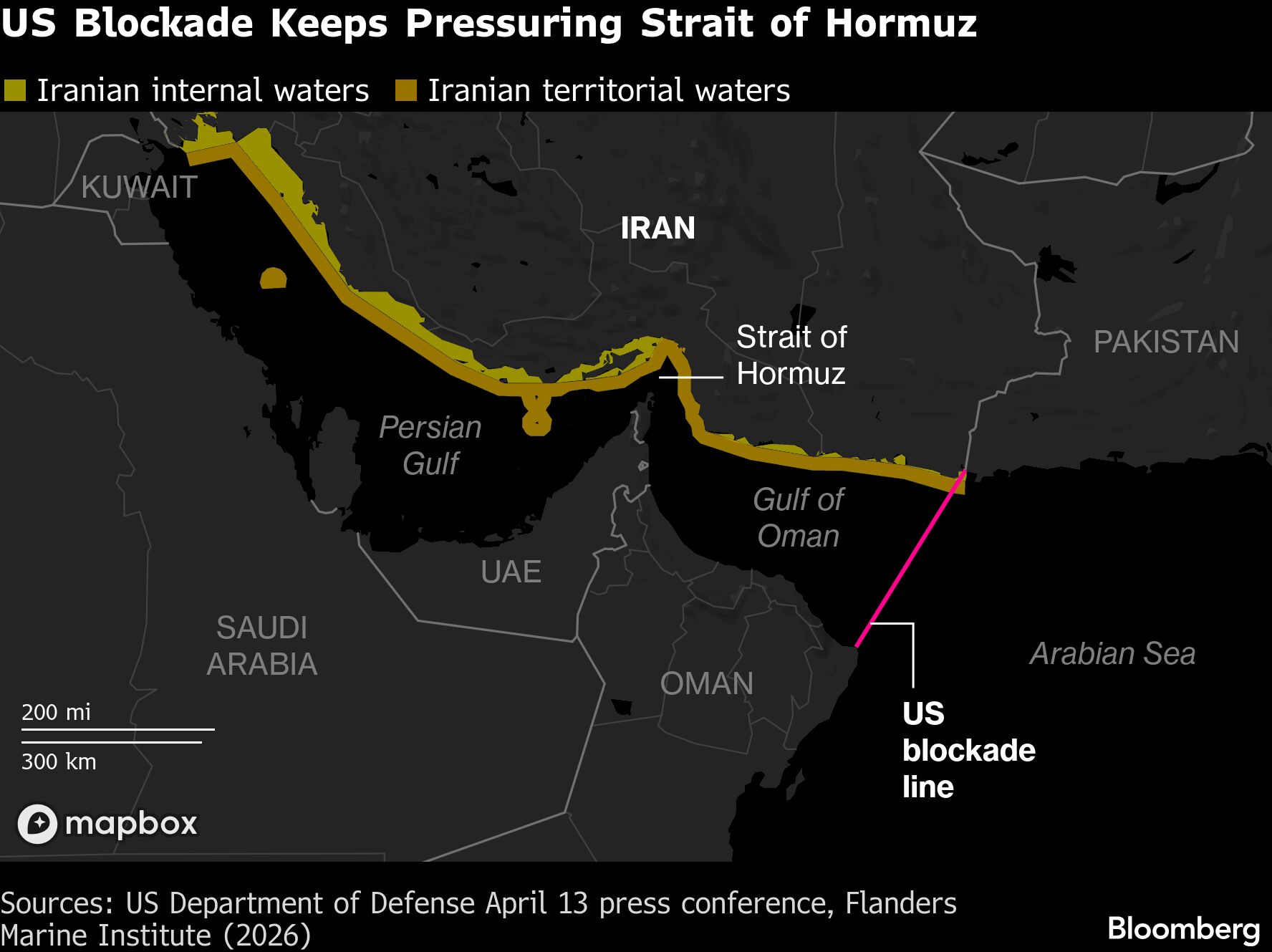
(Bloomberg) -- President Donald Trump told Axios he will not lift a naval blockade of Iran’s ports until he secures a deal with Tehran to address the country’s nuclear program, extending a standoff over the Strait of Hormuz that has caused a global energy crisis.
“The blockade is somewhat more effective than the bombing. They are choking like a stuffed pig. And it is going to be worse for them. They can’t have a nuclear weapon,” Trump said in a telephone interview Wednesday, according to Axios.
Trump said he had rejected a recent proposal from Iran to reopen the strait because it would have delayed talks on the nuclear issue until later.
The blockade lies at the heart of the impasse between the US and Iran, with the Islamic Republic insisting it won’t restart negotiations or reopen the strait as long as the naval restrictions stay in place. Trump says he won’t halt the operation until Iran agrees to a peace deal to end a war that, while now in a ceasefire, is in its ninth week, causing chaos across the Middle East and energy prices to surge.
While Trump said he’d stick with the blockade, US military commanders have prepared a plan for a short and powerful wave of strikes on Iran to raise pressure on the regime, Axios said, citing people with knowledge of the preparations. Axios also reported that Trump is slated to receive a briefing on potential military plans on Thursday.
US Central Command has asked to send the Army’s Dark Eagle hypersonic missile to the Middle East for possible use against Iran. If approved, it would mark the first time the US will have deployed its hypersonic missile.
The administration is also looking at enlisting other countries to help restore safe passage through the strait, the Wall Street Journal reported Wednesday evening, citing a State Department cable.
While US allies have refused to join the military campaign against Iran, the cable enjoins US embassies to persuade allies to join a coalition that would coordinate diplomacy, the enforcement of sanctions and sharing of information, according to the newspaper.
Trump also told Axios that Israel should limit its military actions in Lebanon to “surgical” strikes as the ceasefire there remains fragile.
Brent crude prices climbed with the strait now effectively shut for two months and little sign of it opening soon. The global crude benchmark rose above $119.50 a barrel, a fresh high since the Iran war began. West Texas Intermediate was trading above $107 a barrel.
It’s unclear how much storage and time Iran has left before it would need to close down wells, which may damage them permanently. Analytics firm Kpler estimates it has another 12 to 22 days.
Iranian officials showed no sign of backing down.
Mohsen Rezaee, military adviser to the Supreme Leader, vowed Iran will respond if the US continues its blockade, state television reported. Parliament Speaker Mohammad Bagher Ghalibaf accused Trump of seeking to force Tehran to surrender through economic pressure and internal divisions, the semi-official Tasnim news agency reported.
Trump on Wednesday told reporters that talks are continuing “telephonically” between the two sides after an abortive effort to meet in Pakistan over the weekend.
At the same time, the US is seeking forfeiture of two Iran-linked oil tankers seized by naval forces enforcing a blockade against the Islamic Republic, according to a senior White House official.
Here’s more on the war:
Federal Reserve Chair Jerome Powell warned the energy shock brought by the war “hasn’t even peaked yet,” saying at a regular press conference that “the conflict in the Middle East has added to” economic “uncertainty.”The US has spent an estimated $25 billion on the Iran war, the Pentagon’s budget chief told lawmakers on Wednesday, in the administration’s most complete public estimate of the conflict’s cost so far.Trump said he’d discussed the war in a phone call with Vladimir Putin Wednesday but rebuffed the Russian president’s offer to help secure Iran’s nuclear material, saying that he told the Russian leader, “I’d much rather have you be involved with ending the war with Ukraine.”Rafael Mariano Grossi, head of the UN’s nuclear watchdog, the International Atomic Energy Agency, said in an interview that Iran’s inventory of enriched uranium is “accessible” should the country wish to retrieve the material. He reiterated that the “consensus of the community” is that the majority of Iran’s uranium stockpile remains buried at Isfahan.The Iranian rial has weakened significantly in the past two days, according to bonbast.com, a website that tracks the currency’s value on the parallel market, suggesting rising strain on the country’s economy.| Oil Charges Toward $120 With No End in Sight to US-Iran WarUS Dismisses Iran’s Ability to Handle Oil Backed Up by BlockadeHow a Jet Fuel Supply Crunch Threatens Summer Flights: ExplainerCan the US and Iran Agree to a Deal to End the War?: Explainer |
--With assistance from Veena Ali-Khan, Romy Varghese, Derek Wallbank, John Harney and Laura Davison.
(Updates with Axios report on Thursday briefing in the fifth paragraph.)
More stories like this are available on bloomberg.com
©2026 Bloomberg L.P.