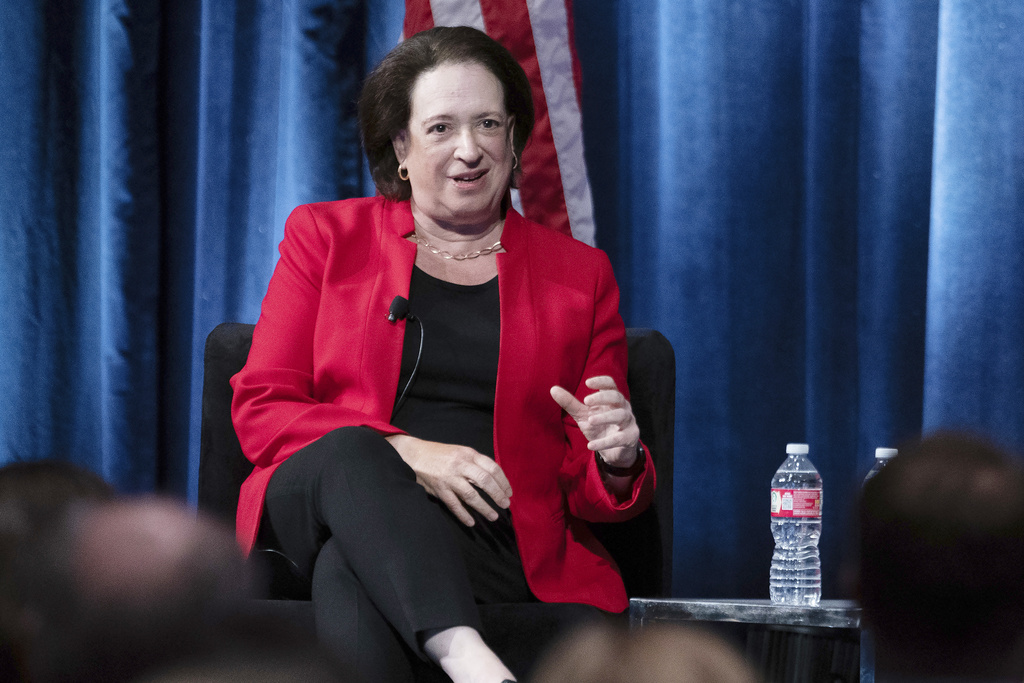
The U.S. Supreme Court‘s decision to strike down a majority-minority district in Louisiana on Wednesday will have “grave” consequences for the future of the Voting Rights Act, Justice Elena Kagan said.
The case, Louisiana v. Callais, centers around Section 2 of the Voting Rights Act of 1965, which states that no standard, practice or procedure should be imposed by a state to deny the right to vote to any U.S. citizen on account of race or color. Louisiana had been ordered to redraw its congressional map in 2022, after a judge ruled that it likely violated Section 2 of the Voting Rights Act because it did not include an additional majority-Black district. A newly drawn map included a majority-Black district was then challenged as a racial gerrymander.
The Supreme Court ruled that the map was an unconstitutional racial gerrymander and the Voting Rights Act did not require Louisiana to create an additional majority-minority district. It remanded the case for further proceedings consistent with that opinion.
Kagan on Wednesday wrote a dissenting opinion, which was joined by fellow liberal justices Sonia Sotomayor and Ketanji Brown Jackson. Kagan said that under the court’s decision, “a State can, without legal consequence, systematically dilute minority citizens’ voting power.”
“The consequences are likely to be far-reaching and grave. Today’s decision renders Section 2 all but a dead letter. In the States where that law continues to matter—the States still marked by residential segregation and racially polarized voting minority voters can now be cracked out of the electoral process,” Kagan wrote.
The court’s majority opinion, which consisted entirely of conservative justices, was delivered by Justice Samuel Alito, who said compliance with Section 2 “could not justify the State’s use of race-based redistricting here.”
“The State’s attempt to satisfy the Middle District’s ruling, although understandable, was an unconstitutional racial gerrymander,” Alito wrote.
Justice Clarence Thomas wrote a concurring opinion, joined by Justice Neil Gorsuch, in which he said he would have gone further in the ruling to hold that Section 2 of the Voting Rights Act “does not regulate districting at all.” He said that how states draw district lines does not fall into any of the categories mentioned in the law, and “no [Section] 2 challenge to districting should ever succeed.”
What Is Louisiana v. Callais?
The case resulted from Louisiana’s response to the population changes disclosed by the 2020 Census. The state needed to recalibrate its congressional districts because of the changes. In 2022, Louisiana enacted a new map called HB1.
The map, like its predecessor, included only one district in which Black voters were a majority of the voting-age population. After the map was enacted, lawsuits were filed in the Middle District of Louisiana alleging that the map violated the Voting Rights Act by “‘packing’ large numbers of Black voters into a single majority-Black congressional district.”
The court ruled in Robinson v. Ardoin that HB1 likely violated the Voting Rights Act by failing to include a second majority-Black district and required the state to implement a new map.
After various legal proceedings, Louisiana enacted the map, SB8, at the center of this Supreme Court case.
On this map, District 6 connected Black populations from Baton Rouge and Lafayette (in the south-central region of the state) with the Black population in Shreveport (in the far northwest of the state).
A group of plaintiffs filed a lawsuit challenging SB8, alleging that District 6 was a racial gerrymander that violated the Equal Protection Clause. A district court ruled in favor of the plaintiffs, and the state appealed to the Supreme Court.
Democrats React to Louisiana v. Callais Decision
Democratic National Committee President Ken Martin said in a statement sent to Newsweek: “Today is a dark day for America — the Supreme Court just rolled back the clock on the Civil Rights Movement. The GOP-captured Supreme Court just effectively killed Section 2 of the Voting Rights Act, a major step back in the fight for racial justice and fair representation. While today’s decision is a gut punch, make no mistake: Democrats will fight tooth and nail to ensure the voices of all Americans will be heard in November and in every election that follows.”
Heather Williams, president of the Democratic Legislative Campaign Committee, said it is a “devastating day for democracy and a wake-up call for all those who seek to protect it.”
“With key parts of Section 2 of the Voting Rights Act weakened, Republicans are now more empowered to drag our democracy backward, silence communities of color, and rig maps to protect their own power,” Willaims said in a statement sent to Newsweek. “State legislatures play a role in drawing over 300 congressional districts, and we must charge into the 2026 elections clear-eyed about the urgency and stakes of the once-in-a-generation opportunity to build Democratic power in the states.”
Do you have a story that Newsweek should be covering? Do you have any questions about this story? Contact LiveNews@newsweek.com.
Related Articles