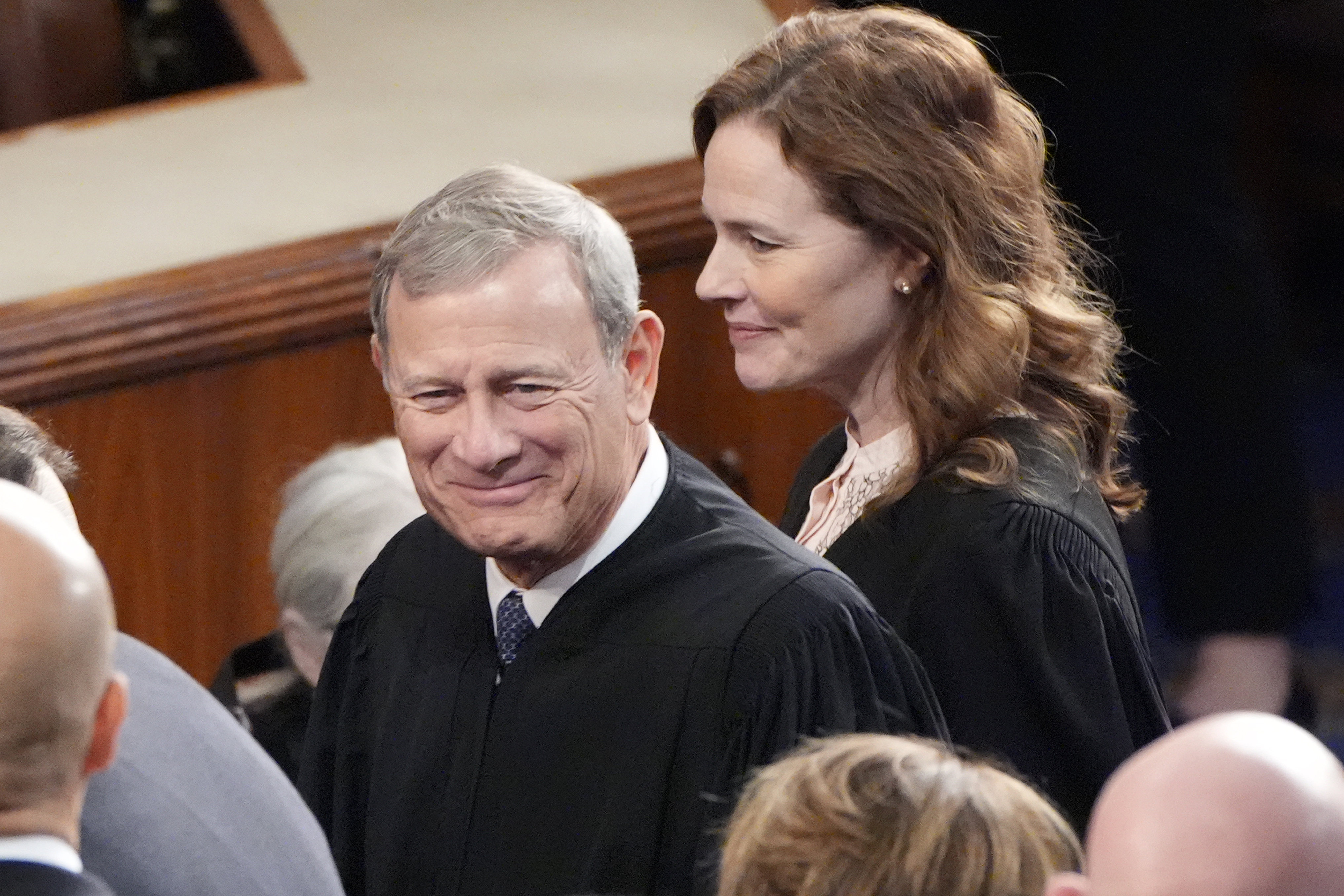
Chief Justice John Roberts and Justice Amy Coney Barrett could play an important role in the U.S. Supreme Court’s ruling in a case about a plan by President Donald Trump’s administration to end Temporary Protected Status (TPS) for Haitian and Syrian immigrants.
The Supreme Court heard arguments on Wednesday in a consolidated case that asks the court whether the administration properly considered conditions in the two nations when it ended TPS and if it discriminated against non-white immigrants. Ending TPS would impact about 350,000 Haitians and 6,000 Syrians.
If the court rules in favor of the Trump administration, it could lead to officials stripping protections for more of the 17 countries currently under TPS. Up to 1.3 million people are protected under TPS. The program allows migrants from certain countries who are already in the U.S. to stay with work permits in 18-month increments, as long as the Department of Homeland Security (DHS) secretary decides that their country of origin is unsafe to return to.
The government is appealing lower-court orders that blocked the DHS from quickly ending TPS for Haiti and Syria. During oral arguments in the case on Wednesday, several conservative justices appeared to be leaning in favor of the Trump administration’s argument that courts have a limited course of action in cases related to TPS.
Justice Neil Gorsuch asked a lawyer representing Haitian immigrants whether the law lets judges step into DHS decisions on TPS.
“I’m struggling with that,” he said.
Alito challenged a lawyer representing Syrian immigrants on his interpretation of the law.
“If we apply ordinary meaning of that term here, I really don’t understand how you can prevail,” Alito said.
Barrett asked the lawyer representing Syrian immigrants whether the process leading up to halting temporary protected status is a “box-checking exercise.”
“Let’s imagine the consultation happens. It’s a robust consultation. But everything that she hears cuts in favor of keeping TPS status and she says ‘I’m terminating it.’ Is that reviewable?” Barrett asked.
The attorney said that would not be reviewable, but courts can review whether DHS asked for information regarding conditions in the country before making a determination.
Liberal justices Ketanji Brown Jackson and Sonia Sotomayor questioned whether race played a role in the administration’s decision to terminate TPS. Solicitor General D. John Sauer, representing the Trump administration, said he strongly disagreed.
Immigrant advocates argued that the Trump administration’s decision to end TPS for Haiti and Syria is not based on the nations’ conditions.
“By trying to kill TPS, they are attacking people who are living and working here legally, paying fees and taxes, following all the rules,” said José Palma, coordinator at the National TPS Alliance. “They are de-documenting people… it’s cruel, arbitrary, pointless, needless and wrong.”
The administration argued that conditions have changed in these nations and a safe return is possible.
Haitian immigrants were first granted protection under TPS in 2010 after a severe earthquake hit the nation, and it has repeatedly been extended because of gang violence that has displaced more than a million people, according to court documents. Syria was added to nations under TPS in 2012 amid a civil war that continued until the fall of the national government in late 2024.
Dozens of immigrants protected under TPS gathered outside the Supreme Court on Wednesday.
The court currently has a 6-3 conservative majority, including three justices appointed by Trump during his first term: Justices Neil Gorsuch, Brett Kavanaugh and Amy Coney Barrett. The court previously ruled in favor of the administration on several key issues, including immigration enforcement.
This article includes reporting by The Associated Press.
Do you have a story that Newsweek should be covering? Do you have any questions about this story? Contact LiveNews@newsweek.com.
Related Articles