
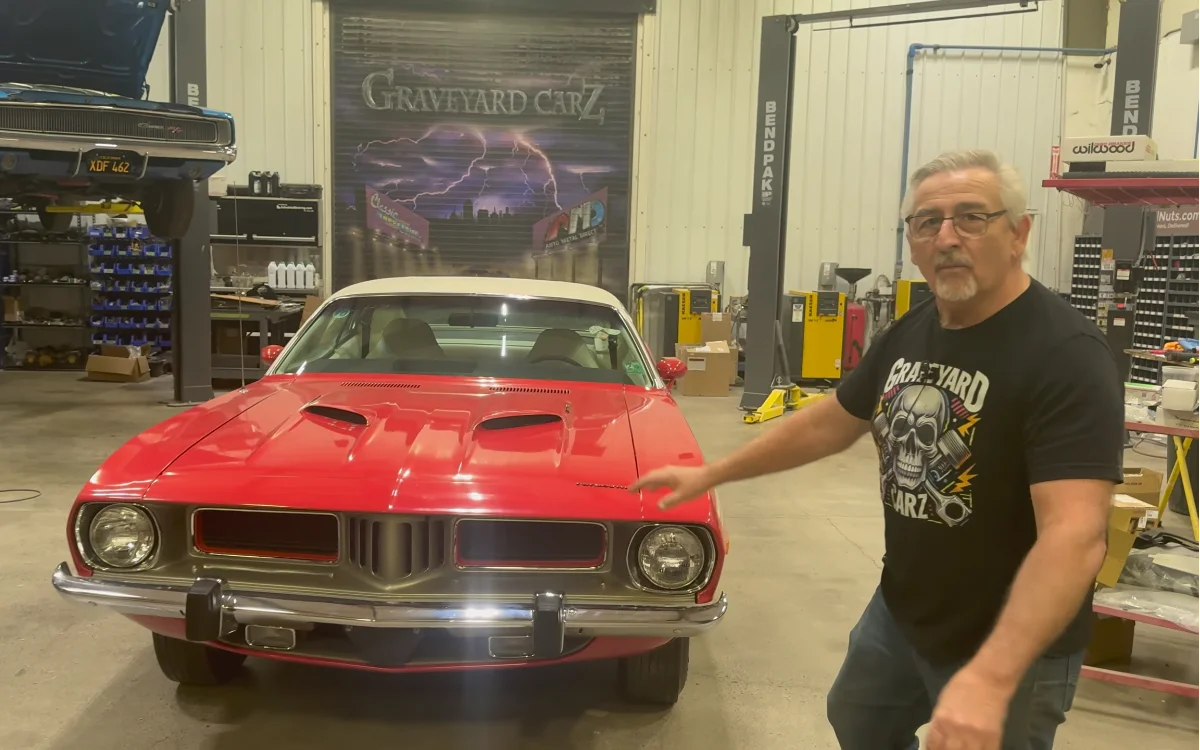
Imagine finding a zero-mile 1974 Cuda Plymouth muscle car, in nearly perfect, original factory condition, that had been lost in a Texas dealership for over 50 years.
Well, that is what YouTuber Mark from Graveyard Carz stumbled across, as they found a 1974 Plymouth Cuda muscle car that had been standing in a five-decade slumber.
This amazing machine has been called the ‘ghost of Detroit,’ and its condition makes it a rare time capsule, a holy grail of barn finds and discoveries.
Few could probably believe a car like this existed, yet here it is in the flesh, and looking as immaculate as ever.
Why this 1974 Cuda muscle car stood still for 50 years
The 1974 Cuda was the last to carry the nameplate, making this discovery even more special.
This amazing car was never sold, never registered, and the dealership never even prepped the car.
That means it is exactly as it was when it left the factory.
There are six miles on the odometer, but these are purely from factory testing.
Under the hood, the muscle car has a 360ci V8 engine making 245hp.
Finished in Rallye Red, after completion, it sat inside a Chrysler-Plymouth dealership in Baytown, Texas.
“See that light shade of red overspray? That’s from the factory,” Mark from Graveyard Carz explained.
This overspray is where the factory literally oversprayed red paint onto some of the car’s front end.
A dealership would likely have touched that up, but that didn’t happen here.
Even small details like the gaps between the header and fenders are noticeable as factory details.
Everything on the car is original; not one thing has been changed from the factory.
On the windshield is ‘1249’ inscribed, which may be the original dealership markings.
Details like that rarely survive on a car like this 1974 Cuda.
How much is this muscle car worth?
Normally, enthusiasts would go for a muscle car that has a gleaming, pristine finish and is truly immaculate.
That can see the value rise into the millions, but this muscle car is a very different prospect.
The imperfections add to its desirability, and potentially add to the value over a regular Cuda.
It’s a raw, time capsule muscle car, one that you rarely get to see.
We asked Classic.com what they thought the value of the muscle car could be.
“This is the rarest kind of find,” Austin Scola, Market Specialist at Classic.com, told Supercar Blondie.
“The classic market sees unrestored survivors occasionally, but a 50-year-old Cuda with six delivery miles, no dealer prep, and zero modifications is a sealed time capsule that just doesn’t have a true com,” he added.
“We’d put a baseline easily above $150,000, but with multiple serious collectors at the table, a number approaching $500,000 is entirely plausible,” Scola told us.
“We likely will never see another like it,” he concluded.
With no real mileage and being fully original, this ‘Cuda could be worth serious money.
Muscle cars don’t get any more special than this.
Plymouth Cuda timeline
1964: Plymouth introduces the Barracuda as a sporty fastback based on the Valiant platform
1969: The ‘Cuda name officially debuts as a high-performance trim package for the Barracuda
1970: The Barracuda moves to the much wider E-body platform to accommodate larger engines
1970: The ‘Cuda becomes a distinct high-performance model available with the legendary 426 Hemi
Also in 1970: Plymouth releases the iconic AAR ‘Cuda specifically for Trans-Am racing homologation
1971: Distinctive quad headlights and fender gills are added for this highly coveted model year
1972: Stricter emissions regulations force Plymouth to drop the big block Hemi and 440 engines
1973: Heavier federally mandated impact bumpers are added as overall performance further declines
1974: Production of the ‘Cuda officially ends due to the oil crisis and shifting consumer demands