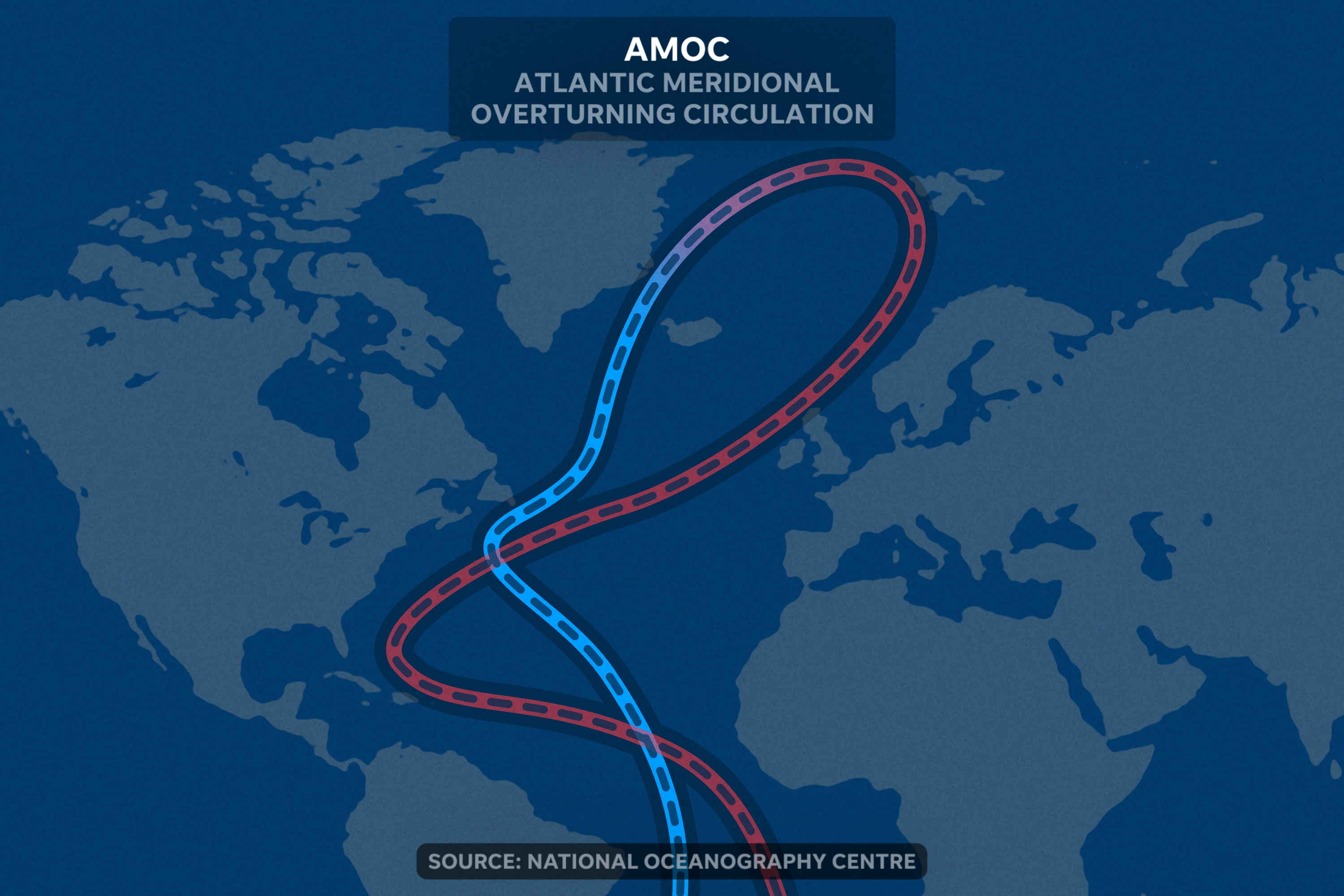
The potential collapse of a key Atlantic ocean current − due to human-caused climate change − is in the news again.
You'd be hard-pressed to come up with a scarier scenario than what's going on now with the "Atlantic Meridional Overturning Circulation (AMOC)," the fickle Atlantic ocean current whose weakening and eventual collapse could change the climate and weather for hundreds of millions of people.
A pair of new scientific studies detail the present and potential future of the AMOC, which was the ocean current at the center of the fictional (and scientifically inaccurate) "Day After Tomorrow" climate change disaster movie in 2004.
Start the day smarter. Get all the news you need in your inbox each morning.
In one study released April 8, scientists at the University of Miami determined that over the past 20 years, the AMOC has already been weakening at four different locations in the Atlantic. In the other study, released April 16, a separate group of European scientists said the AMOC will weaken by 50% by 2100, potentially eventually leading to its "collapse."
So what does this mean? And what's the difference between weakening and collapsing?
A weakening AMOC means the Atlantic Ocean’s climate‑regulating currents slow down over a period of a few decades, while a collapse means the entire current system crosses a tipping point and mostly shuts down − triggering abrupt, potentially irreversible global climate disruptions.
What is the AMOC?
“The Atlantic Meridional Overturning Circulation really is one of our planet’s key circulation systems,” said Niklas Boers from the Potsdam Institute for Climate Impact Research in Germany, the author of a previous study on the topic.
The AMOC is a crucial conveyor belt for ocean water and air, which influences weather. Warm, salty water moves north from the tropics along the Gulf Stream off the U.S. East Coast to the North Atlantic, where it cools, sinks and heads south.
The faster it moves, the more water is turned over from warm surface to cool depths.
The cycle keeps northern Europe several degrees warmer than it would otherwise be and brings colder water to the coast of North America.
Previous studies in 2018 and 2021 have also found that a collapse of the AMOC is possible at some point this century.
Study says AMOC is weakening
The April 8 study by scientists from the University of Miami, published in the peer-reviewed journal Science Advances, revealed that over the past 20 years, the AMOC is weakening at four different latitudes throughout the western boundary of the North Atlantic Ocean.
"In a sense, observations at the western boundary, in isolation from the eastern boundary, constitute the canary in a coal mine for the tendency of the AMOC," study co-author Shane Elipot told USA TODAY via email. "These findings support the evidence of a broader weakening of the AMOC."
Meanwhile, an April 16 study by European scientists, also in the journal Science Advances, found that "most climate models underestimate its decline," CNN reported. "The AMOC is on course to slow by more than 50% by the end of the century, a 'substantial weakening' that’s 60% stronger than that estimated by the average of all climate models, according to the study."
How close to a "tipping point" is the AMOC?
According to Elipot, "the AMOC is likely going towards a tipping point, which means it enters a very weak state from which it could not recover without great effort. If the weakening currently observed continues at the same rate, a collapse of the AMOC could be reached in about 140 years. However, this weakening could accelerate and occur earlier, underscoring the importance of continued monitoring of the AMOC."
How will a weakened AMOC affect the planet's weather and climate?
"A substantial weakening of the AMOC would impact natural and human systems globally, most notably leading to cooler temperatures over the North Atlantic ocean, more winter storms in Europe, and a reduction in Sahelian and South Asian summer rainfall," Elipot told USA TODAY.
"In addition, if the AMOC weakens further, sea level on the American northeast coastline will likely rise more sharply than it already does."
What are the reasons for the weakening of the AMOC?
The weakening is mainly attributed to climate change, according to Elipot, speaking in a podcast interview with USA TODAY. He said global warming prevents the usual sinking of dense, cold water in the North Atlantic by altering water density and causing more freshwater from melting ice to cap the region, reducing circulation.
Mitigating climate change by reducing carbon dioxide emissions and transitioning to clean energy is crucial, according to Elipot, along with ongoing observation and research to better predict and prepare for potential impacts.
This article originally appeared on USA TODAY: 2 studies warn 'Day After Tomorrow' ocean current is in trouble