
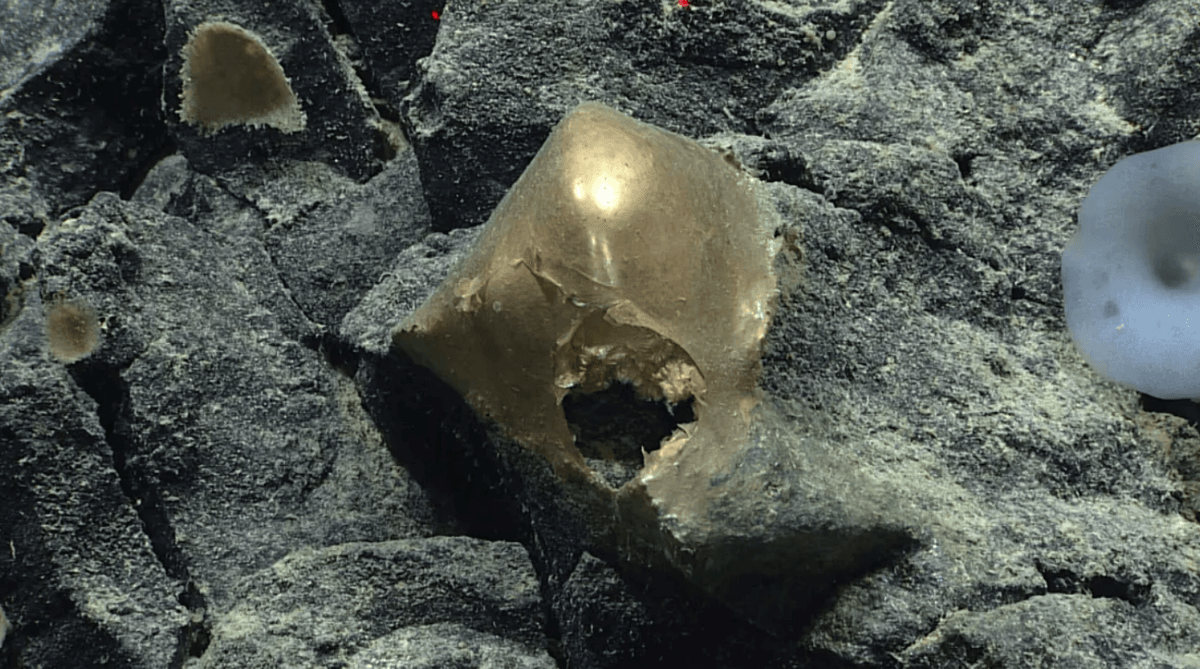
While snooping around the seabed back in late summer of 2023, scientists stumbled across a very bizarre sight. Using a remotely operated vehicle (ROV), their cameras picked up a "golden orb" nestled among the rocky seafloor. They had no idea what it was. It took over two years of research, but they’ve finally cracked the case.
The shiny golden blob was discovered by the NOAA's Seascape Alaska 5 expedition at a depth of 3,250 meters (over 2 miles) in the Gulf of Alaska. Back on the ship, the team operating the robotic sub was blown away.
“I just hope when we poke it, something doesn’t decide to come out. It’s like the beginning of a horror movie,” said one member of the expedition team.
“I don’t know what to think about this,” they added. "My first guess would be a sponge, but I don't know what I'm looking at [...] It seems spongy, but now I'm seeing a potential egg case?”
Fortunately, a robotic vacuum arm was able to snort up the specimen and bring it back to the ship. Once the expedition returned to dry land, it was sent to the Smithsonian National Museum of Natural History (NMNH) for further examination — though even their experts were puzzled.
“We work on hundreds of different samples and I suspected that our routine processes would clarify the mystery,” Allen Collins, Ph.D, zoologist and director of NOAA Fisheries’ National Systematics Laboratory, located within the NMNH, said in a statement.
“But this turned into a special case that required focused efforts and the expertise of several different individuals. This was a complex mystery that required morphological, genetic, deep-sea, and bioinformatics expertise to solve.”
At first glance, the object lacked typical animal anatomy, but it was a fibrous material with a layered surface packed with stinging cells, suggesting it was a cnidarian, an ancient phylum of marine animals that includes corals and anemones.
Next, the researchers turned to genetic evidence. Initial DNA barcoding came back inconclusive, possibly because the sample was contaminated with microscopic life. Still determined to find an answer, they moved on to the more rigorous method of whole-genome sequencing.
This confirmed their suspicions, revealing that the sample contained an enormous amount of genetic material from the deep-sea anemone. It appeared almost genetically identical to Relicanthus daphneae, a cnidarian that lives in the depths of the East Pacific. The golden orb, the team reveals in a new preprint paper, was a clump of dead tissue that had broken away from the base of a giant deep-sea anemone.
So there you have it, no extraterrestrial eggs or ancient artifacts from Atlantis, but still pretty cool.
“So often in deep ocean exploration, we find these captivating mysteries, like the ‘golden orb’. With advanced techniques like DNA sequencing, we are able to solve more and more of them," added CAPT William Mowitt, acting director of NOAA Ocean Exploration. “This is why we keep exploring—to unlock the secrets of the deep and better understand how the ocean and its resources can drive economic growth, strengthen our national security, and sustain our planet.”
The preprint is available on the bioRxiv.