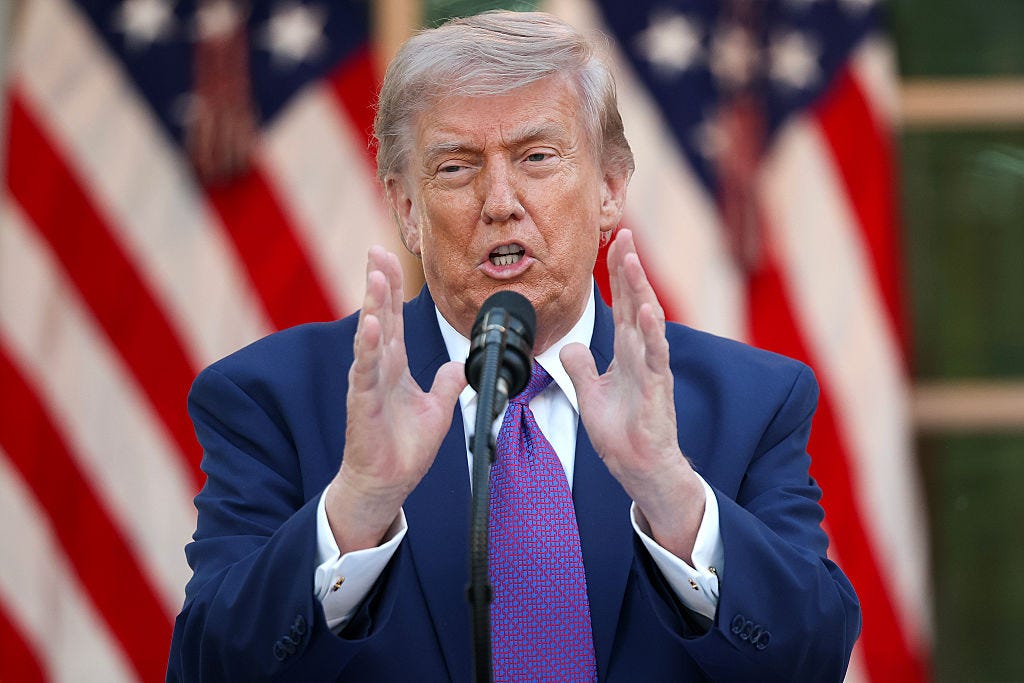
President Donald Trump has defended Chinese nationals purchasing U.S. farmland, while conceding he does not “love it,” in comments that underscore a central tension in his China policy: balancing national or food security concerns with economic realities.
These concerns over Chinese land purchases in the U.S. have increased in recent years, especially when they occurred near military bases, and the Trump administration has sought to restrict these acquisitions.
Speaking to Fox News host Sean Hannity from Beijing during his visit to China, Trump framed Chinese land ownership as a market issue rather than an ideological one.
“Look, it’s not that I love it—you want to see farm prices drop, you want to see farmers lose a lot of money? Just take that out of the market,” said Trump.
He added that Chinese investors had acquired U.S. farmland for years without intervention from previous administrations. “But they’ve had a lot of land for a long time. [Barack] Obama did nothing about it. They bought a lot of it during the Obama administration. He did nothing about it.”
Trump arrived in China on Wednesday evening for high-profile talks with Chinese President Xi Jinping—marking the first visit by an American president in almost a decade.
Chinese Farmland Purchases
On the campaign trail, Trump was already warning against Chinese acquisitions in the U.S.
At a Smithton farm event in Pennsylvania in September 2024, he said that the U.S. should block Chinese purchases of farmland, adding: “we don’t want you buying our land.”
Once at the White House, Trump signed a national security memorandum in February 2025 targeting Chinese and other foreign adversary investments in certain U.S. sectors, including agriculture.
In July 2025, the Department of Agriculture (USDA) announced a “National Farm Security Action Plan” aimed at restricting land purchases by Chinese nationals and other foreign adversaries, working with Congress and other states to pursue legislative and regulatory limits.
“American agriculture is not just about feeding our families, but about protecting our nation and standing up to foreign adversaries who are buying our farmland, stealing our research, and creating dangerous vulnerabilities in the very systems that sustain us,” Agriculture Secretary Brooke Rollins said at the time.
According to the U.S. Department of Agriculture’s most recent Agricultural Foreign Investment Disclosure Act (AFIDA) data (through December 31, 2023), Chinese entities reported owning about 277,336 acres of U.S. agricultural land—representing a small share—less than 1 percent—of overall foreign-held farmland in the U.S.
Ahead of Trump’s visit to China, a bipartisan group of U.S. lawmakers introduced new legislation to close what they referred to as “dangerous loopholes” allowing countries like China to purchase farmland near U.S. military bases.
The bill, proposed by Republican Representative John Moolenaar from Michigan, would expand the authority of the Committee on Foreign Investment in the United States (CFIUS) to review and potentially block land deals involving countries such as China and Russia, particularly those near sensitive military and infrastructure sites.
Chinese Students at US Universities
In his interview, Trump also defended allowing large numbers of Chinese students to study at U.S. universities,
Again, Trump invoked economic imperatives, saying that it would harm “lower schools” if they were removed.
“It’s 500, 000 students that come, good students,” the president told Hannity.
“If you want to see a university system die, take half a million people out of it,” he said.
“I frankly think that it’s good that people come from other countries and they learn our culture,” he added. “It’s a very insulting thing to tell a country ‘we don’t want your people in our schools.'”
In November 2025, the president also told Fox News’ Laura Ingraham that it was important to allow Chinese students to attend American colleges and universities so that they could stay in business and “thrive.”
“We do have a lot of people coming in from China, and we always have—China and other countries,” he said. We also have a massive system of colleges and universities, and if we were to cut that in half, which perhaps makes some people happy, you would have half the colleges in the United States go out of business.”
He added: “We’re taking trillions of dollars from students. You know, the students pay more than double when they come in from most foreign countries. I want to see our school system thrive.”
Key Takeaways From the China Summit
During the summit, Trump and Xi discussed the war in Iran, the president said.
Speaking alongside Xi in the Zhongnanhai garden in Beijing, Trump said the pair “did discuss Iran” and agreed that the two countries want the war to end and do not want Iran “to have a nuclear weapon.”
The White House also said in a readout that China could use its influence over Iran to push for the reopening of the Strait of Hormuz and might consider purchasing American oil to reduce its reliance on the waterway. China buys Iranian oil and a portion of China’s crude oil passes through the waterway.
“The two sides agreed that the Strait of Hormuz must remain open to support the free flow of energy,” the White House said in a statement.
Xi also expressed opposition to the “militarization of the Strait” and rejected efforts to charge fees in exchange for transit, according to the readout. It added: “And he expressed interest in purchasing more American oil to reduce China’s dependence on the strait in the future.”
Xi also warned Trump the two countries could clash over Beijing’s longstanding claim to the self-ruled island of Taiwan, according to a readout published by the Chinese Foreign Ministry.
Meanwhile, Secretary of State Marco Rubio told reporters that the U.S. position on Taiwan, a U.S. trading partner, remained “unchanged.”
Business was a key theme of the talks with prominent U.S. executives, including Tesla CEO Elon Musk, Nvidia CEO Jensen Huang and outgoing Apple CEO Tim Cook present during the visit to discuss expanding market access for American businesses into China and increasing Chinese investment in the U.S.
“This has been an incredible visit,” Trump told reporters at the end of the trip. “I think a lot of good has come of it. We’ve made some fantastic trade deals—great for both countries.”
Beijing said the visit had “deepened mutual trust” between the leaders, who have differing core national security concerns. China has sought to lower the risk of conflict— emphasizing this trip the need for stability in the relationship to avoid future conflict.
Trump has invited Xi to visit the White House in September.
Related Articles