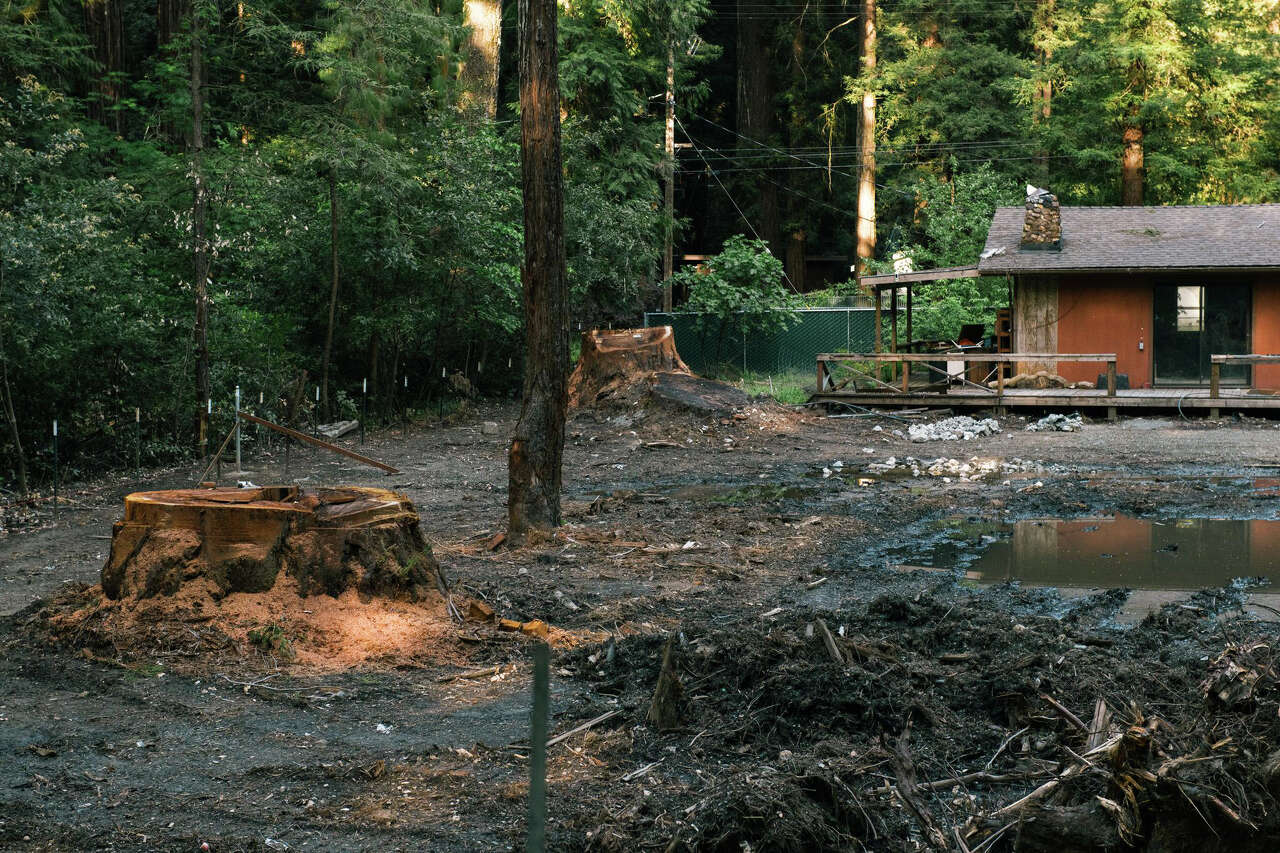
REDWAY - Centuries-old redwood trees tower over homes nestled in this small Humboldt County town along the South Fork Eel River.
But one prominent corner lot now stands out from its heavily forested neighbors.
In front of a low-slung red house stretches an empty expanse of dirt, a muddy puddle and four large, fresh tree stumps. A single redwood, 250 feet tall and roughly 350 years old, still looms over the house, although it will likely soon meet the same fate.
The scene has sparked outrage among residents and environmentalists and raised broader questions about legal protections for the giant trees that are a quintessential part of Northern California.
Redway residents had long believed redwoods in their area were protected by a decades-old Humboldt County zoning ordinance. The law, which requires a special permit to remove any redwood trees greater than a foot in diameter from the Lower Redway neighborhood, passed in the wake of clashes over logging on private property.
So Sue Moloney, 64, said she was shocked to drive her Subaru Forester past the lot in early January and see the four trees "girdled," or slashed with deep cuts all the way around their trunks. The incisions effectively blocked the supply of nutrients to the trees, signaling they were slated to be cut down.
"It was like they put the mark of death on the trees," Moloney said. "It was kinda like the biggest middle finger you could have given the community."
Before it was purchased last October, the unkempt, half-acre property on Oakridge Drive had languished on the market for almost a year. Robert Scarlett, a 24-year-old local and Cal Fire firefighter, bought it for $160,000, records show.
Scarlett wanted his mother to live in the house, he told a local blogger at the time, but worried the trees were dangerous because they could drop large branches or other debris.
The new homeowner had a professional forester examine the property. Five redwoods within 30 feet of the house were deemed "hazardous," according to the inspection report reviewed by the Chronicle.
They were at least 225 years old and 5 feet in diameter, and many residents considered the trees "old growth," a term for ancient forests largely untouched by logging.
But the trees had damaged the home in the past, according to the inspection report, and "continue to pose a safety threat."
In December, Scarlett filed an application with Cal Fire seeking a "structure protection" exemption to cut them down.
The agency, which regulates California timber production and enforces forest-related laws, approved it the following day, records show.
Scarlett told Humboldt County of his plans to remove the trees under a hazard exemption approved by Cal Fire. But county staff did not require an additional special permit - which some residents and activists see as a failure by state and county officials.
One day in January, 84-year-old Redway resident Linda Sutton felt her house shake and windows rattle as the trees came crashing down piece by piece. But Sutton, a longtime environmental activist, was bedridden at the time.
"I couldn't go out. I couldn't stand out there and protest with a sign," Sutton said. "It was like being held captive at home."
Within about a week, four trees were gone.
Redway developed in the 1940s as a small community of second homes where families went to escape the Eureka fog during the summer. The characteristic redwoods offer a shady refuge on warm days, but bring inherent risk other times of year. Many locals tell stories of branches crashing through cabins during high-wind winter storms.
But rather than chopping down entire trees, residents said landowners often choose to cut off limbs or other decaying material to keep them safe and healthy.
"I think many people see themselves as being stewards, good stewards, of the land," Sutton said. "The trees, the wildlife, and people - we're all interconnected."
Scarlett and his mother declined to comment. Tonya Farmer, a local attorney who said she was representing Scarlett, said her client "disputes any allegations that have been circulated and is focused on resolving issues lawfully."
Jeremy Ward, a battalion chief at the Cal Fire Humboldt-Del Norte Unit, said there was "nothing illegal" about the removal process, which met the agency's standards. Accusations that Scarlett got special treatment because he was a Cal Fire employee are false, he said.
"Our resource management staff provided the same level of assistance they provide to any other member of the public who'd come in," Ward said. "Everything was done right based on our understanding of the rules."
Humboldt County Planning Director John Ford also defended Cal Fire and the county, saying he believed neither agency did anything wrong. When Scarlett approached them about chopping down his trees, Humboldt County staff believed "the county really had no say in the matter," Ford said.
This understanding was based on a 2022 tree removal near a PG&E substation in Eureka, when the county was told a state-issued permit took precedence over local laws.
"I think people from our staff who were involved were trying to make the right decisions based on what they knew," Ford said.
Some environmentalists are now concerned that any tree could be identified as a hazard and chopped down if the county fails to exercise its authority.
"If we continue to rely on this sort of logic that allowed him to remove these trees in the first place, we won't have any old growth left in Lower Redway," said Tom Wheeler, executive director of the nonprofit Environmental Protection Information Center.
Following the community backlash, Ford said his department is working to strengthen its permitting process and clarify jurisdiction between Cal Fire and Humboldt County in regulating local tree removals.
"We're not going to sign off or just passively watch any more tree removals," Ford said. In the future, he went on, they'll either require the permit, "or we will have Cal Fire tell us that we don't have jurisdiction there, because the line's gotta be clear."
The fight is now focused on the one remaining tree, which neighbors still hope can be spared.
Ford and Supervisor Michelle Bushnell, who represents the area including Redway, met with concerned residents in March, and the county issued a stop-work order requiring proof that the remaining tree was hazardous.
Scarlett hired an arborist, who found root damage and a large cavity with rot near the top of the tree, according to a report obtained by the Chronicle. The arborist concluded that the tree posed a safety risk to the house, its inhabitants and the public, and other mitigation options like pruning would be "unfeasible."
The county lifted the stop-work order last month in response to the report, paving the way for the massive tree to come down. It's not clear when the homeowner plans to remove the tree.
For many longtime residents, the saga has felt familiar - reminding them of a similar incident that rattled the neighborhood in 1978.
Redway residents were outraged when a man purchased property and began chopping down 18 redwoods that were deemed dangerous, according to stories in the Sacramento Bee and San Francisco Examiner.
Back then, a crowd gathered at the property, shouting at the loggers, and one woman parked her car directly beneath a tree about to be felled until a law enforcement officer dragged her away.
No such physical intervention happened this time. In their younger years, several Redway residents participated in environmental activism, like climbing trees or going on hunger strikes, but said they now feel weary from fighting a battle they thought had already been won.
"Areas either got protected or they got logged," Moloney said. "So all the timber wars really dissipated."
California has roughly 120,000 acres of old growth redwood forests left standing in the wake of widespread logging, or about 5% of the 2.2 million acres pre-European settlement, according to California State Parks.
The recent fight over the trees has grown so heated in the community that Scarlett installed security cameras and a new fence around his property.
On a recent weekday, sparks flew from a loud tool as fence-builder Jonathan Weltsch welded pieces of metal near the edge of the property.
Weltsch said he had seen the battle playing out in local Facebook groups and the comments section of a blog. If the land was his, Weltsch said, he wouldn't have cut the trees down. But he also understood the safety concerns.
"There's a balance," Weltsch said, then pointed down the road and across the river to a state park - one of about five in close proximity to the neighborhood. "I think people should go to the state parks. There's a forest right there - protected forest."
Related Reading
Why thousands of blue sea creatures are suddenly appearing on California beaches
California women's prison faces scrutiny after ‘horrific' pepper spray assault
Congressman opens investigation into Trump administration's involvement in California dam removal
Subscribe
There’s more to San Francisco with the Chronicle. Subscribe today for just 25¢.Read this story on sfchronicle.com