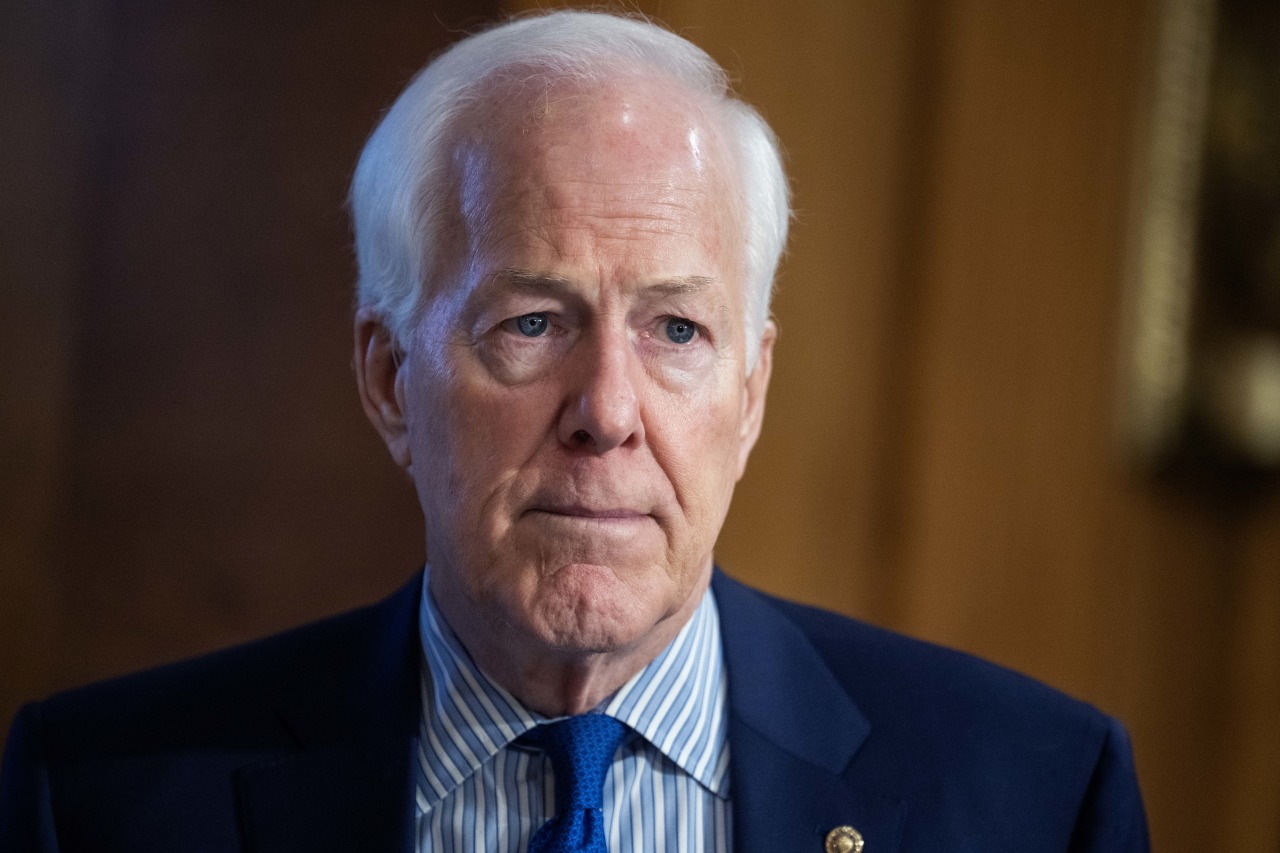
AUSTIN, Texas—Ask Sen. John Cornyn’s loyalists about him and the same words come up again and again. Steady. Statesman. Calm.
They aren’t words associated much with politics anymore.
The senior senator from Texas is locked in the fight of his political life after four decades in public office. His primary runoff against firebrand Texas Attorney General Ken Paxton at the end of May is testing the future of the Republican Party in Texas and the country, serving as a barometer for whether there is still room for a quiet, old-school, aisle-crossing pragmatist in President Trump’s America.
“There’s no country for John Cornyn anymore,” a former top aide said. “It’s no longer a system that’s built on finding common ground, it’s built on winner-take-all cynicism.”
Allies of the four-term senator like to emphasize, in the face of criticism otherwise, that he is very conservative. Data collected by GovTrack, which analyzes congressional data, rated him the 12th farthest-right senator. Yet his name recognition has lagged behind more-colorful politicians, and far-right voters have called him too much a product of Washington and not supportive enough of Trump.
“Because of my demeanor…people don’t see me as angry,” Cornyn said in an interview. “That that somehow means I’m less effective or less supportive of the president, and that couldn’t be more wrong.”
Cornyn elicited a challenge from Paxton, a MAGA warrior popular with the party’s base, after he had fallen out of favor with many grassroots Trump loyalists—even being booed at a party convention in 2022. Polls showed Paxton leading Cornyn and a third candidate, Rep. Wesley Hunt.
But Cornyn capitalized on his support from mainstream party stalwarts and their anxiety that nominating scandal-prone Paxton could make Republicans vulnerable in November. His campaign and groups supporting him spent nearly $50 million hammering Texas airwaves with pro-Trump messaging and attacks on Paxton. Cornyn has shed some of his elder statesman persona with Paxton, running a strikingly negative campaign that included a faux-dating app game featuring Paxton’s alleged mistresses.
In the initial March primary, Cornyn overperformed predictions, winning 42% of votes to Paxton’s 41%, sending them to a runoff in late May. Cornyn heads into it with $8.5 million on hand to Paxton’s $2.6 million. Among the senator’s donors: former President George W. Bush.
Paxton supporters such as Rep. Brandon Gill (R., Texas) have contrasted the relatively muted Democratic criticism of Cornyn against the fervor inspired by Republican Sen. Ted Cruz.
“The left wants to take out Ted Cruz because he fights,” Gill said. “If you don’t have enemies, it’s because you’ve done nothing.”
Rep. Nathaniel Moran (R., Texas), a Cornyn backer, says the race comes down to character, casting Paxton’s ethical controversies as a test of GOP values. “This is a critical election that has, at the heart and center of it, introspection for the Republican party in Texas,” Moran said.
Cornyn, 74, was born in Houston to an Air Force family and grew up moving frequently. In Texas, he got a journalism degree and real-estate license before becoming a lawyer. His political career began largely by accident when he walked into a Super Bowl Sunday party in 1984. The 6-foot-3, prematurely white-haired, 31-year-old caught the eye of local kingmaker Jim Lunz, who had been struggling to recruit Republicans to run for judgeships. He asked GOP colleague Cyndi Taylor Krier “Who’s that?” she recalled.
“He said ‘Let’s get him to run for judge—he looks like a judge,’” Krier recounted.
Cornyn won the district judge seat and later a state Supreme Court justice position. In 1998, he became the century’s first Republican elected Texas attorney general.
The move to attorney general provided a defining early political fight for Cornyn, who believed the state was grossly overpaying lawyers fighting a landmark case against tobacco companies. The pay battle went on for years and ultimately led to a criminal indictment against former Democratic Attorney General Dan Morales.
Morales said he always considered Cornyn a decent person with a good nose for politically popular positions. “The tobacco issue and the way he handled it is as good an example as any to demonstrate his prowess in that regard,” Morales said.
Cornyn ascended to the Senate in 2002, easily eclipsing four others in the Republican primary and beating his Democratic opponent by 12 percentage points. He gained a reputation as a workhorse with a knack for finding consensus between colleagues. From 2013 to 2019 he held the powerful Senate majority whip position, from which he helped steer Trump’s Supreme Court nominees and tax law.
While his Washington clout rose, former advisers said they worried about his low name ID in Texas, even commissioning focus groups on the subject. While his re-election campaigns drew little serious competition, some said they worried he was potentially vulnerable.
Some of Cornyn’s positions drew pushback from Texas Republicans. He has been criticized for his support of DACA recipients, which some opponents likened to supporting immigrant amnesty. In 2022, he became the lead Republican negotiator on the first significant gun bill in decades, after a gunman left 19 children and two teachers dead in a Uvalde classroom.
The Uvalde shooting made Texas the site of three of the 10 deadliest mass shootings in U.S. history in just six years. The gun bill Cornyn helped negotiate allowed more time to check gun buyers under 21 whose background checks showed problems, among other provisions.
Bob Rowling, a billionaire businessman and prominent Republican donor, recalled getting a call from Cornyn, a longtime friend.
“I told him, John, I own a gun company and I’m all for it,” Rowling said. He was amazed when the measure led to Cornyn being booed at the GOP convention that year. It is still frequently used to attack him. “I think he’d do it again though,” Rowling said.
Many expected Cornyn to retire this year, but the senator made it no secret that his personal loathing of Paxton was a key motivation to run again. Friends of Cornyn say they aren’t surprised he is offended by Paxton, whose own top aides told the FBI he was abusing his office, leading to an impeachment and later acquittal. Yet Paxton has ascended in Texas politics for being what some see as the opposite of Cornyn—a no-compromises fighter for right-wing interests. Paxton has denied any wrongdoing.
Sen. John Barrasso (R., Wyo.), who now holds the whip post, said Cornyn’s inclination to listen more than talk aided him in herding member votes. Barrasso is among the senators who have pushed Trump to endorse Cornyn, he said, but the president has so far stayed out of the race.
Cornyn has started making more concessions to MAGA interests. Last month, after Paxton challenged him to get his Senate colleagues to pass a Trump-priority voter-identification bill, Cornyn reversed his longstanding support of the Senate filibuster rule requiring 60 votes to pass most legislation.
Former Texas Gov. Rick Perry, a friend of Cornyn, said Cornyn is part of the old-school mold of GOP officials who believed in sitting down and working with Democrats.
But he acknowledged it is a different time.
“Has the party changed? We’re probably about to see,” Perry said.
Write to Elizabeth Findell at elizabeth.findell@wsj.com