On the Thursday, April 23, 2026, episode of The Excerpt podcast: A large-scale and delicate system of ocean currents that has been active for millions of years and that’s responsible for our warm climate is in danger of collapse. This is according to a new study published in April in the journal Science Advances. Shane Elipot, a physical oceanographer at the University of Miami and one of the authors of the study, joins The Excerpt to share his findings.
Hit play on the player below to hear the podcast and follow along with the transcript beneath it. This transcript was automatically generated, and then edited for clarity in its current form. There may be some differences between the audio and the text.
Podcasts: True crime, in-depth interviews and more USA TODAY podcasts right here
Start the day smarter. Get all the news you need in your inbox each morning.
Dana Taylor:
A large scale and delicate system of ocean currents that's been active for millions of years and that's responsible for our warm climate is in danger of collapse. This is according to a new study published earlier this month in the journal, Science Advances. If that collapse actually happens, scientists warn the consequences could be dire. Hello and welcome to USA TODAY's The Excerpt. I'm Dana Taylor. Today is Thursday, April 23rd, 2026. Joining me to discuss new research indicating that the Atlantic Meridional overturning circulation known as the AMOC may be weakening faster than previously understood is Shane Elipot, a physical oceanographer in the Department of Ocean Sciences at the University of Miami and author of the study. It's good to have you here, Shane.
Shane Elipot:
Thank you very much for having me.
Dana Taylor:
First, help me understand the importance of this complex system and how it functions. What is the Atlantic Meridianal overturning circulation and how does it work?
Shane Elipot:
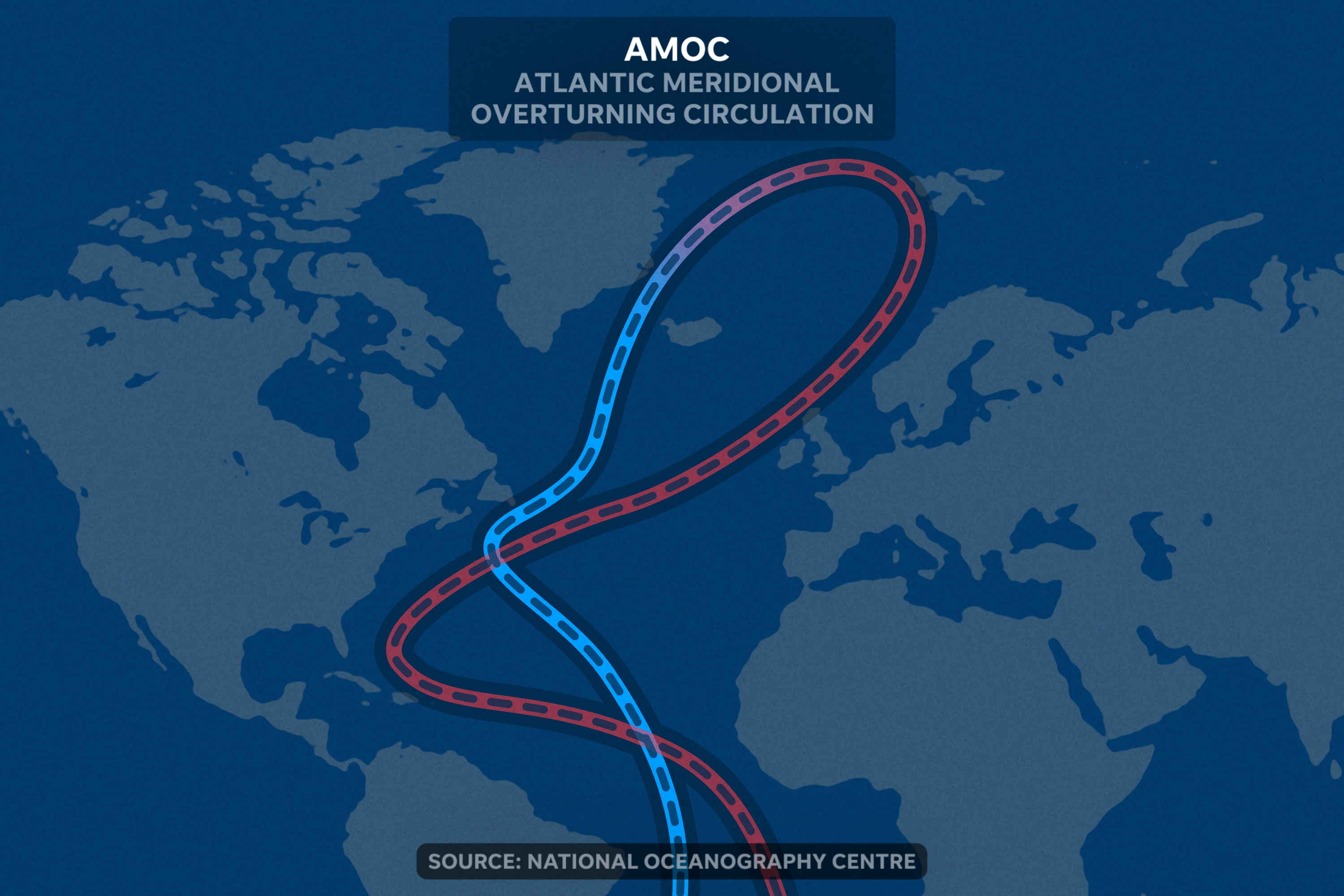
Yeah, so the AMOC is an acronym that we use and it describes a system of currents that we can observe and we can see throughout the entire North Atlantic. In broad terms, what it does is that you have about a very...the top thousand meter of the ocean is actually flowing northward throughout the North Atlantic. And as it reach the northern end of the Atlantic Ocean, the water becomes cooler and denser and sinks eventually to greater depth. And then it returns back south. So this type of ocean currents, we call this a circulation. And sometimes in simplistic terms, it is described as a conveyor belt of ocean currents.
Dana Taylor:
Can you share more about what led you to the study and give an overview of the data you gathered?
Shane Elipot:
Yeah, so the reason why we care about the system of current is because it actually transport a lot of heat. So it's an integral part of the climate system and it affects the temperature of the ocean autonomy, but it also affect the climates over Europe. So there's been a couple of pointers in climate models or in previous studies that have indicated that the system of currents might be weakening. As a result, scientists that I now work with have started in 2004 a campaign to continuously measure the strengths of this currents because of their importance in our climate. So since 2004, we've had in place in the ocean a number of instruments that are recording the temperature, the salinity, and the ocean currents. So at the University of Miami, we've been deploying instruments just east of the Bahamas throughout the water column. And then my colleagues in the UK at the National Ocean Graphic Center have been deploying instruments of the coast of Morocco, south of the Canary Islands.
And then our colleagues from a NOAA laboratory in the US have been measuring continuously the strengths of the Gulfstream. So when you put all these measurements, we combine them all together because you are measuring either end of the Atlantic Ocean, east and west, you are actually able to measure the full strengths of that system of currents of the AMOC. And the amount of heat that this current, the AMOC is transporting is very much tied up to the strengths of it. So that being said, we've been measuring it for about 20 years. And in the last couple of years, we have noticed that the system of currents has been decreasing in a way that statistically we see is significance that the signal of a weakening has raised above a level of natural viability and natural oscillation. So the research that was just published is basically using this data from that rapid array, as we call it.
And then, what we've combined observation from three different other arrays throughout the North Atlantic. And what we found very briefly is that the signal at the western boundary of these different arrays is confirming the signal of weakening that we've been observing at this rapid array at 26 north.
Dana Taylor:
Shane, what does this data reveal regarding how close we are to a point where the AMOC can't recover? Is there a real danger of collapse? And if so, what's the timeframe?
Shane Elipot:
Yeah, so this is a very good question. So it's on a matter of a real timescale and how long you need to have these observations. We've noticed what we've been able to measure is that on average, the strengths of that circulation has decreased by 10% over 20 years. So 10% may sound like a lot or maybe doesn't sound like much, but considering the amount of heat that it actually transport, it is actually significant. So if a collapse of such a current, which is maybe a reduction of maybe 80%, considering the current observe rate, it would take about 140 years from now to decrease. And maybe it will decrease by about 50% by the end of the century if it continues to decrease at this rate. So it indicates that in general, we'll be getting closer to collapse of this system of currents.
Dana Taylor:
Do we know why the AMOC is weakening?
Shane Elipot:
Yes. So the AMOC is very much driven by changes in density in the ocean and changes in density is caused by changing temperature and salinity. So the general global warming climate change that we are experiencing currently because of human activities have led to changes in density that are causing that sinking of water at higher latitude to be reduced, and hence the strengths of that conveyor belt of current to weaken as well. So it's very much part of the general climate change that we are currently experiencing in the world.
Dana Taylor:
The AMOC has weakened before. Shane, can you offer a bit of historical context here on the global consequences?
Shane Elipot:
Yeah, so the AMOC has weakened in the past, and it has even shut down in the past, we think, according to paleoclimate records. But more importantly for us, because what really matters is the impacts for the ecosystem and humans on this planet, we can look at the record that we have here from since 2004. And after about four or five years, the AMOC reduced by 30% during the winter of 2009 and 2010. And scientists that have been working on the data have been able to pinpoint that maybe that was the cause of a very harsh winter over Europe that happened in 2010. So this is one example of a relatively short impact that the EMR may have. So one can imagine that if the ammo were to permanently weaken and collapse, as people say, then we can imagine that this impact would last. It would have lasting impacts basically where a number of climate consequences such as harsher winter and drier summer over Europe.
It has also potentially some impact on the sea level on the East Coast of the US that could affect a lot of coastal communities. It is also expected to displace some climate patterns and some weather patterns in some distant part of the world because the climate is very interconnected. So it is expected that the belt of rain that we find around the equator might be displaced southward, and it would have some impact on food production in Africa. It would warm up the Southern Hemisphere compared to the Northern Hemisphere. So it would have some lasting impact if you want if such big reduction were to last in the future.
Dana Taylor:
Which regions of the world are most exposed here, particularly in the US, and what are some of the near term risks?
Shane Elipot:
Yeah, so because the system of current is for the North Atlantic, the regions that are going to be the most affected are around the Atlanic Ocean. So as I mentioned earlier, the climate over Europe is likely to be affected in short term once the AMOC has declined, as well as the sea level around the East Coast of the US and also throughout Europe because the AMOC is very much embedded into the dynamics of ocean currents and ocean currents are related to the shape of the sea level throughout the North Atlantic. So if you weaken the currents, unfortunately one of the consequences is that you are going to increase the sea level by quite a bit on the East Coast of the US, so affecting coastal communities.
Dana Taylor:
And finally, I want to get your thoughts on what government can do right now to prepare for collapse, and if you think any of those things are being done.
Shane Elipot:
So I don't think you're asking the scientist here. I think you are asking the individual who is in a society. Personally, I think that we could be doing more in the US or throughout the entire world to limit CO2 emissions, to transition towards clean energy that are going to allow us not to rely so much on burning fossil fuel. We need also to be better prepared in terms of resilience in coastal areas when we're looking at impacts such as sea level. So all the same things that you're hearing about how to adapt and mitigate and trying to limit the impacts and climate change, we have to do the same thing. And this is me talking as an individual citizen living in the United States.
Dana Taylor:
It was lovely speaking with you, Shane. Thank you so much for sharing your findings with us here on The Excerpt.
Shane Elipot:
Thank you very much for giving me the time to talk.
Dana Taylor:
Thanks to our senior producer, Kaely Monahan, for her production assistance. Our executive producer is Laura Beatty. Let us know what you think of this episode by sending a note to podcasts@usatoday.com. Thanks for listening. I'm Dana Taylor. I'll be back tomorrow morning with another episode of USA TODAY's The Excerpt.
This article originally appeared on USA TODAY: Doomscrolling alert: The Atlantic current may be headed for collapse | The Excerpt