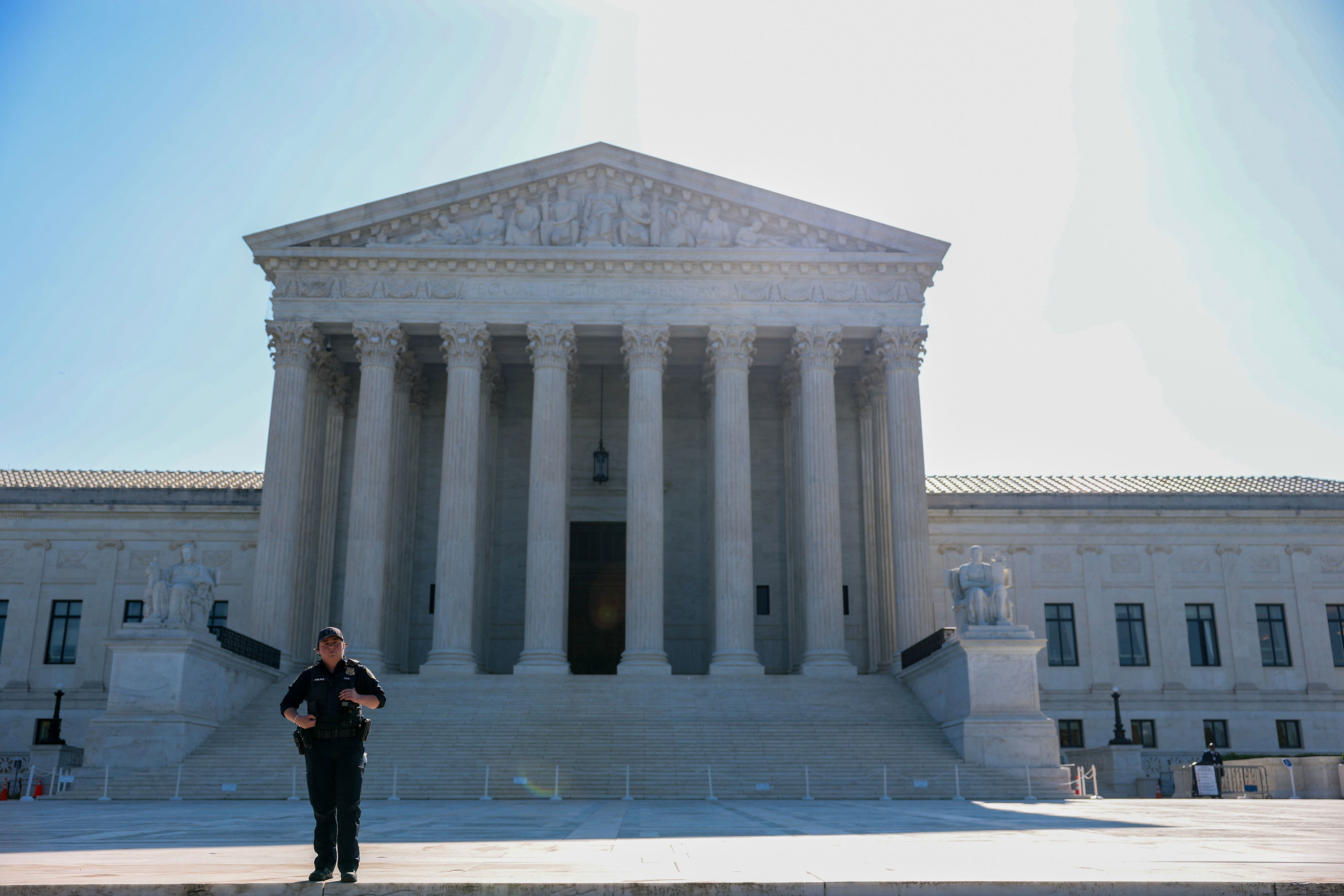
The U.S. Supreme Court appeared inclined Monday to allow police to use geofence warrants—a digital surveillance tool that collects the location history of cellphone users near crime scenes—in a case that could reshape how law enforcement uses location data nationwide.
What Are Geofence Warrants?
Geofence warrants erect a virtual perimeter around a specific location and direct technology companies—most often Google—to identify cellphones present in that area during a defined window of time.
During nearly two hours of arguments in the case of Okello Chatrie, who pleaded guilty to a 2019 Virginia bank robbery, the justices appeared to reject the argument that geofence warrants are too broad to comply with the Fourth Amendment. The ruling, expected later this term, will determine whether police can continue using location-based digital warrants in cases nationwide—and arrives alongside ongoing court battles over a related and even more controversial tool: reverse keyword search warrants.
The warrants have also been used in a wide range of cases nationwide, but they have drawn intense scrutiny from civil liberties groups who argue they sweep up the location data of innocent people who happened to be near crime scenes.
Why It Matters
The justices are weighing how a constitutional provision ratified in 1791 applies to technology the nation’s founders could not have envisioned—a question the Supreme Court has wrestled with repeatedly in recent years. A ruling allowing geofence warrants would effectively endorse a tool already in widespread use by police across the country to identify suspects in cases where investigators have no other leads.
What Happened in Court
Justice Sonia Sotomayor pushed back on Chatrie’s lawyer Adam Unikowsky, who argued the warrants are too general. “This isn’t that. It identifies a place, a crime, a timeframe,” Sotomayor said. The justices appeared eager to avoid issuing a sweeping ruling—instead potentially limiting the time and geographic scope such warrants can cover, or declining to address whether geofence searches even amount to a Fourth Amendment search at all. The court could ultimately rule that even if a warrant is required, police can constitutionally conduct geofence searches.
The federal appeals court in Richmond previously upheld Chatrie’s conviction in a fractured ruling. In a separate case, the federal appeals court in New Orleans ruled that geofence warrants “are general warrants categorically prohibited by the Fourth Amendment”—creating the kind of split the Supreme Court is now expected to resolve. Even a ruling for Chatrie may not help him personally: the federal judge who ruled the search violated his rights still allowed the evidence to be used because the officer applying for the warrant reasonably believed he was acting properly. Chatrie is currently serving a prison term of nearly 12 years.
The Related Battle Over Reverse Keyword Warrants
While geofence warrants identify who was somewhere, a separate but related digital tool—reverse keyword warrants—identifies who searched for something. Police use these warrants to ask Google to reveal the IP addresses of users who searched for specific terms during defined time windows, such as a victim’s address or a phrase like “pipe bomb.” The two tools are distinct legally but are often discussed together because they both raise novel Fourth Amendment questions.
Reverse keyword warrants have been used in a string of high-profile investigations, including the bombings in Austin, Texas; the 2018 assassination of Brazilian politician Marielle Franco; and a fatal arson in Colorado. They were also central to a 2016 Pennsylvania rape investigation that led to the conviction of John Edward Kurtz, a state prison guard who was sentenced to 59 to 280 years in prison after his Google searches for the victim’s address led police to his door.
The Pennsylvania Supreme Court upheld Kurtz’s conviction in late 2024 but split on its reasoning—three justices said Kurtz should not have expected his Google searches to be private, while three others said police had probable cause to identify anyone who searched the victim’s address before the attack. A dissenting justice argued probable cause requires more than a “bald hunch.”
In Colorado, the state Supreme Court ruled in 2023 that a similar warrant in a deadly arson case was constitutionally defective for not specifying “individualized probable cause,” but allowed the evidence to be used because police had acted in good faith. “If dystopian problems emerge, as some fear, the courts stand ready to hear argument regarding how we should rein in law enforcement’s use of rapidly advancing technology,” the majority wrote.
The Privacy Stakes
Civil liberties advocates argue both tools threaten to turn ordinary internet users into suspects. The American Civil Liberties Union (ACLU), the Internet Archive and several library organizations filed an amicus brief in the Pennsylvania case warning the warrants give police “unfettered access to the thoughts, feelings, concerns and secrets of countless people.”
University of Pennsylvania law professor and civil rights lawyer David Rudovsky framed the stakes bluntly. “What could be more embarrassing,” he asked, if every Google search “was now out there, gone viral?”
Google said in a statement that its processes for handling law enforcement requests are designed to protect user privacy while meeting legal obligations. “We review all legal demands for legal validity, and we push back against those that are overbroad or improper, including objecting to some entirely,” the company said. Google does not publicly break down how many of these warrants it receives each year, according to a January 2024 brief by the Electronic Frontier Foundation and the Pennsylvania Association of Criminal Defense Lawyers.
What Happens Next
The Supreme Court’s ruling on geofence warrants is expected later this term.
Reporting from the Associated Press contributed to this article.
Related Articles