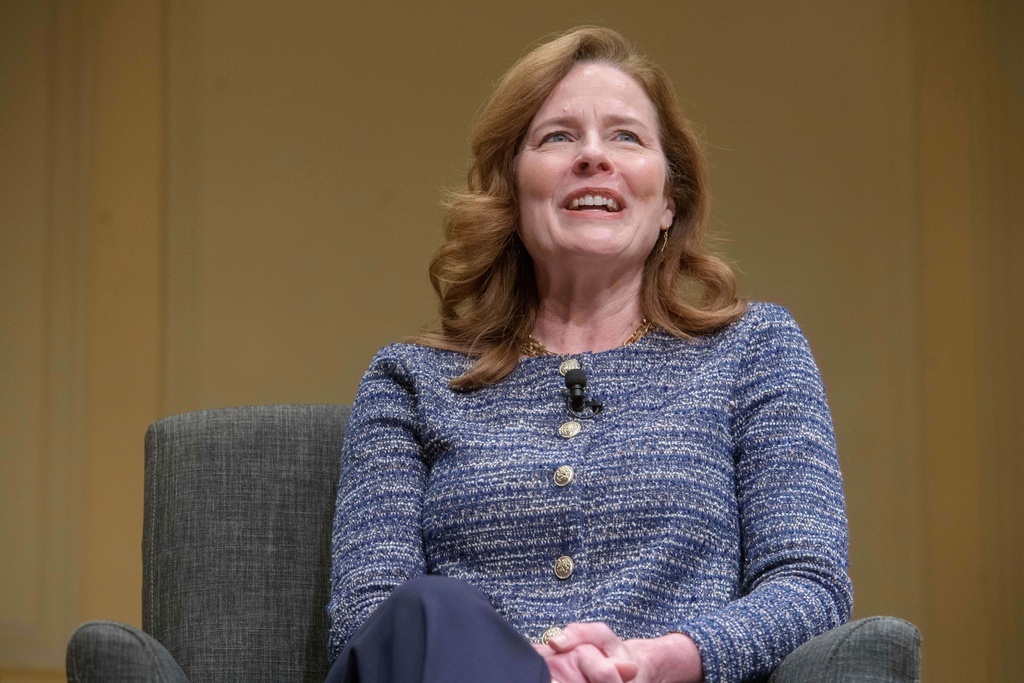
Supreme Court Justice Amy Coney Barrett said changes to the Constitution should “come from the people” at an event on Saturday where she also said she would “reject the label” of conservative and instead call herself “an originalist.”
Barrett, who joined the court in 2020, is one of six Republican-appointed justices and one of three President Donald Trump nominated to the bench in his first term. The court’s conservative majority has ruled in the Trump administration’s favor on several key issues, including immigration enforcement. However, Barrett has joined the court’s liberal justices in ruling against the president several times, including in a major decision on tariffs.
“Chief Justice Roberts a couple of years ago famously said: ‘We don’t have Obama judges, and Biden judges, and Trump judges. We just have judges.’ So I would reject the label of a conservative justice, but I would say that I’m an originalist justice,” Barrett said at an event at Crystal Bridges Museum of American Art in Bentonville, Arkansas.
What Is Originalism?
Originalism is a judicial philosophy that interprets constitutional provisions according to their original public meaning at the time they were adopted. Supporters argue it constrains judicial power and preserves democratic legitimacy. However, critics say it can limit the Constitution’s ability to adapt to modern realities.
Barrett said she viewed the Constitution as a “foundational document.”
“I view myself as bound to apply the text of the Constitution—as I was saying, you know, I’m bound to apply the text of statutes—and to leave more things to the democratic process, that unless the Constitution speaks to it, then I think change should come through the ratification process. Change should come from the people,” Barrett said.
The U.S. Constitution has been amended 27 times since 1789. The amendment process requires approval by two‑thirds of both chambers of Congress and ratification by three‑quarters of the states, a deliberately high bar that has not been cleared since 1992.
Barrett’s Views on a Justice’s Role
Barrett also discussed her views of a justice’s role at Saturday’s event, which the organizers billed as part of Crystal Bridges’ yearlong celebration of the 250th anniversary of the signing of the Declaration of Independence.
“The Constitution gives Congress a lane, it gives the president a lane, and it gives the judiciary a lane. And my lane is kind of defined by making sure that I’m not getting out over my skis, that I’m respecting the democratic process,” Barrett said.
The justice said that means that even if she views something as unfair, “but it’s something that my fellow citizens have said should happen in a law,” then “it’s not up to me to override that and say, ‘Well, my sense of fairness means that I should decide this case one way or another.'”
Barrett said a “small percentage” of cases break down by party of the appointing president.
She also said she did not like being labeled a “swing vote” on the court.
“I don’t like that label because it makes me sound sort of flighty, and I think, you know, you could say a lot of things,” Barrett said. “I don’t think I’m flighty. Let’s see, I think ‘independent’ or just, you know, ‘following the law’ would be the way to describe it.”
Barrett Has Faced Criticism from Trump and Democrats
Barrett has faced mounting criticism from across the political spectrum in recent months, including from President Trump and some of his supporters, who have expressed frustration when she has sided with liberal justices or ruled against the administration on key issues. Her occasional alignment with the court’s liberal wing has fueled claims among some conservatives that she has not consistently upheld expected ideological positions.
Before the Supreme Court’s 6-3 ruling against the Trump administration’s tariff policy, the president publicly criticized two justices he appointed—Neil Gorsuch and Barrett. Writing on Truth Social, Trump said the pair “were appointed by me, and yet have hurt our Country so badly,” reflecting frustration among some conservatives over rulings seen as breaking from his agenda.
When asked after the ruling if he regretted nominating Gorsuch and Barrett to the bench, the president said he “wasn’t going to answer that,” but said they are an “embarrassment to their families.”
He also said, “I’m ashamed of certain members of the court, absolutely ashamed, for not having the courage to do what’s right for our country,” in reference to the majority justices.
At the same time, liberals have also been sharply critical of Barrett over decisions that reinforce the court’s conservative majority, arguing that her rulings on issues such as executive power and constitutional interpretation carry significant legal and political consequences. The dual criticism reflects her position at the center of several high-profile cases, where her votes have at times defied expectations on both sides of the divide.
Do you have a story that Newsweek should be covering? Do you have any questions about this story? Contact LiveNews@newsweek.com.
Related Articles