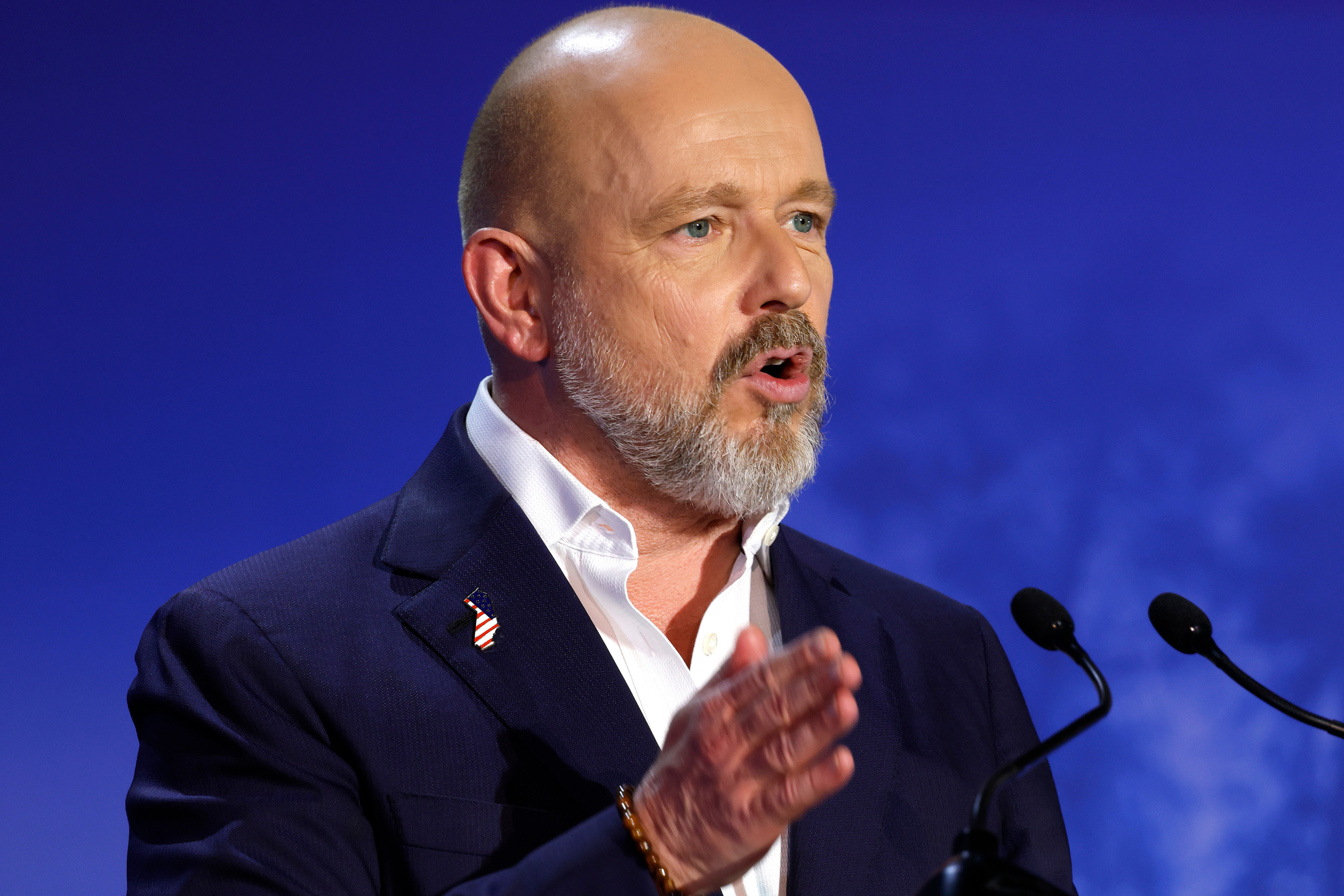
Republican Steve Hilton moved into first place in California’s June 2 gubernatorial primary in a new late-April poll that showed him leading following a major televised debate.
A new SurveyUSA poll conducted April 28–May 1 shows Hilton leading California’s open primary field with 20 percent, a two-point edge over billionaire Democrat Tom Steyer after their first televised debate, which aired on CBS on April 28.
Hilton, who has the backing of President Donald Trump, has consolidated support on the right as the race tightens. Trump’s endorsement has elevated Hilton’s national profile and added fresh attention to a contest where even small polling shifts are beginning to matter more.
“Steve Hilton is leading the field because Californians are ready for real change,” Hector Barajas, communications director for Steve Hilton for Governor, told Newsweek.
“People are tired of the same failed politicians and the same failed excuses, while costs keep rising and families are being pushed out of the state. Steve’s Califordable agenda to lower costs, make communities safer, and build a government that actually works for working people is clearly resonating with voters across California.”
A narrowing field—accelerated by the exits of Eric Swalwell and Betty Yee—is beginning to concentrate support and reshape the race’s top-two dynamics, although Hilton’s rise from 18 percent to 20 percent in the latest poll does not take into account the impact of a subsequent debate on CNN.
Voters in the June 2 primary face a fluid race where debate performance and late movement could reshape which two candidates advance to November.
Newsweek has contacted Steyer’s campaigns for comment.
Why It Matters
California’s top-two primary system means party labels offer no protection, and a fragmented Democratic vote could allow two Republicans to advance in heavily Democratic territory.
With ballots being mailed and debates airing back-to-back, even small movements in polling can have outsized strategic consequences.
What To Know
A new KGTV-TV/SurveyUSA poll conducted April 28–May 1, 2026, shows Hilton at 20 percent and Democrat Steyer at 18 percent, a reversal from the same pollster’s earlier April 8–10 survey, which had Steyer ahead by three points.
That represents a five-point swing toward Hilton in less than three weeks—one of the sharper shifts seen in the race to date—and it came immediately after the first major televised debate, hosted by CBS, and before the second one, hosted by CNN on May 5.
SurveyUSA interviewed 1,415 adults statewide online using a nonprobability panel from April 28 to May 1, identifying 991 likely primary voters for the topline results; responses were weighted to U.S. census benchmarks for demographics including age, gender, ethnicity and education. The poll reports a margin of error of approximately plus or minus 4.2 percentage points for likely voters.
A Fragmented Field Below the Front-Runners
The rest of the field remains fragmented. Republican Chad Bianco places third on 12 percent, up from 8 percent previously, while former Health and Human Services Secretary Xavier Becerra climbs six points to 10 percent.
Democrat Katie Porter holds steady at 8 percent, with San Jose Mayor Matt Mahan at 7 percent, Antonio Villaraigosa at 5 percent and Tony Thurmond at 2 percent.
Seventeen percent of likely voters remain undecided, underscoring how unsettled the race remains even as early ballots are distributed.
Shifting Coalitions and a Volatile Race
Patterns inside the data point to shifting coalitions rather than a uniform surge.
Steyer’s support among independent voters fell sharply—from 24 percent to 11 percent—while Bianco rose notably with that group, from 4 percent to 14 percent.
Among Democrats, Becerra’s support more than doubled, indicating consolidation within part of the party even as the overall vote remains split.
The cost of living continues to dominate voter concerns, cited by 41 percent of respondents—more than three times as many as those choosing the next-highest issue, homelessness—and both Hilton and Steyer drew 22 percent support among those voters, suggesting neither has yet broken decisively on the state’s central economic issue.
What Other Polls Show
Other polling broadly shows a similar competitive but fragmented landscape.
An Emerson College poll conducted April 14–15 among 1,000 likely voters, using a mixed-mode approach of voter file contacts and online panels, found Hilton leading with 17 percent, followed by Steyer and Bianco at 14 percent each; the survey reported a margin of error of plus or minus 3 percentage points.
RealClearPolitics’ polling average, covering surveys from April 14 through May 1, placed Hilton at 18.5 percent and Steyer at 16 percent, a narrower but consistent lead for the Republican candidate.
Taken together, the data suggests a race defined by volatility rather than momentum.
Hilton’s post-debate bump is statistically meaningful but still sits within a crowded and highly competitive field, where multiple candidates remain within striking distance of the second-place cutoff.
With the second major debate hosted by CNN now completed—but no polling yet available to measure its impact—the trajectory seen after the first debate offers a clear signal: televised performances, at this late stage, can still move the numbers.
Update: 05/06/26, 11:28 a.m. ET. This article has been updated with a statement from Steve Hilton’s campaign.
Related Articles