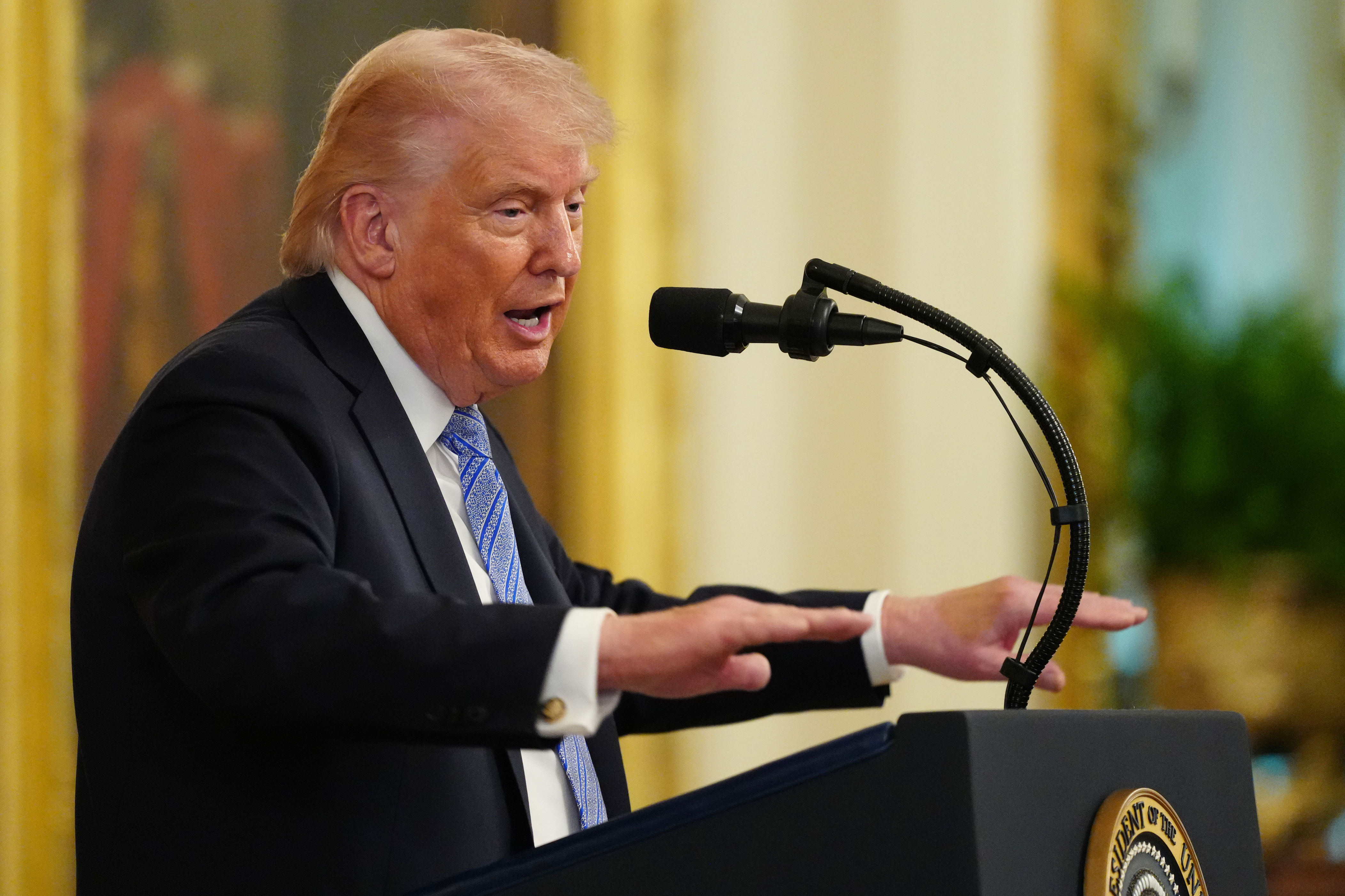
President Donald Trump’s disapproval rating has reached record highs on both the economy and healthcare, according to new national polling and a CNN analysis.
The figures underscore a marked deterioration in approval across two of the most politically decisive issues ahead of the midterms.
Voters, campaigns and candidates now face a reshaped political landscape in which Trump’s core strengths—economic stewardship and populist health messaging—are under growing strain.
Key Points to Know
- Trump’s disapproval has hit record highs on two defining issues—65 percent on healthcare and 70 percent on the economy, according to a CNN analysis and the latest CNN/SSRS poll, respectively.
- Economic approval is now stuck in the low 30s across major polls, with net ratings ranging from -24 to -40, signaling broad-based weakness rather than an outlier result.
- The decline is steep: Trump has swung from positive territory early in his second term to deeply negative ratings, with drops of more than 30 points in multiple surveys.
- Public sentiment has turned decisively negative, with large majorities saying the economy is worsening and costs are rising.
- On healthcare, CNN’s Harry Enten summed up the scale of the problem bluntly, saying that Trump is posting “the highest disapproval for any president this century… a score you don’t want to be winning on.”
Why It Matters
Trump’s 2024 victory rested heavily on promises to restore economic strength and improve affordability.
Sustained declines in approval on both the economy and healthcare threaten to erode a central pillar of his governing coalition at a critical moment in the electoral cycle.
Record Disapproval On Healthcare And MAHA Risks
Speaking on CNN this week, the network’s chief data analyst, Harry Enten, drawing on his own aggregate of polling, described Trump’s standing on healthcare in stark terms.
“Sixty-five percent disapprove of him on healthcare,” Enten said, calling it “the highest for any president this century.” He added that it is “a score you don’t want to be winning on,” placing Trump above previous peaks for Barack Obama and George W. Bush.
The dynamic is unfolding alongside tensions tied to “MAHA”—or “Make America Healthy Again”—the populist health agenda associated with Health and Human Services Secretary Robert F. Kennedy Jr.
The framework blends anti-establishment messaging, particularly around vaccines, with more broadly popular proposals such as removing certain food additives.
But polling suggests the coalition it once helped build is fracturing.
Enten noted that Democrats hold a 16-point advantage on vaccine policy, warning that it is an area where Republicans are politically exposed.
“Democrats crush on this,” he said, arguing that any push to foreground vaccine changes would likely trigger backlash.
He added the administration may need to “tiptoe around it unless they want to take the wrath of the American public,” underlining the political sensitivity of the issue heading into the midterms.
At the same time, Robert F. Kennedy Jr.—once seen as an electoral asset—has seen his own standing deteriorate.
Enten said his net favorability has fallen from positive territory (+8) to around -15 overall and as low as -26 among independents, highlighting a weakening of a previously valuable bloc of support.
Healthcare has long been a difficult issue for presidents—but Trump’s position now sits at the outer edge of that historical range, amplifying the political risk.
Across-The-Board Weakness In Economic Polling
A CNN poll conducted by SSRS from April 30 to May 4, 2026, among 1,499 U.S. adults using a probability-based panel found Trump’s approval on the economy at 30 percent, with 70 percent disapproving—a net rating of -40.
The survey was conducted online and by telephone with a margin of error of ±2.8 percentage points.
That result represents the lowest economic approval recorded for Trump across either of his terms in CNN polling, with the disapproval figure also setting a new high-water mark
Other major national surveys point to the same pattern. A Reuters/Ipsos poll conducted May 8–11 among 1,254 U.S. adults using Ipsos’s KnowledgePanel, with a margin of error of ±2.8 percentage points, found roughly 30 percent approval against 64 percent disapproval, a net rating of -34.
Meanwhile, a YouGov/The Economist poll conducted May 1–4 among 1,573 U.S. adults, with a margin of error of ±3.4 points, recorded 34 percent approval and 58 percent disapproval, for a net rating of -24.
Taken together, as shown in the chart below, approval is clustered in the low 30s, disapproval consistently higher, and net ratings firmly negative across all surveys. The visual pattern points to convergence rather than volatility.
Public Mood Mirrors The Polling Decline
Perceptions of the broader economy have deteriorated in parallel. A YouGov tracker shows a rising share of Americans now say the economy is “getting worse,” reflecting a broader collapse in confidence.
The CNN/SSRS poll reinforces that mood: 77 percent of Americans say Trump’s policies have increased the cost of living in their communities, including a majority of Republicans.
Political Implications Heading Into Midterms
The economic numbers carry particular weight because they strike at the core of Trump’s political appeal.
Polling consistently shows the economy remains voters’ top issue, meaning sustained weakness here has disproportionate electoral consequences.
White House Response
The White House has pushed back, framing the polling as disconnected from the broader mandate of Trump’s 2024 victory.
Spokesman Kush Desai said Trump was “resoundingly re-elected” because he understood voters’ economic concerns, arguing the administration remains focused on tax cuts, deregulation and energy policy to restore growth.
He acknowledged short-term disruption tied to “Operation Epic Fury” but said officials expect inflation to cool and wages to rise as those policies take hold.
Related Articles