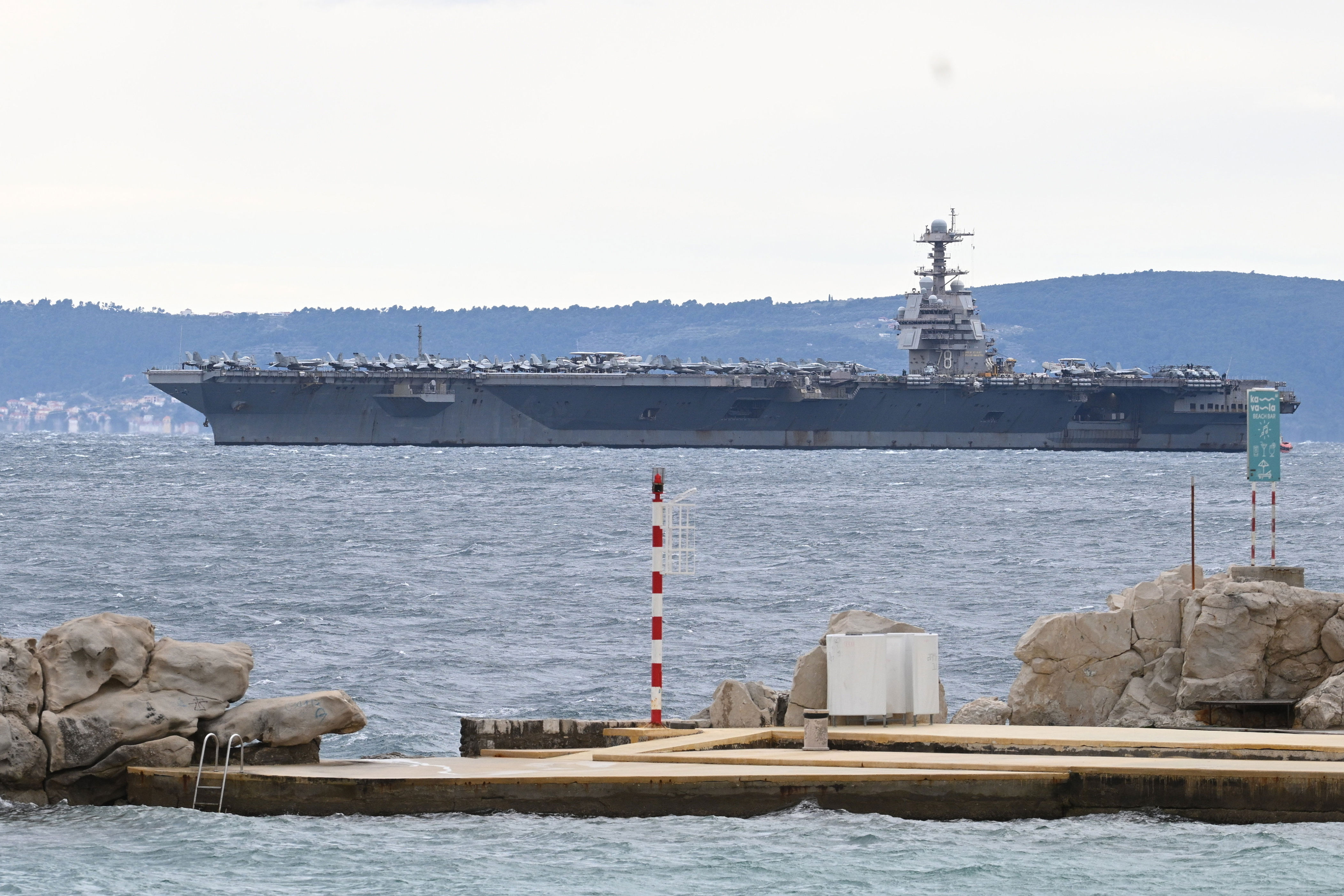
The aircraft carrier USS Gerald R. Ford will depart the Middle East and begin the sail for home in coming days, multiple U.S. officials said, an expected relief for roughly 4,500 sailors who have been deployed for 10 months — but a loss of significant firepower as peace talks between the United States and Iran stagnate.
The Ford is one of three aircraft carriers in the region — the others are the USS George H.W. Bush and the USS Abraham Lincoln — amid hostilities with Iran. While the Ford is in the Red Sea, the Lincoln and Bush are operating in the Arabian Sea to enforce the U.S. blockade targeting vessels carrying oil or goods from Iranian ports.
It was not clear precisely when the Ford would depart the Middle East. One official said that it is probably expected back home in Virginia around mid-May.
As of Wednesday, the Ford had been deployed 309 days — the record for the longest time any modern U.S. aircraft carrier has been at sea, which has worn on the ship. It’s undergone some repairs after sustaining damage in a laundry room fire that injured some sailors, and the ship has had repeated issues with its toilets. Once the ship is back in port, it is expected to undergo extensive repairs and maintenance.
At a congressional hearing Wednesday, multiple lawmakers addressed the ship’s extended deployment, questioning Defense Secretary Pete Hegseth whether the cost to the ship and crew was necessary. Keeping the Ford at sea so long will affect not only its future availability but also the readiness of other warships because the yards that perform their maintenance have limited capacity.
“I worry about the USS Ford,” said Rep. Gil Cisneros,” (D-California). “What trade-offs are we making?”
“A tough decision-making process led to the extension,” Hegseth said, “in consultation with the Navy.”
Typical carrier deployments last six or seven months to keep the ships on their maintenance schedules.
The Ford, the Navy’s newest carrier, left port at Naval Station Norfolk on June 24 to sail for Europe. It was later directed by the Trump administration to sail back across the Atlantic to the Caribbean, where it assisted in the U.S. blockade of Venezuela’s oil exports and the January capture of President Nicolás Maduro.
Its deployment was then extended, and the carrier was sent to the Middle East to support U.S. war operations against Iran.
The Navy has had a sizable role in the Venezuela and Iran operations, sending more than a dozen warships to both theaters. In the Arabian Sea, the Navy has turned back 39 vessels — in some cases boarding and seizing them — to prevent them from transporting oil or cargo that benefits Iran. On Tuesday, U.S. forces boarded another ship, the M/V Blue Star, and let it go after inspection.
The blockade at present is the main source of military pressure the U.S. is exerting on Iran as the Trump administration seeks to force Tehran to reopen the Strait of Hormuz and abandon its nuclear program.
Noah Robertson contributed to this report.
Most Read From The Washington Post
- ‘It’s not okay to steal a charity’: Musk testifies in trial over AI’s future
- See which jobs are most threatened by AI and who may be able to adapt
- The man turning the Pentagon into a venture capital firm
- He made a fake ICE deportation tip line. Then a kindergarten teacher called.
- The unflattering secrets revealed so far in Elon Musk’s latest legal feud