
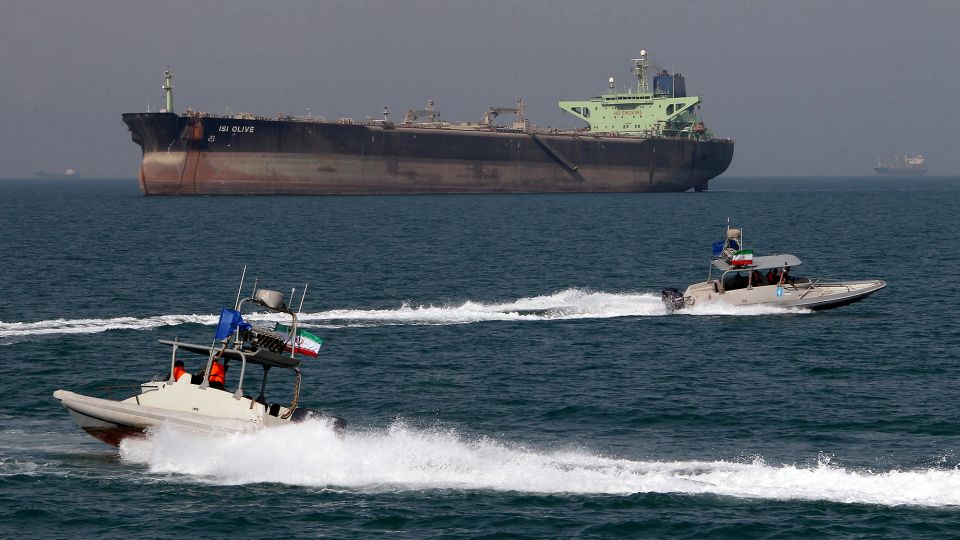
Iran’s conventional navy warships might be largely destroyed, but analysts say that’s never where its true sea power lay.
The country’s ability to credibly threaten commercial ships passing through the Strait of Hormuz actually hinges on multiple layers of cheap and unconventional warfare systems – drones, mines and a fleet of small attack boats, which are harder to detect than traditional naval assets.
Dubbed the “mosquito fleet” by military analysts, these small vessels deployed by the Islamic Revolutionary Guards Corps (IRGC), and crucially the missiles, guns and other weapons those boats can deploy, present a huge strategic challenge to the United States military as it attempts to mitigate threats across a huge area of sea.
It’s essentially guerrilla warfare on the water, with the geography also favoring Iran as there is no alternative route for ships needing to pass through the narrow Strait of Hormuz chokepoint.
“The number of vessels that would be required to provide area defense for commercial shipping, which is ultimately what this is about, would be quite significant,” said Sidharth Kaushal, a senior research fellow on sea power at the Royal United Services Institute for Defence (RUSI) think tank. “And of course, that can prove immensely resource intensive.”
The IRGC’s use of small boats goes back decades, particularly after the US military proved it could decimate Iran’s traditional navy during operations in the Persian Gulf in 1988. Since then, “the regular Iranian Navy was always something of a parade ground force, whereas the IRGC’s Navy, which was built around asymmetrical assets that the Iranians thought would actually be useful in a war… was always the more strategically important asset,” Kaushal said.
These small skeleton-crew vessels and drone boats are “quite low profile” because of how close to the water line they are, the analyst said, so radar systems often end up detecting them too late. To effectively track those threats, the US needs to deploy assets like helicopters and drones.
The IRGC Navy also deploys repurposed civilian vessels, like fishing dhows, for covert activities like minelaying, adding complexity to any monitoring operation, according to a report from the DC-based Hudson Institute.
“This overall architecture is designed to impose friction and attrition rather than to seek or win a decisive naval engagement,” the Hudson Institute noted.
“The IRGCN (Navy) designs and manufactures its vessels to remain affordable, evade sanctions, and be easily replaceable in wartime,” the report said. That approach allows Iran to imperil other countries’ vessels “at a relatively low cost while placing an adversary’s high-value assets – and the global maritime economy – at risk.”
Some of Iran’s asymmetric threats, like the mines themselves and so-called ‘midget submarines,’ are more straightforward for the US Navy to combat. Those small ‘midget’ subs tend to operate out of well-known Iranian ports, making them easier for the US to target if it chooses to, Kaushal said.
Plus, the US has unmanned undersea vehicles that it can deploy to scan the sea floor and identify mines, said Bryan Clark, a senior fellow at the Hudson Institute, in an interview with CNN. But identifying an entire shipping route that is safe from mines is a painstaking process that takes time.
Meanwhile, Iran’s multi-layered strategy also means the US Navy has to guard against anti-ship missile launchers, which are hidden throughout hundreds of miles of rocky, mountainous terrain on the country’s southern coast. Those missile batteries are mobile, making them harder to eliminate, analysts say, and the long Gulf coastline means that Iran can attack well beyond the strait itself.
“It’s that kind of mix (of capabilities) and complexity which provides a significant degree of problems,” said Nick Childs, senior fellow for maritime security at the International Institute for Strategic Studies. He said the problem a mosquito fleet poses to the US military and commercial vessels is that “you can never be quite sure and absolutely certain that something might not get through.”
“The attacks that we have seen that have actually done damage to shipping recently tended to be missiles, perhaps the ‘suicide’ drones as well. But the thing that preys on people’s minds has been the naval mines and the fast-attack craft,” Childs said.
Twenty-six vessels in the Strait of Hormuz and the Persian Gulf have been attacked by Iran since the war began, according to the latest data from the United Kingdom Maritime Trade Operations Centre (UKMTO).
“The other factor is that the Iranians, at a more strategic level, don’t actually have to score a lot of hits. They only have to score enough hits on shipping to convince insurers and ship owners that they don’t want to risk both the lives of crewmen and cargo,” Kaushal added. “So in some ways, the ask for the US Navy is considerably higher than that for the Iranians.”
President Donald Trump said on Tuesday that the US will pause its short-lived effort to “guide” vessels through the Strait of Hormuz but will maintain its blockade of Iranian ports. Two US-flagged merchant ships passed through the strait as American forces took out Iranian threats, US Central Command said in a statement on Monday, but there was little sign of any meaningful boost to overall shipping traffic through the strait.
Iranian state media characterized the move to pause the operation as a “US failure.”
Meanwhile, this week, Iran launched a new regulatory body to govern traffic through the strait, as part of its plan to impose hefty tolls for safe passage. The US Treasury Department released an advisory on May 1 indicating that shipping companies could face sanctions if they choose to pay tolls to the Iranian regime.
Iran and the US once again traded fire on Thursday despite the ceasefire. Trump said that American forces destroyed Iranian attackers targeting three US Navy destroyers as they transited through the strait, warning that “we’ll knock them out a lot harder, and a lot more violently” if Iran doesn’t sign a deal soon.
CNN’s Henry Zeris, Alejandra Jaramillo and Aileen Graef contributed to this report.
For more CNN news and newsletters create an account at CNN.com