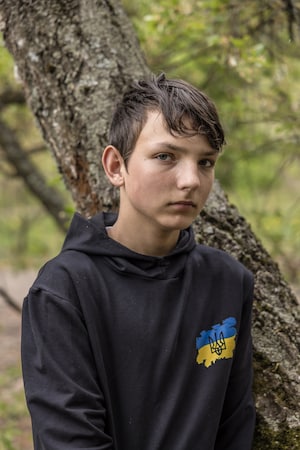
CHERNIHIV, Ukraine — On a cool evening last month, 12-year-old Anatolii Prokhorenko was up in a pear tree, cutting off a damaged branch for a neighbor, when he heard the buzz of a drone.
That sound often means death in Ukraine, and not just for soldiers on the front lines. Increasingly, civilians are tracked, chased and attacked by small, commercially available drones equipped with cameras, rigged with explosives and steered by fingers-on-joysticks a dozen miles away.
Ukrainians, darkly, have dubbed this Xbox-inflected hunting of civilians as Russia’s “human safari” — a terror campaign that started in the once-occupied southern city of Kherson. In recent months, it has evolved with new technology and spread to border areas around the country.
Anatolii knew it had recently reached the small farming village where he and his family live in Ukraine’s northern Chernihiv region, seven miles from the Russian border. Tractors, like the one his father frequently drove, had been hit in the fields. In March, a drone blew up a car next to a shop. Another had exploded on Anatolii’s street just the day before.
Now, the one he spotted was heading right for his house.
As he clung to the tree trunk, the black quadcopter buzzed past, flying just off the ground and bearing down on a cluster of buildings where three of his younger siblings were playing with other kids in their yard.
He watched as unseen eyes seemed to zero in on the structures and the drone began to climb, apparently rearing to strike.
“It saw the children and started gaining altitude,” Anatolii said. “That’s when I realized something was about to happen.”
What Anatolii did next — something he had rehearsed, something few civilians in Ukraine have been taught — might have saved the lives of those children, his mother changing a diaper inside or other neighbors on the block.
His story — and the fact that a 12-year-old in a pear tree knows how to fight back against a Russian drone — illustrates how deeply a tactic that the United Nations calls a war crime has dissolved the line between soldier and civilian in the fifth year of Russia’s war.
Within drone range of Russian territory, survival itself has become a military skill.
“It’s a really horrible problem the Russians are imposing on Ukrainian civilians in these towns where they’re using the human safari tactic,” said Robert Tollast, a military sciences researcher at the Royal United Services Institute in London.
The attacks demoralize by design. And they force Ukrainian commanders to spread their drone defenses — which range from jamming signals to covering whole highways with netting to skeet shooting them from the sky with shotguns or machine guns — ever thinner, Tollast said.
The drone hunts started two years ago in Kherson, when Russians just across the Dnieper River began deploying cheap commercial first-person view (FPV) quadcopters to stalk and strike civilians going about their days — biking to work, waiting at bus stops, walking their dogs.
A drone dropped an explosive on a man riding a moped in November 2024, and then dropped another on the ambulance that came to help him.
By April 2025, the attacks were killing 42 civilians a month and injuring nearly 300, according to report by an independent U.N. human rights commission.
Investigators determined that the campaign was ordered by Moscow to systematically terrorize the populace and amounted to “murder as a crime against humanity.”
Ukraine’s first response was jamming — flooding the frequencies the drones depend on with empty radio noise. For a time, it helped.
But Russia’s answer was to equip drones with fiber-optic filament: a hair-thin tether that unspools in flight like a spiderweb for 12 miles — or twice that with smaller payloads — carrying video to the operator and commands back. Bypassing radio signals entirely, these drones can’t be jammed.
Adapting an off-the-shelf FPV drone to fiber-optic controls is a cheap and effective hack, Tollast said. Although the filament can tangle or break as it’s draped across miles of countryside, units often deploy two or three drones on each mission to provide backup and better targeting reconnaissance.
The advantages of the physical connection are huge, Tollast said, and both armies increasingly use them for a range of battlefield missions. Not only are they immune to jamming, they don’t lose signal at longer distances or behind barriers the way line-of-sight radio controls do.
Russia deployed the technology at scale in its push to expel Ukrainian soldiers from Russia’s Kursk territory in late 2024 and 2025, using the unjammable devices to collapse Ukraine’s supply lines. At the time, Russia enjoyed a huge advantage in fiber-optic drone production, making roughly 50,000 per month to Ukraine’s 20,000.
But Ukraine is catching up, and last year used long-range strikes to knock out Russia’s only domestic fiber-optic factory in Saransk, leaving the Russians dependent on Chinese imports. Both sides are dealing with rising costs of the hair-thin cable as more of it is gobbled up by the global boom in AI data centers.
That hasn’t stopped Russia from adapting the same technology for attacks on civilians in border areas, according to Ukrainian officials, the U.N. and locals who increasingly find the superfine filaments draped across streets and houses far from the front lines.
Anatolii and his father, Volodymyr Poltoratskyi, 49, had started noticing the glinting gossamer threads a few months earlier.
“In winter, it’s actually beautiful in its own way,” Poltoratskyi said. “They hang across the road and on the trees like garlands, and frost forms on them.”
One day in autumn, as father and son were cutting firewood in a nearby forest, Anatolii saw a soldier they knew handling some of the filaments. The boy asked what he was doing.
The soldier — an explosives specialist who goes by the call sign “Dynamo” — showed him how the fiber-optic material, like a fishing line, was almost impossible to pull apart without slicing the skin. Then he demonstrated three techniques the soldiers had found to break it, a combination of loops and pinches. Best to count to 15 after a drone passes before trying it, Dynamo had said, so you’re out of the drone’s view and don’t become the target.
It was a brief encounter to sate a boy’s curiosity. Father and son went back to loading wood on the tractor.
The drones kept coming. Russia had learned that the fiber-optic FPVs — which can stay low and fly behind hills, always connected and sending back clear video — were adept hunters, especially of unsuspecting civilians.
“They are very good at creeping up on their targets,” Tollast said.
Which is why when Anatolii heard the buzz from his tree, he looked up and saw nothing. It was below him, just a few feet above the ground.
And he saw something else, glinting in the low evening sun: the very fine fiber-optic contrail behind it.
As the drone moved toward his family, Anatolii dropped to the ground. He ran 20 yards and got his fingers around a hairlike umbilical running all the way to Russia. He made a loop, pulled it slightly, and remembered the soldier’s instruction: Count to 15.
“I didn’t have time,” he said. “So I counted to 10 and I broke it.”
The line snapped. The drone abruptly veered upward, banked away from the children and the houses, and spiraled into a section of wild ground next to the neighborhood.
“I waited for an explosion, but there was nothing,” Anatolii said. He wondered if it landed on its back. Later, he would learn that it crashed in a dense, swampy thicket.
Civil authorities came and poked around but didn’t recover it and warned the civilians not to get close. Soldiers said they might try to salvage the camera, which can be reused. But for now, it is buried in the swamp and Anatolii’s only souvenir of the drone he defeated is a small skein of the fine white filament that was his weapon.
“How can a civilian person, especially a child, do something like that?” Dynamo, the soldier who took a moment to teach a boy a military trick no kid should ever have to know, told The Washington Post. “Not every soldier would have been able to react in a split second like that.”
Anatolii was feted as a hero in Ukraine, but more as a target by commenters on Russian Telegram channels, so his family of seven have moved for now to a borrowed two-room apartment in Chernihiv, the regional capital, two hours south.
They travel back and forth to tend their potato crop and still find fiber-optic tracks. One of their neighbors, a 47-year-old woman, was injured Sunday when a drone struck her car.
These high-tech hunters, the family knows, are now a regular part of rural life — and death.
Most Read From The Washington Post
- China gains major edge on U.S. amid Iran war, intelligence report finds
- DOJ lawsuit escalates fight over discipline for Trump administration attorneys
- Pentagon abruptly cancels troop deployment to Europe amid frustrations with NATO
- Effort to halt Iran war stalls in House despite rising GOP frustration
- CIA director travels to Cuba as fuel reserves hit zero