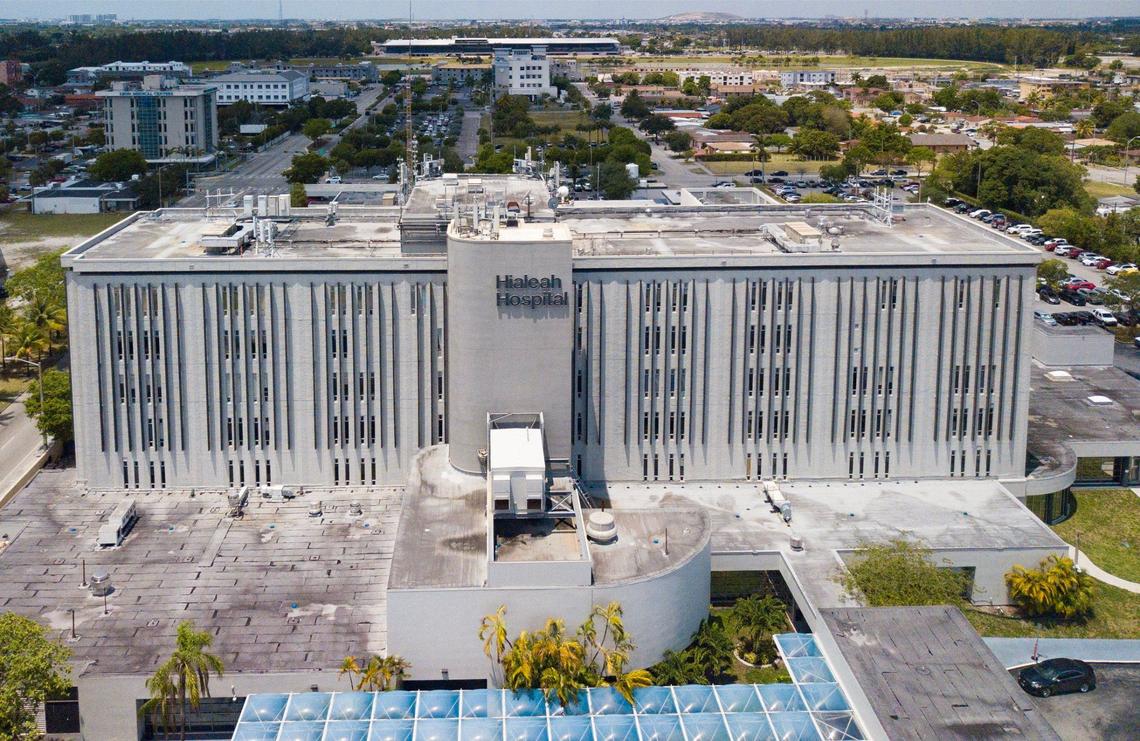
Hialeah has a hole in its finances that the new mayor is now uncovering, stemming from a long-running problem that remained largely hidden from the City Council for years.
Since taking office in January, Mayor Bryan Calvo has begun confronting what high-ranking city hall officials had long treated as a quiet but growing financial problem within the Public Works Department: millions of dollars in uncollected water and sewer bills tied to two of Hialeah’s major hospitals, as well as businesses and condominium associations.
That bill accumulated over several administrations and were not disclosed to the City Council.
The Public Works Department, which oversees the city’s water and sewer system, is carrying about $4.5 million in uncollected payments, including a combined debt from Palmetto General Hospital and Hialeah Hospital that has grown to roughly $3 million, according to city records obtained by the Miami Herald.
Calvo is taking an aggressive stance in seeking to collect outstanding balances from the debtors, including the hospitals, arguing that the city cannot continue allowing large private institutions to accumulate unpaid debt while enforcing strict payment rules on residents.
“How can I tell a senior resident living alone on a fixed income that if they don’t pay their water bill, service will be shut off, while at the same time allowing a for-profit hospital to accumulate millions in unpaid bills?” Calvo said. “Small number of violators are currently creating a $4 million problem.”
Broader utility debt
According to a report from the Public Works Department obtained by the Herald, on top of the hospitals’ outstanding balances there are nearly $1.2 million in unpaid bills tied to residential buildings. The largest delinquent account in this group is the Village of Hialeah Condo on 12th Avenue, with more than $362,000 outstanding, making it the highest non-hospital debtor.
Other residential accounts with unpaid water bills, according to the city records, include:
- El Paraíso at Hialeah Condo Association on 76th Street, with more than $281,000 in outstanding debt.
- Westland Eden Condominium, with more than $118,000.
- Villa Catalina, with more than $98,000.
- Westland Plaza Gardens Condominium, with more than $69,000.
- Bella Luna Condo Association on 24th Street, with more than $50,000.
- Flamingo Apartments on 4th Avenue, with an unpaid balance of $41,000.
- Bonterra Community Development District, with an unpaid balance of $39,000, located in the newer development area of Hialeah near the west Interstate 75 corridor.
- Imperial Terrace Condo on 44th Place, with an overdue balance of $34,000.
All the accounts listed are more than 120 days past due, yet the records show the city has not disconnected water service to those properties. Hialeah standard protocol for overdue water accounts is to send notices requesting payment. If balances remain unpaid for 120 days, the city can shut off water service when legally permitted or when authorized by the mayor’s office.
The remaining more than $349,000 in unpaid water bills are tied to various LLC business accounts. Among them is Thumberlina Academy, which owes $105,000. Public records show the account was placed on a 24-month payment plan established in March.
Calvo told the Herald that as the city has contacted the hospitals, officials also sent letters to condominium associations, individual unit owners, and LLCs to make them aware of the situation.
The city issued formal notices in April and set a May 17 deadline for a payment agreement. If no deal is reached, officials say enforcement actions could include liens on properties, legal action, andr, if necessary, service restrictions such as cutting off some or all water, including the hospitals.
While he was not mayor when the bills accumulated, Calvo said the city may have treated larger customers differently.
“I wasn’t here, but we were treating bigger customers a little differently than we were treating residential customers - residential customers are put feet to the fire,” Calvo said. “But these condominiums and hospitals were being treated a lot more gently, and obviously it’s created a huge financial issue in the department.”
Lack of transparency
The disclosure has prompted broader questions among City Council members about how the city’s finances were managed and whether elected officials had a full picture of the growing debt while city budgets were being approved.
Four of the seven current council members who served during the administrations of mayors Esteban Bovo and Jacqueline García-Roves said they only became aware of the outstanding balances after being contacted by a Herald reporter, raising concerns about how the issue remained outside the council’s regular oversight.
Calvo, himself a former council member during Bovo’s term, said he only learned of the debt after requesting an audit of the department.
Councilwoman Melinda De La Vega, who has served as a city official since 2024, said she was surprised the matter had never been brought before the council and called it a major failure.
“This raises serious concerns about oversight, transparency and communication,” De La Vega said. “My focus now is on getting a full accounting of how this occurred and working with all parties to implement responsible solutions that protect our residents and our infrastructure.”
Council President Carl Zogby, who is in his ninth year as an elected official, said the problem appeared to have been deprioritized for years and not properly disclosed to the council. He said the handling of the issue pointed to a lack of transparency from Bovo’s leadership.
“It wasn’t a priority - maybe apathy on their part - and there was little to no effort to explainto the council what was happening,” Zogby said. “Despite all [Bovo’s administration] talked about transparency, there was no transparency at all.”
Councilwoman Monica Perez, who is in her seventh year as an elected official, placed some blame on the city’s Public Works Department, suggesting Bovo may not have been aware of the mounting debt - or may not have considered it a priority.
“Maybe it was something they were not aware of. Maybe they weren’t informed - I assume that was the reason we weren’t told,” Perez said. “Maybe it wasn’t a priority for them, and this administration [Calvo’s] took a different route to collect certain funds.”
But records show a different scenario.
Documents reviewed by the Herald show that in January 2025, officials across the city’s legal department, Public Works, finance and accounting offices, as well as the mayor’s office - including the chief operating officer at the time and representatives of the hospitals’ owners - were discussing how to address the growing debt, indicating that multiple departments were aware of the uncollected balances.
Mounting hospital debt
One of the records reviewed by the Herald is an email from Karl Holzenberg, director of Public Works Finance and Budget, dated January 2025, during the Bovo administration. The email states that Tenet Healthcare, which has previously owned both hospitals, carried a “small” outstanding balance of $115,000.
Tenet sold the hospitals in August 2021 to Steward Health Care, when Carlos Hernández was mayor. Over the following years, the debt grew to about $1.6 million across two hospital ownerships during Bovo’s administration, and continued piling up during García-Roves’s nine-month interim administration.
Legal experts argue that collection of Tenet’s debt, which dates back at least to 2021, may be barred under Florida’s five-year statute of limitations for written contracts. The city may have lost its opportunity to collect the funds last year.
By the time the hospitals filed for bankruptcy under Steward Health Care in May 2024, they were already delinquent on water and sewer bills owed to Hialeah. Records show Steward’s water bill payments were sporadic in 2023, with only one payment made in 2024, months before the health care giant filed for bankruptcy.
Tenet and Steward Health Care did not respond to the Herald requests for comment.
Holzenberg also noted that Healthcare Systems of America, which had assumed operations of the hospitals when he sent the email in January 2025, carried a balance of $215,000. Since then, the debt has climbed to more than $2.3 million, spanning prior administrations, without public disclosure until Calvo ordered an audit.
In an emailed statement to the Herald, Healthcare Systems said it had not paid Hialeah because the city wanted to charge it for Steward’s overdue payments.
“HSA has tried to make water payments. However, the City stated that they will apply payments from HSA to the previous Steward invoices. This is not an acceptable option as HSA is not responsible for Steward’s payments per the Steward bankruptcy court,” HSA said. “Additionally, HSA has been requesting its own water account from the City for more than a year. However, the City has continued to insist that HSA pay the old water bill from Steward. HSA is again asking the City to please send the HSA water bill under the HSA water account so that HSA can pay its water bill. HSA looks forward to quickly resolving this issue with the City.”
No one has been able to fully explain why it took the city so long to identify that the hospitals were behind on their bills. The Public Works Department, which manages about 30% of the city’s budget, has long been viewed by some former mayors, including Bovo, as a “piggy bank” used to help balance city finances when needed.
Under Bovo’s administration, the department also underwent a transition after the ublic Works director at the time, Armando Vidal-widely regarded as a de facto city manager and one of the most influential figures in the administration-retired in 2023. Former officials from the Bovo administration told the Herald it took them three years to fully establish oversight of the department, describing it as previously operating “autonomously.”
Bovo did not respond to the Herald’s request for comment. The Herald has been unable to contact Vidal, whose last known phone number is disconnected.
Although the uncollected debt represents a small fraction of the city’s roughly $350 million in annual water and sewer billing, it has taken on greater significance in Hialeah, long described by former finance officials as a “poor city”. Over the past decade, the city also imposed a franchise fee on water bills-starting at 10%, later reduced to 4%, and eliminated last year-in an effort to help support the Public Works Department. Against that backdrop, the growing level of unpaid accounts has become a significant fiscal concern.
“We need to prevent this from happening again,” Calvo said. “It’s about establishing a clear process, that’s something the water department should be able to handle in-house - send a notice, make a call, or contact the account holder.”