When you think about classic Ford muscle cars, it’s hard to ignore the Mustang. It’s certainly a popular option that remains a staple in the brand’s lineup today. However, when the Mustang made its debut in 1964, it wasn't alone. Ford actually had multiple irons in the fire, and some models just happened to be more popular than others.
While the Mustang was a sports car designed for smaller families, Ford was also building options for the drag strip and NASCAR. It was an affordable option for those wanting a high-performance personal vehicle. As a result, a few other key muscle cars of the era seemed to disappear in its shadow. For example, Ford built a street car that packs a wallop with 425 horsepower that still flies under the radar. An iconic engine sets it apart from the competition and allows it to keep up with other racing-oriented models such as the Mustang Shelby. There are multiple reasons why enthusiasts are still hunting it down.
Ford Had A Muscle Car Obsession In The 1960s
While you shouldn't let the 1964 Ford Mustang take up the entire muscle car spotlight of the 1960s, it is a key model. It inspired combining potent V8 engines with compact bodies. The available 4.3-liter V8 engine pumps out 164 hp and 258 lb-ft of torque, but the 4.7-liter V8 engine delivers 210 hp and 300 lb-ft However, the V8 K-Code cranks out 271 hp.
Another example of '60s Ford muscle is the 1964 Ford Fairlane Thunderbolt, a classic race car. It features a 7-liter FE-Series Big Block V8 engine with an official rating of 425 hp and 480 lb-ft of torque. However, many people believe that it actually delivered between 500 and 600 hp as a model specifically designed for drag racing.
Later, the 1968 Ford Torino Cobra Jet made its debut with the intended purpose of dominating NHRA stock racing. The renowned 428 cubic-inch 7.0-liter Cobra Jet V8 engine produces between 335 and over 400 hp. It’s often referred to as the Mustang’s more muscular brother with more luxurious features. But in that same era, there was another muscle car specifically designed to conquer NASCAR that, seems to be so far, almost no one remembers. While the Mustang, Fairlane Thunderbolt, and Torino are great classics, don't let this 425-hp slip by unnoticed.
The 1964 Ford Galaxie 500 R-Code Shouldn’t Be Forgotten
The Ford Galaxie made its debut in 1959, but it was taken to the height of the horsepower wars when the 1964 Ford Galaxie 500 R-Code model arrived to outpace the competition. However, this muscle car is so rare that it can easily be overlooked. While 920,000 full-size Galaxie models were produced in 1964, fewer than 1,000 models with the R-code engine were built. This is an ultra-rare muscle car with debated production numbers due to lost records. It’s possible that very few models survived, as there are only 76 R-Code Galaxie models known to exist on the official registry today. If you magically happen to stumble across one, expect to pay between $60,000 to $120,000 to take it home.
Unfortunately, this car was a racing-only option, designed to dominate NASCAR and drag strips, while the Ford Mustang and other options were more practical for families and daily driving. It was discontinued quite early due to its lack of sustainability, weak fuel economy of eight miles per gallon, and high production costs.
Under The Hood Of The 1964 Ford Galaxie 500 R-Code
The 1964 Ford Galaxie 500 R-Code features a 427 cubic-inch 7.8-liter V8 engine with 425 hp and 480 lb-ft of torque at 3,700 RPM. Although some argue that it provides more power. Plus, the engine has dual four-barrel carburetors, a 10.9:1 compression ratio, and mechanical lifters, making it an early icon for drag racing and NASCAR.
The 427 R-Code engine is typically paired with a four-speed manual transmission, but an automatic transmission was also available. It can accelerate from 0 to 60 mph in about 5.8 seconds with the ability to cover a quarter mile in under 14 seconds. Plus, it has a top speed of 140 mph, which is phenomenal for the time.
It didn’t feature power steering or air conditioning to enhance its racing performance. Plus, it has cast-iron header-style exhaust manifolds, an independent front suspension with heavy-duty coil springs, tubular shock absorbers, and an anti-sway bar. Also, it often had heavy-duty drum brakes, but restored models may benefit from feature disc brake upgrades.
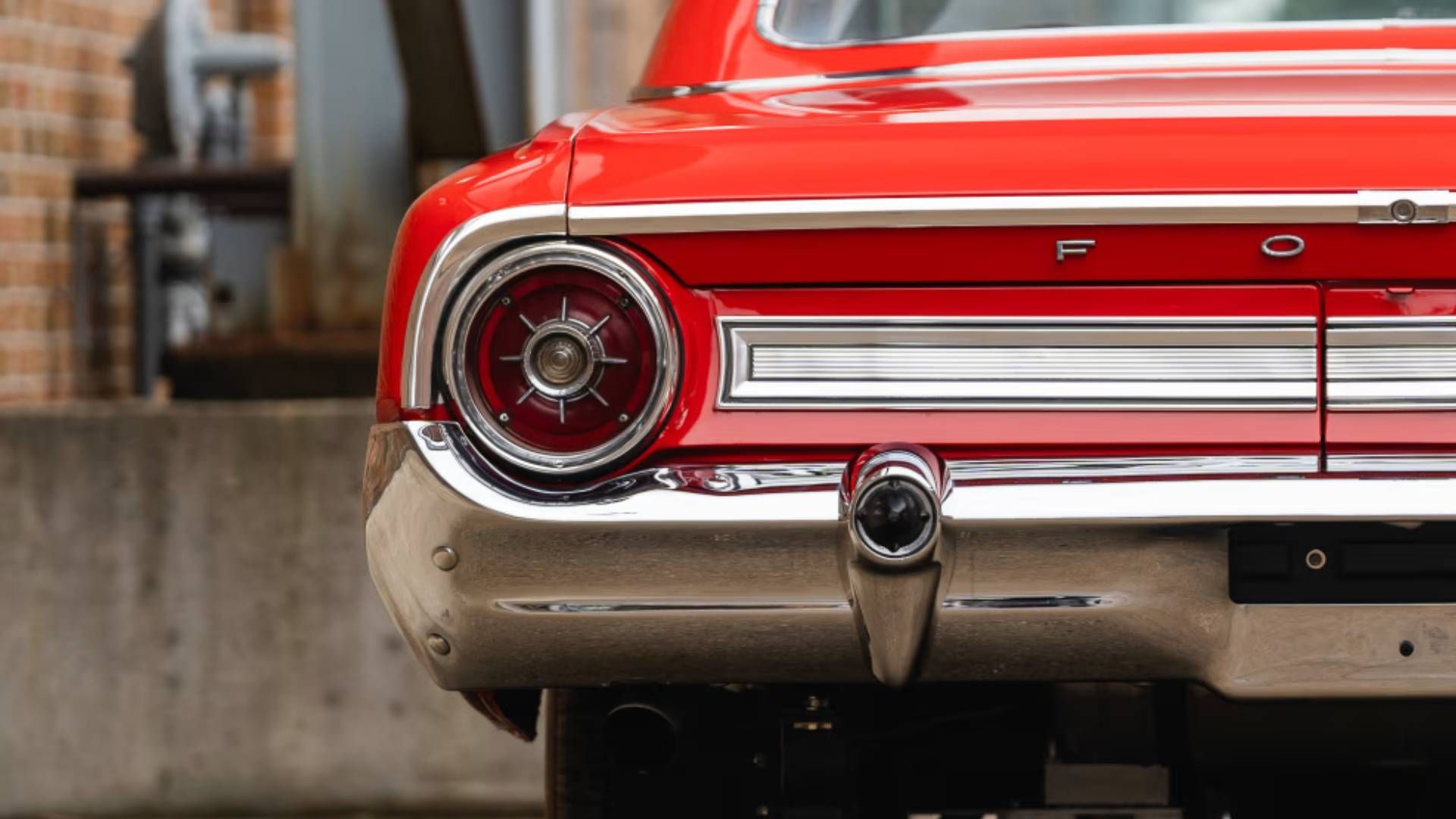
Exterior features include an aerodynamic fastback design, and the 500 lightweight model is paired with a fiberglass hood with a massive scoop and a lightweight chassis. A horizontal grille with three vertical ribs, stacked quad headlights, circular taillights, and chrome trim on the sides sets it apart with a unique style.
The Galaxie 500 R-Code Left Its Mark On NASCAR
You can thank the 1964 Ford Galaxie 500 R-Code for shaping NASCAR’s focus on aerodynamic styling to improve speed and performance. The fastback roofline improves high-speed stability and reduces drag. It convinced automakers that specific body shapes are necessary to win.
Plus, the Galaxie R-Code prompted the use of high-performance large-displacement engines and influenced the development of even more powerful engines. At the time, NASCAR teams were using racing production machinery that was readily available to the public. I bet plenty of folks still wish this was the case today.
With unmatched durability, the Galaxie R-Code proved itself as a dominant workhorse, especially in high-banked, long-distance racing. Best of all, the Galaxie is a true winner. It secured 30 Grand National races in 1964, allowing Ford to win the Manufacturer’s Award of Excellence that season.
It’s considered to be the high point of Ford’s historical ‘Total Performance’ era with its “Win on Sunday, Sell on Monday” philosophy. People could go to the dealership and leave with a race car featuring a NASCAR level of performance. It was simply a wild and innovative time worth remembering.
Source: Aldan American, Auto Evolution, Fastest Laps, Bring a Trailer