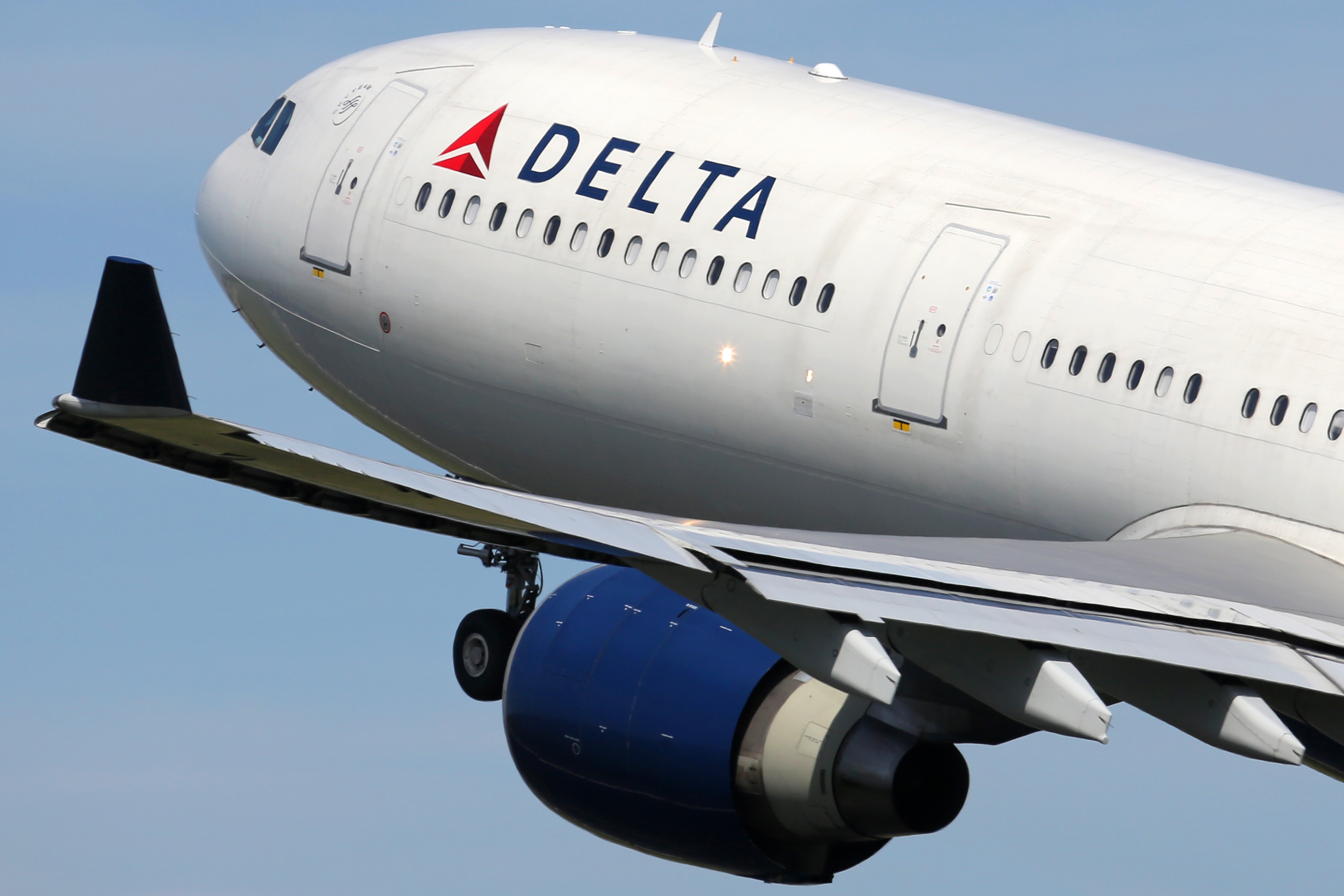
Delta is set to overhaul its in-flight service model beginning May 19, eliminating beverage service on hundreds of shorter routes while expanding full offerings on longer ones—a shift that has sparked debate among travelers online.
The change, first highlighted in a popular post on X, formerly Twitter, by aviation insider JonNYC, will impact economy passengers flying in Delta Main Cabin and Delta Comfort.
Under the new structure, flights of 350 miles or more will receive full beverage and snack service, while routes under 349 miles will no longer offer any in-flight service at all. All of the flights that are transitioning have under one hour of flight time in the air.
The adjustment effectively removes Delta’s “Express” beverage option, which previously covered mid-range flights and offered limited drinks like coffee, tea and water.
Instead, the airline is simplifying service tiers, a move that will upgrade roughly 600 daily flights to full service while cutting offerings on about 450 others.
‘A more consistent experience’
“Delta is adjusting onboard beverage service to create a more consistent experience across our network,” a Delta representative told Newsweek.
“Customers traveling in Delta Comfort and Delta Main on flights 350 miles and above will now receive full beverage and snack service, while shorter flights will no longer offer food and beverage service—with the exception of Delta First which always receives full service.
“Even on the small number of flights without beverage service, our crew will continue to be visible, available and focused on caring for our customers, like they do on every flight.”
The shift comes amid broader changes across the airline industry following the abrupt shutdown of Spirit Airlines.
“It is with great disappointment that on May 2, 2026, Spirit Airlines started an orderly wind-down of our operations, effective immediately,” the carrier said in a statement reported by Newsweek.
“All flights have been cancelled and customer service is no longer available.”
Spirit’s closure has intensified competition among legacy carriers like Delta, with some air travelers linking the service cuts to reduced pressure from low-cost rivals.
“Every time an airline dies, the legacy carriers take away a perk,” a critic remarked on Reddit.
Others pointed to how much air travel has changed over time.
“Sadly remembering how, 50 years ago, a two-hour flight came with full meal service,” a contributor lamented.
Some commentators are frustrated by the complete removal of service on shorter routes—many of which connect major cities. Others see benefits in the simplification, especially on slightly longer flights that will now receive full service instead of the limited “Express” option.
“Farewell SunChips and water, you saved so many travelers from starvation,” one Reddit pundit quipped.
Another individual tied the changes directly to recent industry turbulence: “Damn. Spirit ain’t been down for a full day.”
Logistical Challenges
Industry observers note that short flights often present logistical challenges for crews, especially when turbulence or tight schedules limit the time available for service. By eliminating service on the shortest routes, airlines can streamline operations while focusing resources on flights where full service is more feasible.
At the same time, Delta’s move aligns with a broader recalibration across the aviation sector.
Spirit CEO Dave Davis said in comments reported Newsweek that, “the sudden and sustained rise in fuel prices in recent weeks ultimately has left us with no alternative but to pursue an orderly wind-down of the company,” highlighting the financial pressures shaping airline decisions across the industry.
For passengers, the changes will depend largely on route length. A flight just over 350 miles may now offer a more robust experience, while one slightly shorter could have no service at all—an outcome that continues to fuel discussion among frequent flyers ahead of the rollout later this month.
Newsweek has reached out to xJonNYC for comment via X.
Related Articles