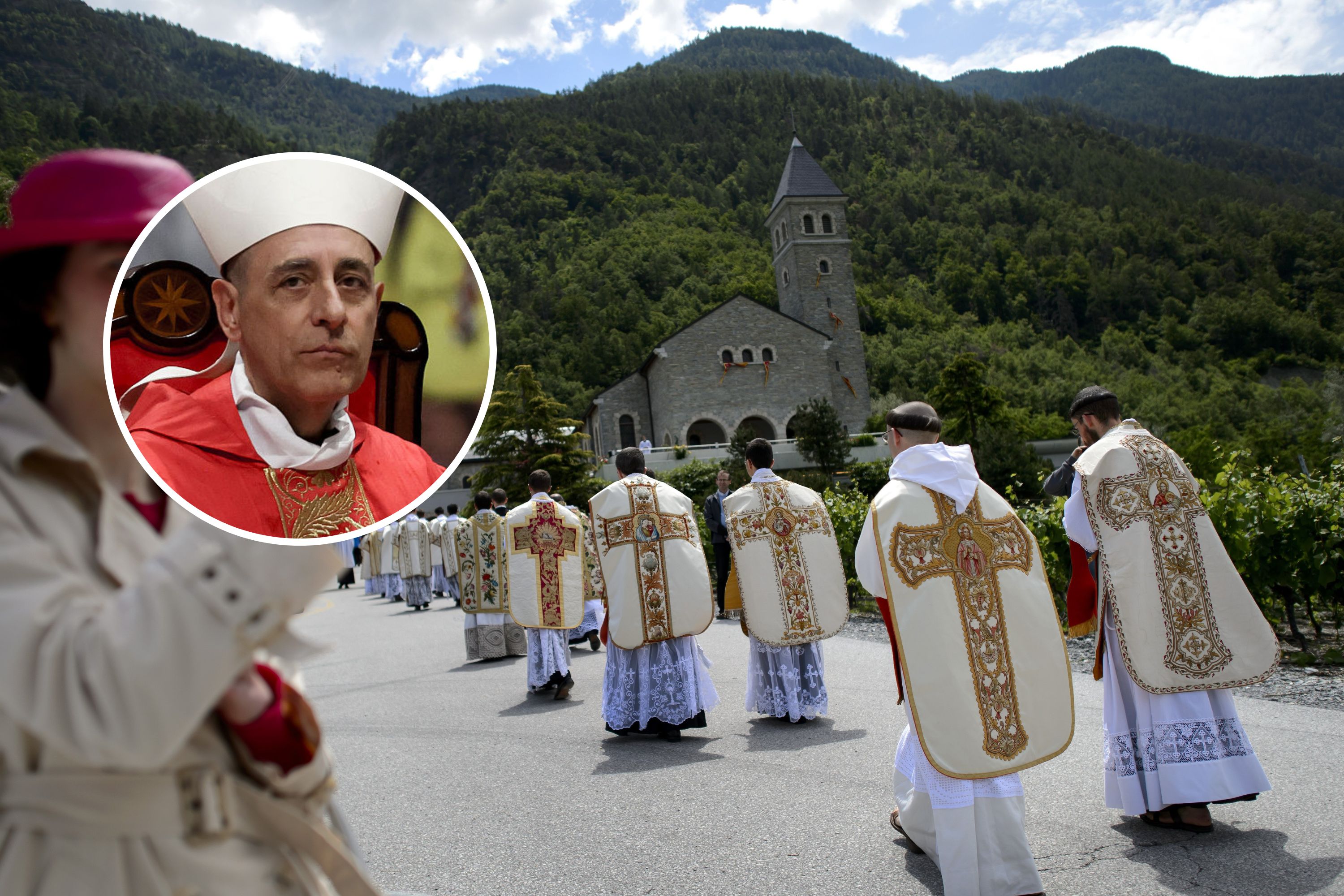
Members of a breakaway Catholic group face excommunication if they carry out plans to ordain new bishops without Pope Leo’s approval, the Vatican has warned.
Ultra-traditionalist Church rebels Priestly Fraternity of Saint Pius X (SSPX) announced in February that it would ordain bishops without the pope’s approval in July.
The Vatican’s head of discipline, Cardinal Víctor Manuel Fernández, told the society on Wednesday that doing so “will constitute ‘a schismatic act'”—a formal rupture—with the papacy and “a grave offense against God,” which requires excommunication.
“I reiterate what has already been communicated,” said Cardinal Fernández in a Vatican press release.
“The episcopal ordinations announced by the Priestly Fraternity of Saint Pius X do not have the corresponding pontifical mandate. This action will constitute ‘a schismatic act,’ and ‘formal adherence to the schism constitutes a grave offense against God and entails the excommunication established by the law of the Church’.”
The cardinal’s statement quoted from the late St. John Paul II’s letter Ecclesia Dei, written shortly after the society’s ordination of four bishops, in June 1988.
The Vatican’s release added, “The Pope wished to explicitly confirm his desire to continue praying that this new schismatic act may be avoided.”
What Is the Priestly Fraternity of Saint Pius X (SSPX)?
The SSPX was founded in 1970 by French Archbishop Marcel Lefebvre in opposition to many of the reforms that followed the Second Vatican Council, including the wider use of vernacular languages in Mass instead of Latin, according to Encyclopaedia Britannica.
Dedicated to the old Latin Mass, the society tends to oppose liberal theology and embrace conservative teachings.
The group’s relationship with Rome fractured in 1988 after Lefebvre consecrated bishops without papal approval, leading to excommunications and a long-running dispute over its status within the Catholic Church.
In 2009, Pope Benedict XVI lifted the excommunications of the four bishops consecrated by Lefebvre in an effort to heal the schism, though the Vatican said the society still had no canonical status in the Catholic Church and its ministers did not legitimately exercise ministry. Formal doctrinal talks between Rome and the SSPX later stalled over disagreements on the authority of the Second Vatican Council and modern Church teachings.
Despite the dispute, Pope Francis extended some concessions to followers of the society in recent years. In 2015, he granted SSPX priests the authority to validly hear confessions during the Catholic Church’s Jubilee Year, later making the measure permanent. The Vatican also authorized local bishops to permit SSPX priests to officiate certain marriages under specific conditions, signaling continued efforts to reconcile the group with Rome.
How Pope Leo Clashed With Donald Trump
Pope Leo XIV has clashed with President Donald Trump over immigration, nationalism and U.S. foreign policy, coming to a head in weeks over Leo’s criticism of the war in Iran.
Leo strongly condemned war shortly after the U.S. and Israel bombed Iran, saying the “delusion of omnipotence” that caused it has led to “absurd and inhuman violence.”
Last month, when Trump wrote on social media that “an entire civilization will die tonight” if Iran failed to meet a U.S. deadline, Leo responded: “This is truly unacceptable.” Trump later posted a scathing attack on the pope in a post on Truth Social, calling him “weak on crime” and “terrible for foreign policy.”
Last week, Trump said the pontiff was “endangering” Catholics with his opposition to the war in Iran. “The pope would rather talk about the fact that it’s OK for Iran to have a nuclear weapon,” Trump told Hugh Hewitt, a conservative radio host. “I don’t think that’s very good.”
Leo told reporters on May 5: “If anyone wishes to criticize me for proclaiming the Gospel, let them do so with the truth. The Church has spoken out for years against all nuclear weapons, so there is no doubt about this, and I simply hope to be heard for the sake of the Word of God.”
Both the pope and Trump administration officials have downplayed the rift. Leo previously said there has been a “narrative that has not been accurate in all of its aspects.”
The pope added that it was “not in my interest at all” to engage in a debate with Trump, as he prefers to focus instead on preaching a message of peace.
U.S. Vice President Vance, a Catholic, who last month said Pope Leo should “be careful” when he talks about theology and American foreign policy, responded on X: “I am grateful to Pope Leo for saying this. While the media narrative constantly gins up conflict—and yes, real disagreements have happened and will happen—the reality is often much more complicated.”
Related Articles