Here’s what you’ll learn when you read this story:
- Excavations into the Wogan Cavern under Wales’ Pembroke Castle showed evidence of life from 120,000 years ago.
- Preliminary data traced human activity at the site back to 45,000 years ago, but Neanderthals were likely there deeper into history.
- The oldest finds are the remains of an assortment of animals, including hippopotamuses, woolly rhinoceroses, and reindeer.
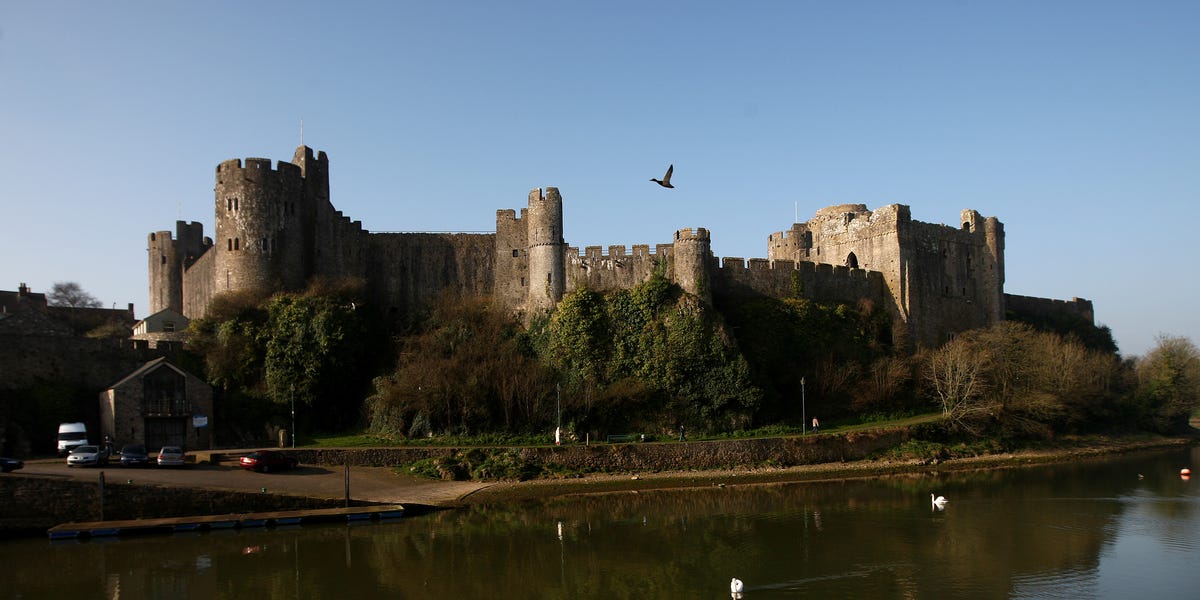
Experts had long known that Wales’ 11th-century-built Pembroke Castle—the birthplace of King Henry VII—stood above a cave, dubbed the Wogan Cavern. But they thought it had been dug out by the Victorians, and that at this point, it contained little remaining archaeological value. But a speculative excavation proved that theory very, very wrong.
The cave excavation revealed evidence of prehistoric humans and unusual animal remains—hippopotamus and woolly rhinoceros bones, anyone?
“Despite the limited work done so far, we can already say that Wogan Cavern is a truly remarkable site,” Dob Dinnis, excavation director for the University of Aberdeen, said in a statement. “Not only is there extremely rare evidence for early Homo sapiens, there are also hints at even earlier human occupation, probably by Neanderthals.”
The Wogan Cavern sits beneath the northern part of the castle. Now home to greater horseshoe bats, its large size and relatively flat cave floor made it an ideal home for a range of uses, both tens of thousands of years ago and in more (slightly) modern times. Experts believe it was a storeroom in the Middle Ages, and there’s evidence of use during the Roman period as well. But its history goes much deeper.
“We are optimistic that the cave can chart a long sequence of human activity, from hunter-gatherers living there immediately after the last Ice Age around 11,500 years ago, back to Britain’s earliest Homo sapiens between 45,000 and 35,000 years ago, and maybe also earlier traces likely left by Neanderthals,” Dinnis said.
Kate Britton, a specialist in archaeology at the University of Aberdeen, said that the cavern serves as a unique opportunity because the sediment is so well kept. “Pilot studies have shown that ancient DNA is preserved, in both the bones and the cave sediments,” she said. “The project’s team of specialists are excited to learn as much as possible about the cave and its early inhabitants—animal and human—in the coming years.”
The human component is the most intriguing to those studying the cavern. There’s only a limited group of British sites able to showcase the shift from Neanderthals to modern humans, and Pembroke Castle’s Wogan Cavern may have just jumped to the top of the list—potentially helping researchers understand the Neanderthal-to-human transition and the intertwining relationship the two may have had.
The Aberdeen-led team is planning new, intensive excavations in May, and is expecting to find additional evidence of activity in the cavern. Already, the early work has uncovered bones of mammoths, woolly rhinoceroses, reindeer, hippopotamuses, and wild horses, as well as stone tools and evidence of human occupation across multiple periods. The animal activity may be up to 120,000 years old, according to the hippo bones that the team believes date to the last interglacial period.
Jon Williams, Pembroke Castle manager, said that as Wogan Cavern has started to reveal its secrets, those secrets have proven to be quite different from the medieval history normally dealt with at the site, and others across the country.
“There is no other site like it in Britain—it is a once-in-a-lifetime discovery,” Dinnis said. “With this new project we can learn a great deal about our early prehistoric forebears, about how they lived and what their worlds looked like.”