
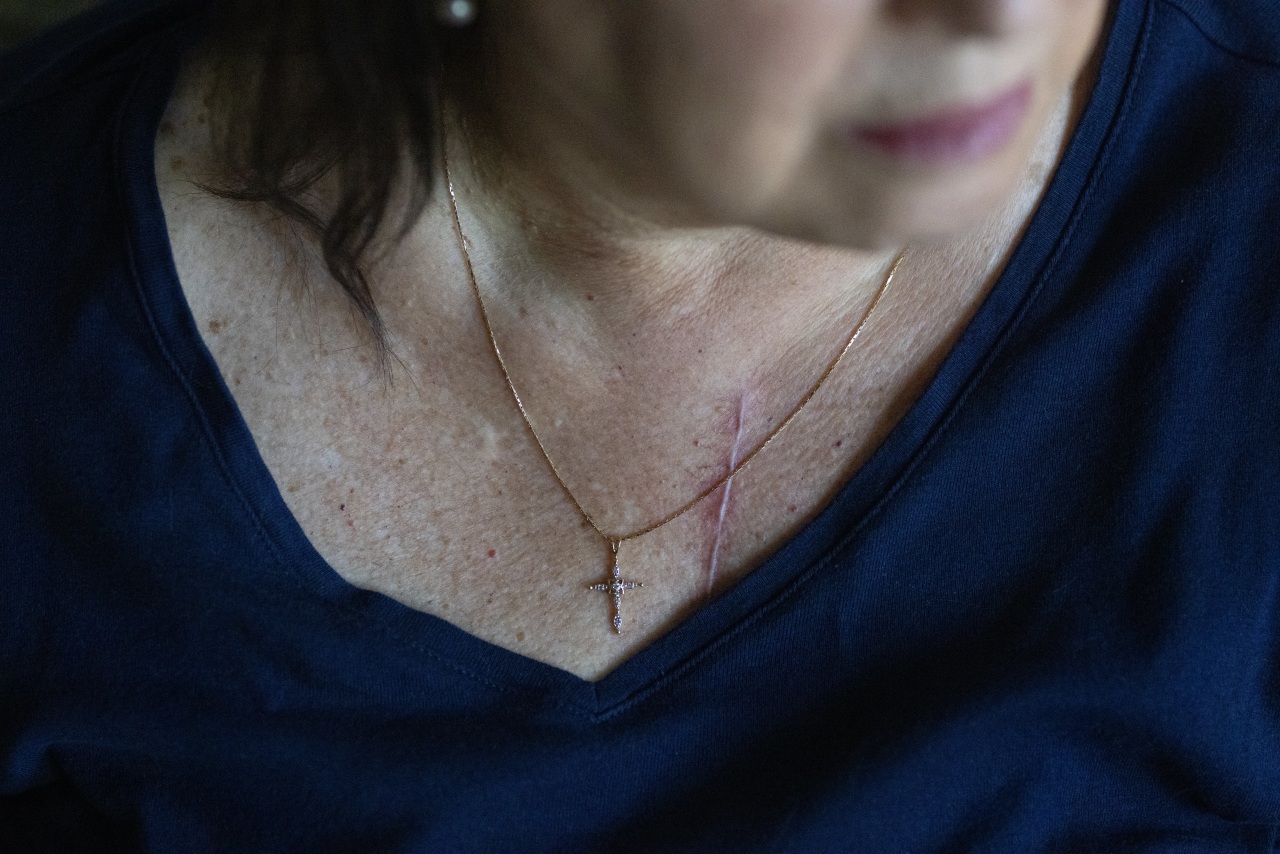
After months of dizziness and arms aching so badly she could barely walk her dog, Susan Glannan lay stunned in a sunny hospital room as a doctor told her she should have open heart surgery.
The idea of a surgeon cracking her chest open and stopping her heart terrified her. Glannan, who was 64, lived alone. She didn’t have her affairs in order. And just four years earlier, she had had a procedure that she thought would take care of her heart problem—a diseased aortic valve. “I was disappointed and scared,” she said, “and I started worrying, ‘Do I have a will?’”
That first procedure was called a transcatheter aortic valve replacement, or TAVR. It’s considered one of the biggest innovations in cardiovascular medicine, offering a way to spare patients the physical and emotional trauma of open heart surgery.
TAVR was approved in 2011 for frail, older patients unlikely to withstand surgery—people with no more than a few years left to live. The Food and Drug Administration later approved it for healthier patients at intermediate and low risk of dying from surgery.
Yet there’s limited research on how long the valves might last. And as TAVR has become more widely used among younger and healthier people, some are finding that their valves don’t work as well or last as long as they hoped. The procedure they thought would spare them a complicated surgery leads some to the operating table anyway.
“It never dawned on me that four years later I’d be like, the murmur is bigger than it ever was,” Glannan said. “I never should have gotten the TAVR.”
After her TAVR in 2021, Glannan was back on her feet in a few days. But by 2025, the TAVR valve was stiff and leaking, dangerously restricting the flow of blood to the rest of her body.
Glannan is one of more than 710,000 Americans who received a TAVR between 2015 and 2024. The procedure is designed to treat severe aortic stenosis, in which calcium buildup narrows the opening of the aortic valve. Symptoms include fatigue, shortness of breath, chest pain and a fluttering heartbeat. Aortic stenosis affects at least 1.5 million Americans, and if severe and left untreated, can lead to heart failure and death.
TAVR is an appealing option for patients and doctors because it’s a simpler, less invasive procedure than a surgical aortic valve replacement (SAVR), with shorter recovery times.
Aortic stenosis most commonly develops with aging, and most cases are in people over 65. The number of people under 65 who have gotten a TAVR has grown even though surgery is recommended for that age group under U.S. medical guidelines unless they have a shortened life expectancy or a health condition that makes surgery risky. TAVR valves haven’t been well studied in that age group.
Nearly one-third of patients ages 40 to 65 who need to replace their aortic valve receive a TAVR, according to a recent study.
Whether a patient has a TAVR or a surgical aortic valve replacement should depend on their health and projected life expectancy, said Dr. Vinay Badhwar, president of the Society of Thoracic Surgeons and executive chair of the West Virginia University Heart & Vascular Institute.
“TAVR is an outstanding lifesaving treatment for high-risk and elderly patients, but surgery may be the better choice for low-risk younger patients,” Badhwar said. “Our focus must be on the optimal long-term outcome.”
TAVR valves, as well as many surgical valves, are made with animal tissue and eventually deteriorate—faster in younger, more active patients, according to studies. How long they last is important to study in younger patients because “it’s clear many of them are going to outlive the durability of the valve,” said Dr. Martin Leon, professor of cardiology at Columbia University Irving Medical Center and co-principal investigator of a clinical trial following low-risk patients.
Doctors are concerned by recent data from another clinical trial in low-risk patients suggesting that some TAVR valves may wear out faster than their surgical counterparts.
Explant growth
Some TAVR patients end up needing an “explant,” a complex surgery to remove the original aortic valve along with the TAVR valve and sew in a new surgical one. While uncommon, the explant is the fastest-growing type of cardiac surgery, by rate, in the U.S. today. It is a riskier operation than regular surgical aortic valve replacement.
Leon Schiefer, then 55, learned after a 2019 physical that he had severe aortic stenosis. He didn’t feel sick, but was told he would need to get his valve replaced to keep working as a long-haul trucker.
A cardiologist and a cardiac surgeon near his home in Vassar, Mich., both recommended a TAVR to Schiefer. The recovery from open heart surgery would be long, particularly for Schiefer, who weighed about 350 pounds, the surgeon told him. Reluctant to miss months of work, he agreed. He had the TAVR on a Monday and was back driving Friday.
This past December, Schiefer began feeling short of breath and tight in his chest. Tests didn’t turn up any problems, but by January he was in such bad shape he had to stop trucking.
He later sought care further from home at University of Michigan Health, where doctors found his heart barely pumping, depriving his brain and other organs of oxygen. They told him he had days to live.
Schiefer’s TAVR valve had become calcified and was leaking, leading Schiefer to heart failure, said Dr. Robert Hawkins, the cardiac surgeon who operated on him in February. He replaced it and fixed three blocked arteries.
Schiefer, who has lost 90 pounds since he had the TAVR, still has heart failure, but said he is improving. He feels he might have been better off if he had initially had surgery instead of the TAVR. “I wouldn’t have got in the boat I got in,” he said.
The number of TAVR explants has grown more steeply than cardiac specialists anticipated and is likely to continue to grow as more younger people get TAVRs and outlive their valves, said Dr. Shinichi Fukuhara, a cardiac surgeon at University of Michigan Health who has performed more than 175 TAVR explants.
“Almost nobody’s thinking about what’s next,” he said.
Valve makers and many doctors say when a TAVR valve wears out, a new valve can be inserted inside the old one, like Russian nesting dolls. The number of patients undergoing a second TAVR procedure after their valve wears out is also growing. But little is known about how long second TAVR valves last, and the nesting doll procedure doesn’t work for everyone.
Market expansion
Edwards Lifesciences, Medtronic and other companies have built TAVR into a global business with $7.02 billion in 2025 revenue, estimated to increase to $9.91 billion in 2030, according to Wells Fargo Securities.
Last year the FDA approved use of Edwards TAVR valves for patients with severe aortic stenosis but no symptoms. Edwards, the market leader, and Medtronic are exploring use of TAVR for patients with moderate aortic stenosis. Both companies fund education for physicians and clinical trials, including currently following valves in low-risk patients for 10 years. The FDA in March approved a TAVR valve from another company for a condition called aortic regurgitation.
“Our goal is to follow the science to see how we can help patients,” said Dr. Todd Brinton, Edwards’ chief scientific officer. Patients under 65 who get TAVR are a small subset and include people with other health conditions like prior cancer or radiation that make surgery not possible or optimal, he said. All patients who get a TAVR, including those under 65, are approved by a “heart team” of cardiac specialists, he said.
The real challenge, he said, is “the larger number of people over 65 who are at higher risk and not receiving diagnosis or treatment.” Edwards is supporting an initiative by the American Heart Association to improve diagnosis and appropriate treatment, he added.
TAVR technology is advancing, with companies developing newer valves to improve long-term outcomes, according to Medtronic and Edwards, which both also make the traditional surgical valves. More surgical options have emerged too, such as smaller incisions in the chest, or a robotic surgery that involves a smaller incision on a person’s side near the armpit.
Jane Booth was diagnosed with severe aortic stenosis at 62. A cardiac surgeon near her home in Orange County, Calif., recommended surgery and warned that the recovery would be long. “He said, you’re going to get depressed,” recalled Booth, who walks 5 to 6 miles a day and plays tennis. “For me not really having a lot of symptoms being told we’re going to do all this heavy duty stuff to you, it was frightening.”
She learned about the possibility of a TAVR at Cedars-Sinai in Los Angeles. She had the procedure there at age 65, when insurance covered it.
Her recovery was quick. As for replacing the TAVR valve when it wears out, “I’m just not worrying about it,” said Booth, now 69. “The technology continues advancing.”
Age isn’t a cutoff, said Dr. Raj Makkar, director of interventional cardiology at the Cedars-Sinai Smidt Heart Institute who performed the procedure on Booth. A patient’s preference, health and anatomy all have to be taken into account, he said.
Younger patients may have both surgical aortic valve replacement and TAVR over their lifetime, he said: “The two techniques are complementary.”
As more young or low-risk patients get valve replacements, doctors need to plan for more, either surgery or TAVR, over the patient’s lifetime, said Dr. Kendra Grubb, chief medical officer of Medtronic’s structural heart business. As a practicing cardiac surgeon, she encountered younger patients who would “come in and say, ‘I’m here for a TAVR,’” she said.
But “surgery is still the gold standard for those who are under 65,” Grubb said.
Hospital scare
Glannan, who lives in Odessa, Fla., was relieved when a heart team recommended a TAVR in 2021, when she was 60. With a busy job and her dog, the last thing she wanted was to be knocked off her feet for months.
After the procedure, she said she felt “maybe 30 to 40 percent better.” Follow-up tests every year showed a leak around the valve. In 2024, she started having dizzy spells. She struggled to bring in groceries and had to rest on the stairs in her three-story townhouse.
The symptoms scared her as they worsened. “I thought I had taken care of it and was going to have smooth sailing for 8 to 10 years and then get another one of the same thing,” Glannan said.
In spring 2025, she went back to her doctors, who recommended a second TAVR. But then she had to find new doctors when her insurance changed. In November, a new primary care doctor told Glannan her heart sounded like “a bunch of galloping horses,” Glannan recalled. Soon after, she was admitted to the hospital because she thought she was having a heart attack.
Dr. Eric Wherley saw Glannan needed a new valve. A test showed calcium deposits peppering the leaflets of the TAVR valve, making it hard for it to open and close. Blood was leaking around it.
Wherley, a cardiothoracic surgeon with the AdventHealth Pepin Heart Institute in Tampa, Fla., and a team of specialists felt that taking out the TAVR valve and sewing in a surgical one was the best option. He hoped a surgical valve would last longer and then Glannan could have a TAVR when it wore out.
Glannan tried not to cry as Wherley made a case for open heart surgery.
Over the next few days, she came around to the idea. She had the surgery in December. For weeks afterward, she could barely look at the purplish scar running from her neck down her chest.
Now, Glannan is grateful, back working as a business development executive and walking her dog, a terrier named Marley. The dizziness is gone and she has more energy.
“I thought I asked all the right questions and dug deep enough,” she said of getting a TAVR. “But with the heart, your defense goes down.”