Four years after the full-scale invasion of Ukraine, Russia is facing a spring of discontent.
Rolling digital blackouts in Russian cities have touched a nerve with ordinary citizens and public pushback against Russian President Vladimir Putin is emerging.
Russia has weathered wartime economic pain while its security services keep protests in check. And the conflict in the Middle East has given Russia’s war effort an unexpected boost through higher oil prices.
Nonetheless, Russia’s repressive apparatus of state now appears to be shifting into high gear. In recent weeks, law-enforcement authorities have launched a new round of high-profile political arrests and raids. And in parallel, the Russian government has been resurrecting the ghosts of the Soviet past.
The most recent example: On Tuesday, officials from Russia’s Investigative Committee raided the offices of one of Russia’s largest publishers and detained staff members, following a year-old criminal investigation into what authorities allege is a case of “LGBTQ propaganda.”
The publisher, Eksmo, is the owner of an imprint called Popcorn Books that published young-adult fiction.
One of its titles appears to have drawn particular scrutiny: “Summer in a Pioneer Tie,” a 2021 bestseller featuring the story of a queer romance between two young men at a Soviet summer camp.
Authorities detained several individuals connected to the publishing house last year; the Popcorn Books imprint was shut down in January.
Putin’s Russia has long been hostile to what it deems to be dangerous Western ideas, with the Kremlin leader positioning himself as a defender of traditional values.
In 2023, Russia’s Supreme Court declared what Russian authorities call the “international LGBTQ movement” an extremist organization, imposing potentially serious criminal penalties for LGBTQ activism – or apparently, in the case of Eksmo, the act of publishing.
Russian state news agency TASS said top Eksmo managers were released on bail after questioning. But the publishing industry is not the only place where space for free expression is dwindling in Russia.
Earlier this month, police raided the offices of Novaya Gazeta, the independent newspaper whose co-founder won the Nobel Peace Prize in 2021.
Russian state news agency RIA-Novosti, citing the Ministry of Internal Affairs, said journalist Oleg Roldugin was detained for questioning in connection with a criminal case over the alleged illegal mishandling of personal data Roldugin denied guilt ahead of a hearing.
The chilling effect of the case is clear.
Novaya Gazeta was forced to shut down its print edition after the 2022 invasion of Ukraine but continues to publish online; the raid pushes the remnants of Russia’s free press further to the margins.
Sharing independent news in Russia is already tough. The government bans popular social media platforms such as Facebook and Instagram and is pushing to impose a state-controlled messaging app called MAX as the population’s default portal for digital services. And the Novaya Gazeta raid came on the same day as Russia’s Supreme Court designated Memorial, the storied human-rights organization, as “extremist.”
In a statement, UN human rights chief Volker Türk said the designation was “effectively criminalizing critical human rights work” in Russia.
While the attack on the press is underway, the authorities are also reviving old symbols of political repression. A few days ago Russia’s FSB Academy, where Putin trained to be a KGB agent, was renamed in honor of Feliks Dzherzinsky, the dreaded founder of the Soviet secret police.
The toppling of Dzherzinsky’s statue outside KGB headquarters in 1991 was one of the symbolic acts that marked the end of the Soviet Union. But authorities in Russia appear intent on embracing the country’s dark, totalitarian past.
On Thursday, Reuters reported, the embassies of Poland, Estonia, Lithuania and Latvia issued a protest to the Russian Foreign Ministry, after a memorial complex in the Siberian city of Tomsk dedicated to the victims of the Soviet secret police was dismantled. And earlier this month, Russia prompted outrage by installing an exhibit that some commentators said defiled the Katyn Memorial, the site of the mass execution of Polish POWs by the Soviets in 1940.
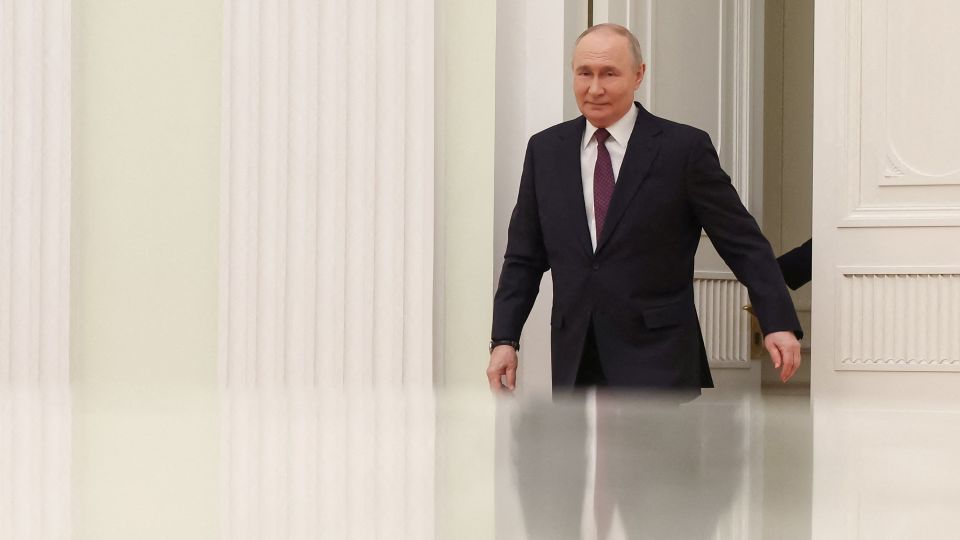
But if the Russian government is resurrecting the ghosts of the Soviet past – and making life for ordinary Russians a whole lot more inconvenient – Putin himself is showing public indifference.
On Thursday, Putin broke his silence on the rolling digital blackouts, which hit the country’s capital in early March.
“I can’t help but point out what people are also encountering in large cities — it’s rare, but unfortunately, it does happen,” he said. “I’m referring to certain internet problems and outages in major metropolitan areas.”
Putin said the unpopular internet disruptions – which have hit e-commerce and made many apps and electronic services inaccessible – were “related to operational work to prevent terrorist attacks.” But he also appeared to suggest that the public’s need to know was limited.
“Widespread public information in advance can be detrimental to operational development, because the criminals, after all, hear and see everything,” he said “And, of course, if information reaches them, they will adjust their criminal behavior and their criminal plans.”
In other words, life during wartime means putting up with some inconvenience. And Russia’s security services broadening and deepening a crackdown on civic life shows little sign of abating.
For more CNN news and newsletters create an account at CNN.com