
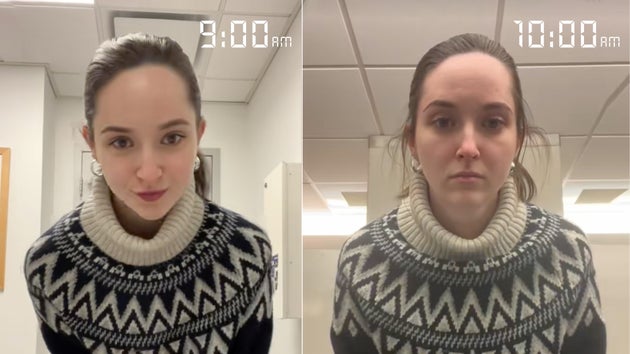
When Noa Donlan clocks in to her corporate job in the morning, she shows up fresh-faced — but then “office air” strikes.
“I’ll go to the bathroom and be like, ‘Oh my God, I could have sworn I left the house looking way cuter.’ And I’m like, what happened?” she told HuffPost.
In a series of popular TikToks this year, the Boston-based professional is showing the hour-by-hour visual progression of how “office air” worsens her appearance. “I get really oily and sweaty really quickly,” she said.
Like this article? Keep independent journalism alive. Support HuffPost.
The idea of “office air” ruining good hair and skin days was popularized last year, but Donlan’s posts are touching a new nerve.
“What stood out to me the most was just how physically different I felt like I looked like at different points in the day,” Donlan said. “I was like, ‘I bet other people are maybe feeling the same way.’”
Many were. Donlan’s “office air” videos, with captions such as “POV: you’re a victim of office air,” have been seen millions of times.
“I look like a sick Victorian child by lunch,” one commenter agreed, while another concurred, “How am I greasy and dry at the same time.”
Donlan said her friends and family who work in corporate environments agree that one can feel and look worse at the office. “Almost everyone I know who works a job has been stressed at their job at some point, and I think it definitely contributes to how they feel,” she explained.
But while many TikTokers believe in “office air theory,” health experts are less convinced that you can blame “office air” for your appearance.
It Could Simply Be Your Natural Circadian Rhythm, Derm Explains
“I don’t think it’s a real phenomenon,” Dr. Zakia Rahman, a clinical professor of dermatology at Stanford University in California, told HuffPost. “We look under that harsh lighting after a day of work, and then we think, ‘OK, all of these changes are related to the office air,’ when in fact they’re related to the circadian rhythms that we have and natural things that happen throughout the
day.”
Instead of blaming office air, try pointing the fingers at biology and gravity.
Rahman said your body’s 24-hour circadian rhythm causes cortisol changes that could change how your face looks. “The oil production actually also varies based on this circadian rhythm,” she said. “And so after many hours, that oil secretion can actually make the skin look greasier.”
Gravity could also be another reason why you look more fresh in the morning and wilted by the afternoon. “When we get up in the morning, our face appears more plump, because when we lay down, the face retains more fluid than when we’re standing up during the day,” Rahman explained. “As that fluid shifts, the skin thickness decreases and the wrinkles can become apparent.”
How you apply makeup can also be the culprit for your skin’s changing appearance over the course of a work day. “The oil glands produce sebum, and so [makeup] may look different as it settles in,” Rahman said. “And so we see large pores and lines.”
To be clear, the air you breathe at work does impact your health. Poor air quality in an office building can lead to dry, itchy and red skin, as well as watery eyes, fatigue and dizziness, and it’s still a “serious issue” in workplaces and schools, said Parham Azimi, a research associate in environmental health at the Harvard T.H. Chan School of Public Health. But “appearance impact is not a really scientific term,” he told HuffPost.
Azimi said that there is not scientific evidence to back up office buildings quickly changing your physical appearance, as some “office air” believers claim, but research does show it can change your overall physical health and mental acuity over time.
In one study, office workers with good indoor air quality performed 26% higher on tests than workers in conventional buildings, even after controlling for annual earnings, job category and level of schooling.
If you suspect that your stale, stuffy office air is causing you health problems, Azimi said one quick way to verify this is to get a simple CO2 sensor, which can measure carbon dioxide concentration in the air. If your work CO2 concentration is high, then “the space is not getting enough fresh air,” he said.
Azimi said workers could also check how they feel and look on days they work outside the office, and be cognizant of placebo effects. “Approach it more scientifically to make sure that it’s really the office air that is causing that,” he suggested.
As for Donlan, she does think drinking more water, using a humidifier, and sleeping more helps lessen the effects of her “office air” look. “If the air is dusty and dry, staying hydrated can really help,” she said.
“I don’t want people to get this notion that working in an office is bad, because I think there’s a lot of value to it,” Donlan said. But for her personally, she wants people to know working in an office for eight hours straight under florescent office lighting can have long-term effects. “I think it shows in my face, and I think it does for a lot of other people as well,” she said.