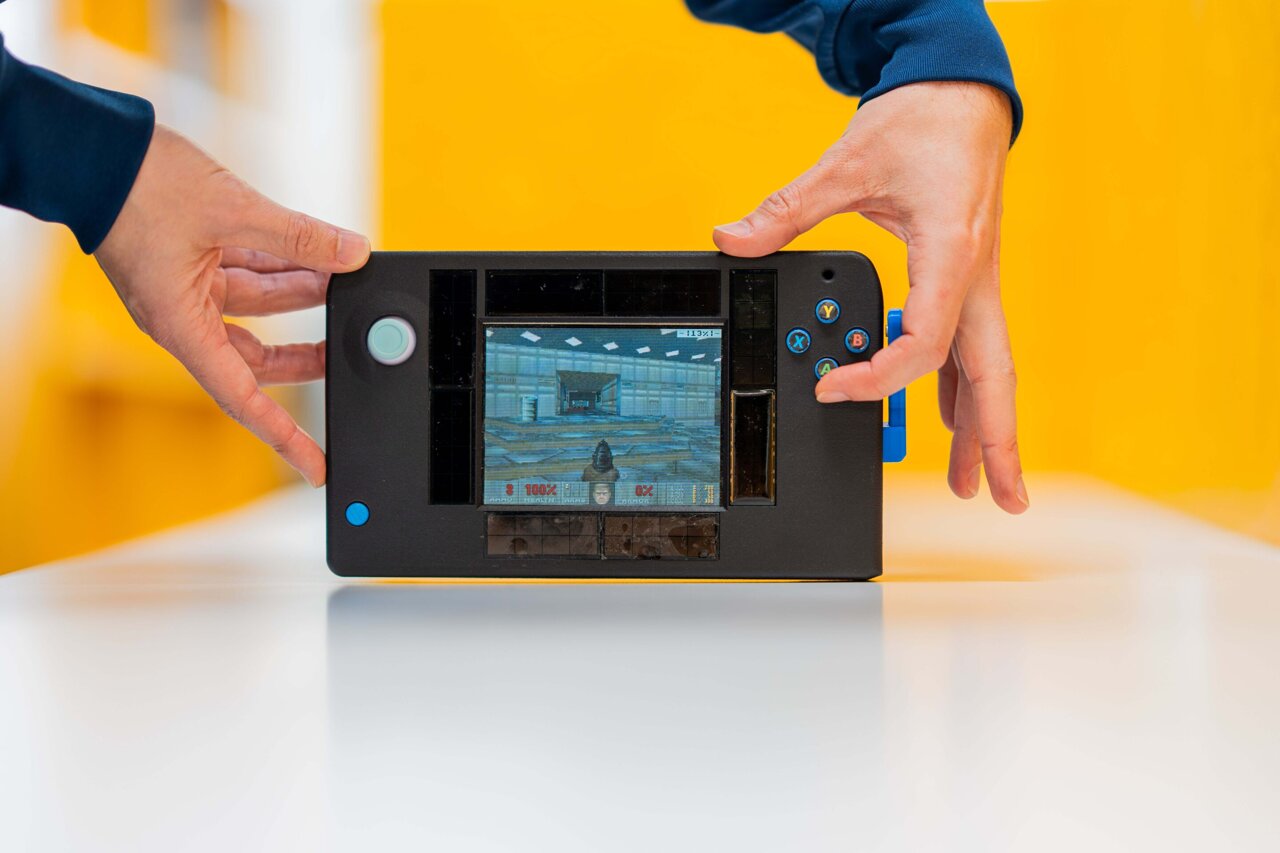
Researchers at Delft University of Technology (TU Delft) have designed a portable game console powered by solar panels and a cranking device. They embedded the crank into the gameplay experience, allowing users to—for example—fire a weapon in DOOM, or change the speed of Tetris blocks. They discovered that gamers respond positively to these innovative experiences, and they see huge potential in new, sustainable and battery-free ways of gaming that are also better attuned to our body's movements.
Subscribe to our newsletter for the latest sci-tech news updates.
Researcher Przemyslaw Pawelczak and his team had previously developed a solar-powered game console, with small panels integrated into the device. Their innovation attracted global attention and sparked a debate around our dependency on battery-powered devices. Now the researchers are taking it one step further and exploring how the use of kinetic energy can not only generate power, but also enhance the gameplay experience, so that gaming is better attuned to the human body.
A new way of gaming
To do this, researchers Przemyslaw Pawelczak and Jasper de Winkel have designed a new version of their game console. Przemyslaw explains, "The console has two ways to harvest energy. A set of small solar panels around the screen and a crank attached to the right-hand side of the console. The crank is connected to a direct current motor that converts the rotating movement of the crank into electrical energy."
The console can run different games, including classics like Tetris, Super Mario, and the first-person shooter game DOOM.
Researcher James Broadhead worked with 60 gamers to test how different crank configurations influenced the gameplay experience. In one setup, cranking was simply used to power the game. In another, the crank generated energy and contributed to the gameplay experience. For example, cranking rewarded DOOM players by allowing them to fire weapons. In Tetris, cranking made the blocks slow down. The third setup was battery powered, against which they compared the battery-free setups.
New and engaging
The researchers found that for both battery-free setups, the respondents reacted positively and were surprised by the new feature.
Referring to the first setup, one respondent said, "At the beginning, I was quite annoyed when the battery died. But after a few times, I began to enjoy it. Like I knew it was coming, I knew that I could anticipate it."
Another said, "I'm getting a little bit too addicted to my phone, to Instagram and stuff. But with this thing, it's like when it dies, I just cannot continue."
Most users who tried the second setup appreciated the crank for its novel and engaging nature, especially when playing DOOM. One user said, "Connecting it to a weapon made it more interesting and more of an enhancement."
Another said, "I really liked it, using it as a weapon. Also, because I just needed to do that to keep playing."
New games
The researchers see a lot of potential in combining sustainable energy generation with gameplay.
"And there is more to discover," says Broadhead. "We need to take ergonomics into account because, for example, some gamers experienced difficulties coordinating gameplay and cranking simultaneously. And we could experiment with other forms of power generation, such as squeezing or pulling a rope."
The nostalgic aspect of these games also plays a role.
Broadhead says, "People remember these classic games from years ago. They don't want them to change. This means that there are many opportunities to create new games with integrated power-generation tools. This is a chance to design game consoles that are more in tune with our bodies, with design elements that feel both natural and engaging."
In 2020, a team of researchers from TU Delft and Northwestern University developed the first battery-free version of a classic handheld gaming console to explore the potential of intermittent computing. The device ran on solar power and user interaction, allowing games to continue even after brief power losses. The project demonstrated how future low-power devices could operate without batteries. It also raised awareness about reducing battery waste and making electronics more sustainable.
Provided by Delft University of Technology
This story was originally published on Tech Xplore.