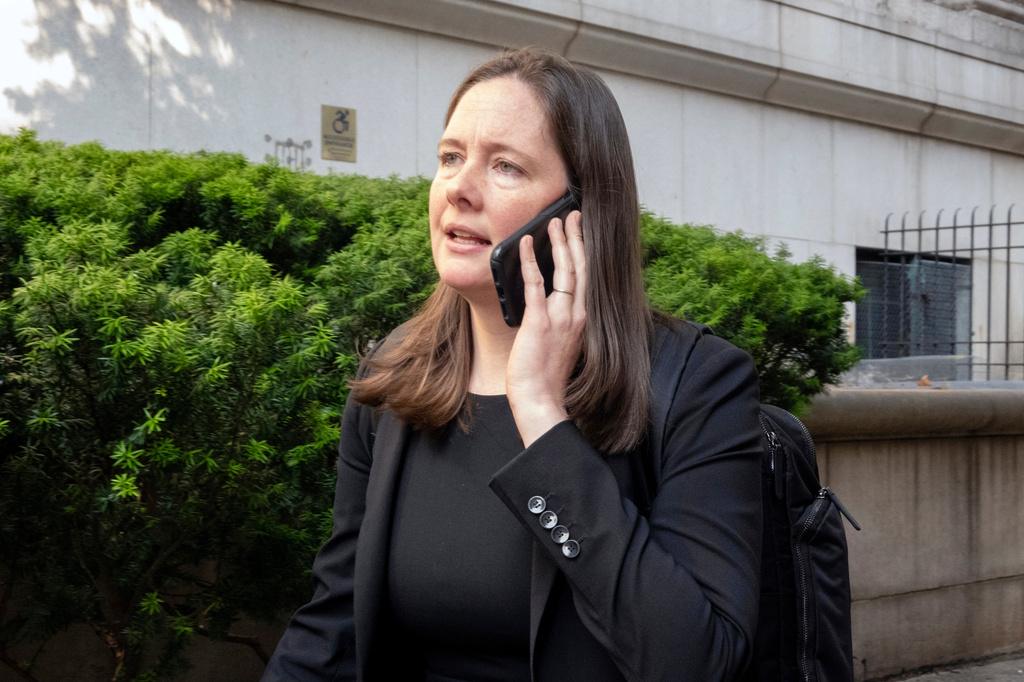
A federal judge allowed a wrongful termination lawsuit brought by Maurene Comey, a former federal prosecutor and the daughter of former FBI Director James Comey, to move forward in federal court on Tuesday, rejecting claims that the firing under President Donald Trump’s “executive power” should be handled by an executive branch agency.
Judge Jesse M. Furman for the Southern District of New York ruled that the court has jurisdiction to hear the case. Furman said Maurene Comey was fired after 10 years working on some of the country’s most high-profile cases at the United States Attorney’s Office for the Southern District of New York. She led the prosecution of Sean “Diddy” Combs, which resulted in his conviction last year.
Maurene Comey alleges she was fired “solely or substantially because her father is former FBI Director James B. Comey, or because of her perceived political affiliation and beliefs, or both.” Trump fired James Comey in 2017.
Furman ordered the Department of Justice (DOJ) to answer Maurene Comey’s claims within two weeks of the filing and set a pretrial conference for May 28. He said Comey was told she was fired under Article II of the U.S. Constitution, which grants the president “executive power.”
“Requiring employees such as Comey to seek relief through the Executive Branch in the first instance when, as here, the Constitution, not the statute, is invoked as the basis for the adverse action, and the employee’s challenge thus raises questions about Executive power and the separation of powers, makes little sense,” Furman said in an opinion and order filed Tuesday.
Newsweek reached out to the DOJ for comment.
The Trump administration argued that Comey must bring her claims before the Merit Systems Protection Board, an Executive Branch agency created by the Civil Service Reform Act of 1978, and any appeal must be filed with the
United States Court of Appeals for the Federal Circuit.
“The Court concludes that Comey’s case does not fall within the purview of the CSRA’s scheme because she was fired pursuant to Article II of the Constitution, not pursuant to the CSRA itself. Defendants’ sole reliance on the Constitution — rather than the removal provisions of the CSRA — places Comey’s case outside the universe of cases that Congress intended the MSPB to resolve,” Furman wrote.
During oral arguments in December, the judge refused to let Comey gather evidence to learn who ordered her firing, saying the government had made serious arguments that her firing must first be considered by the Merit Systems Protection Board.
Why Is Maurene Comey Suing the Trump Administration?
Maurene Comey filed a lawsuit against the DOJ, Executive Office of the President, Executive Office for United States Attorneys and several other federal government plaintiffs in September of last year. She was fired from her position as assistant U.S. attorney for the Southern District of New York several months prior, in July 2025.
She alleged that the federal government “did not identify any cause or provide Ms. Comey any due process for her removal,” and instead cited Article II of the Constitution. She alleged that her termination was “unlawful and unconstitutional.”
Maurene Comey also alleged that the administration violated statutory protections under the Civil Service Reform Act.
The former federal prosecutor alleged that her firing was “politically motivated” and said it came after “President Trump’s supporters called for Ms. Comey’s firing.”
Maurene Comey is seeking various forms of relief, including her reinstatement and an award of back pay.
This article includes reporting by The Associated Press.
Do you have a story that Newsweek should be covering? Do you have any questions about this story? Contact LiveNews@newsweek.com.
Related Articles