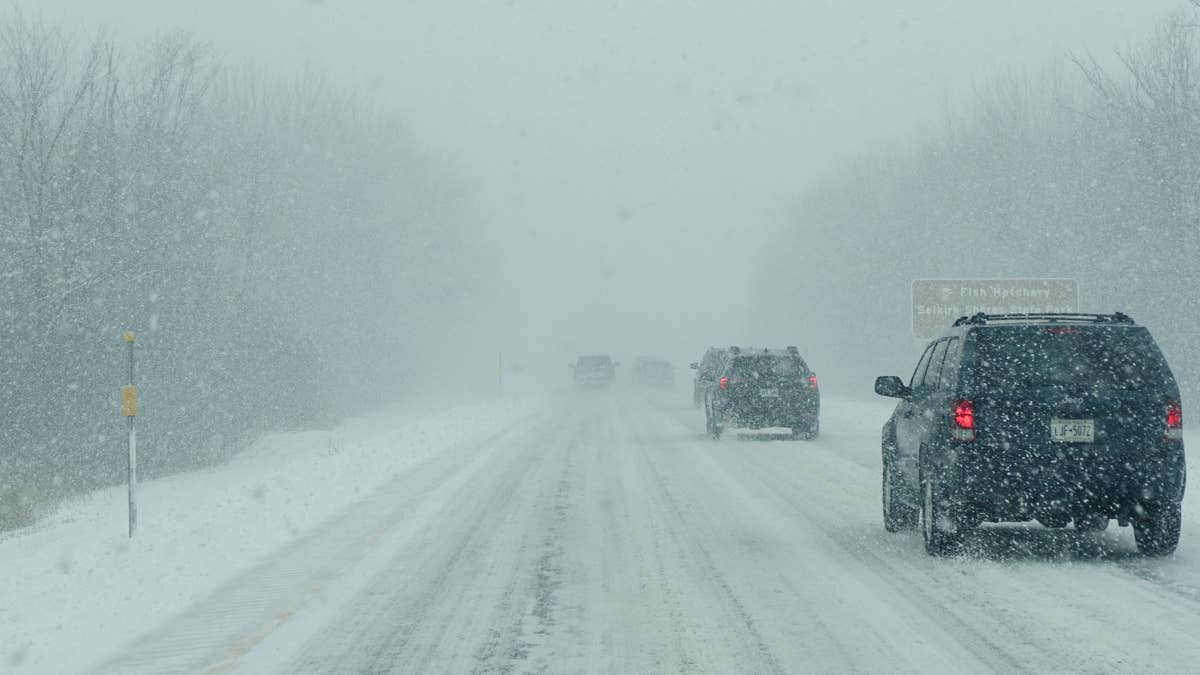
The late-season Pacific storm flagged earlier this week is now arriving across the Western U.S., and the Weather Prediction Center has upgraded its heavy snow risk to HIGH for both Monday and Tuesday, a significant escalation from earlier outlooks. Winter Storm Warnings remain in effect through NWS Sacramento and NWS Reno for the Sierra Nevada, with the system tracking east into Colorado and the Rockies through midweek. The peak of the storm falls on Tuesday, May 5, which also happens to be Cinco de Mayo, putting cold rain and active chain controls in place across much of the West on what is normally a patio-and-margarita evening.
Current Status
- I-80 over Donner Pass: open, chain controls expected Sunday evening above 7,000 ft
- US-50 over Echo Summit: open, chain controls expected overnight
- US-395 Eastern Sierra: open, high wind impacts on crest
- Tioga Pass (Hwy 120): closed seasonally, will not reopen this week
- Sonora Pass (Hwy 108): open at lower elevations, summit conditions deteriorating
Caltrans QuickMap is the live source. Status changes by the hour during active storms.
What Changed in the Last 24 Hours
The biggest update: the probabilistic heavy snow outlook now sits at HIGH for both Monday and Tuesday, the top tier of the categorical risk scale; yesterday's outlook had Tuesday at moderate. The model consensus tightened overnight and the probability band widened.
The Sierra takes the first hit Sunday night into Tuesday. The system then tracks east, with Colorado Rockies and the I-70 corridor under the same HIGH heavy snow flag for Tuesday into Wednesday.
Next 48 Hours
Snow level drops to about 6,000 ft by Monday morning and 4,500 ft by Tuesday morning, with the heaviest accumulation running Sunday night into Tuesday afternoon. Full closures of Donner and Echo Summit become likely Monday into Tuesday.
When both close at the same time there is no realistic crossing of the central Sierra. Tioga, Sonora, and Ebbetts are not options.
Tires: The Part Most Drivers Get Wrong in May
This is the trap that catches Bay Area and SoCal drivers every late-season storm. Most have already swapped to summer tires or are running all-seasons that are well past their winter usefulness. A Winter Storm Warning in May is the same warning it would be in February. The rubber on your car does not know the calendar.
What actually matters at the chain control:
All-season tires count as standard tires under California's chain control system. Once R2 controls go up, all-seasons require chains regardless of how new they are. R3 means chains required on all vehicles, no exceptions.
Summer tires lose grip below roughly 45°F even on dry pavement. On wet or snow-covered roads at the elevations involved here, they are dangerous. If you drove to Tahoe on summer tires, do not assume your AWD compensates.AWD distributes power to four contact patches; if those patches are summer compound, you have four sliding tires instead of two.
Dedicated winter tires (snowflake symbol) with at least 6/32" tread depth are the only tires that meet R1 chain controls without requiring chains.
M+S all-terrain tires on trucks and SUVs are not the same as 3PMSF (three-peak mountain snowflake) rated tires. The M+S rating is a tread pattern designation; 3PMSF is an actual snow traction test. Check the sidewall before assuming you are exempt.
If you are not sure what is on your car, you are running all-seasons so be sure to carry chains.
If You Are in Tahoe Right Now
Sunday afternoon is the last clean window. Leave before 4 pm PT and you should clear Donner before chain controls go up at lower elevations. Leave later and plan for chains regardless of drive type. If you cannot leave Sunday, the better call is to stay through Wednesday.
Cinco de Mayo on the Road
Tuesday is one of the higher DUI-incident days of the spring even in normal weather. This year, much of the West will be dealing with cold rain on the Front Range, wet or icy pavement at elevation, and ongoing chain controls in the Sierra. If you are driving Tuesday evening, plan around it the same way you would in February. The festive date does not change what the road is doing.