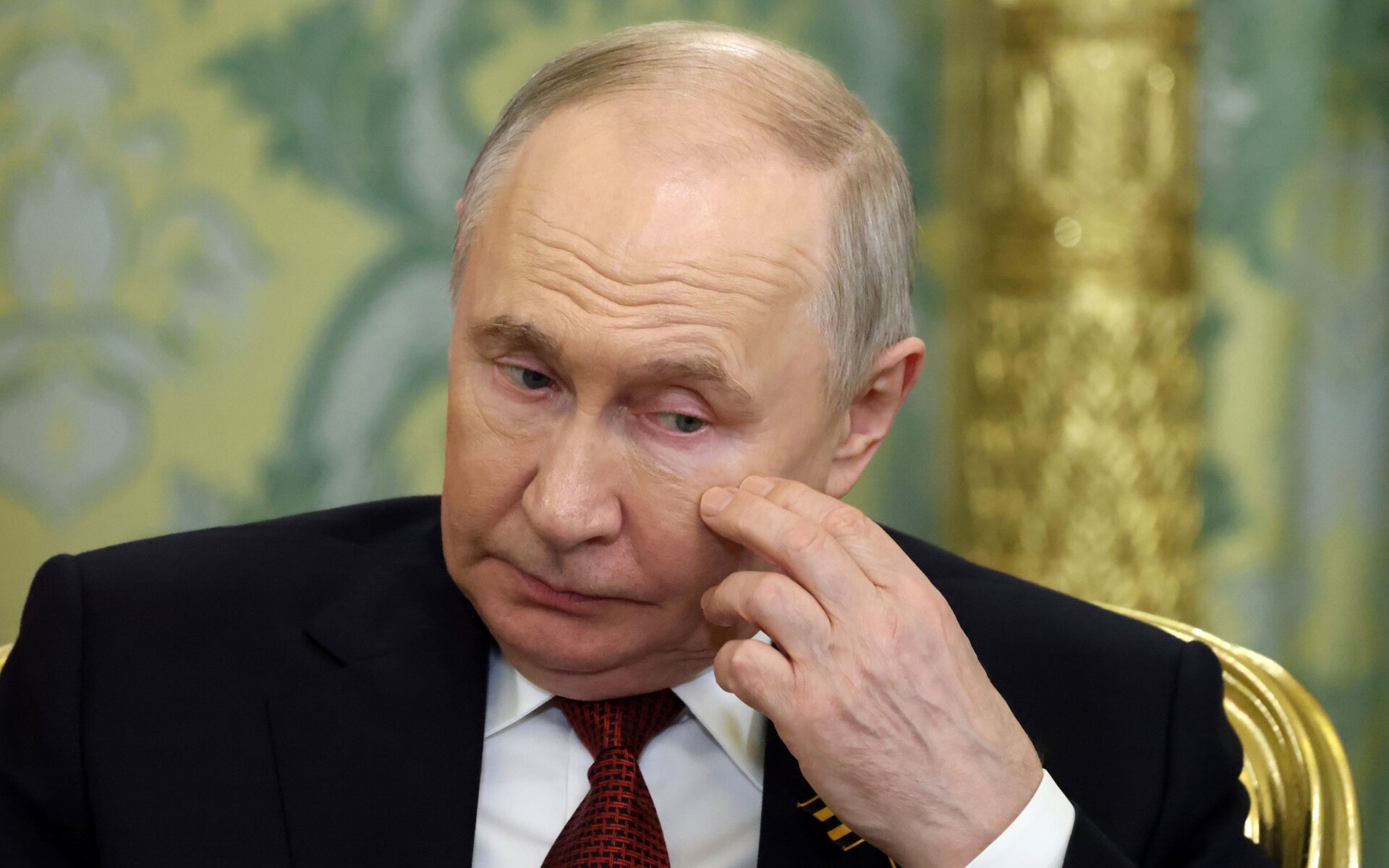
Volodymyr Zelensky claimed a victory this week after Vladimir Putin said that the war in Ukraine was “coming to an end”.
Mr Zelensky, who had already forced the Russian president to scale back the annual military parade in Moscow, said he had now pressured Putin to restart peace talks.
“We pushed him a little,” he claimed.
While an end to the war remains distant, Mr Zelensky’s claims hold some truth.
Battlefield data analysed by The Telegraph suggest the Kremlin’s war machine is under serious strain.
After years of grinding, attritional offensives and a high number of casualties, Russia’s battlefield momentum has slowed sharply in recent months. In some sectors, it is reversing altogether.
In April, Russian forces suffered a net territorial loss in Ukraine, the first such setback since Ukraine’s incursion into Kursk in 2024, according to the Institute for the Study of War (ISW).
The Washington-based think tank assessed that Moscow lost control of 46 square miles over the month, continuing a decline that started towards the end of 2025. Russian forces captured 557 square miles over the past six months, compared with more than 888 during the same period a year earlier.
In the opening four months of 2025, Russian troops seized an average of almost four square miles per day. This year, that figure has collapsed to nearly one.
At the current rate of advance, analysts estimate it would take Russia three decades to occupy the Donbas, which Moscow insists is key to any peace settlement.
Analysts also warn that part of the slowdown is seasonal, as eastern Ukraine endured a colder, wetter winter than the previous year. Weather alone, however, does not explain the increasingly frozen front line, with drones now dominating almost every mile of the battlefield.
Thousands are launched daily by both sides, hunting armour, supply vehicles and isolated infantrymen. The result is a war of attrition in which neither army can mass forces without being detected and destroyed.
Russian troops have increasingly abandoned large mechanised assaults in favour of infiltration tactics: small groups of soldiers moving on foot, through tree lines and abandoned villages, attempting to erode Ukrainian positions gradually.
It has created vast stretches of contested terrain known as the “grey zone”, where neither army truly has control.
Jaroslava Barbieri, a research fellow at Chatham House, told The Telegraph: “Drones make it increasingly impossible to make meaningful territorial advances, so Russian troops often favour incursions that attempt to infiltrate the front line along different sections.
“But they’re not always able to succeed in what they’re trying to do as well as prioritise a direction of strategic importance around Donetsk, which they want to capture and sell that as a victory.”
A deepening crisis in communications along the front line has compounded Russia’s problems. SpaceX’s decision in February to block Russia’s use of Starlink terminals inside Ukraine prompted a Ukrainian counter-offensive that ended with Putin’s men losing territory between southern Dobropillya and north of Varvarivka.
Government restrictions on Telegram, introduced in part to curb dissent and operational leaks, have also hampered battlefield communications.
Meanwhile, Ukraine’s long-range drone strikes continue to hit logistics hubs, fuel depots and energy infrastructure deep inside Russia.
The relatively small gains Russia has made continue to come at an extraordinary cost.
According to independent Russian outlets Mediazona and Meduza, an estimated 352,000 Russian soldiers had been killed by the end of last year. Western officials believe the overall casualty figure – including wounded – sits just below 1.2 million.
What will be more troubling to Putin, however, is that recruitment is no longer keeping pace with these heavy losses.
Between January and March, Russia lost around 89,000 troops killed or wounded while recruiting only 80,000 replacements, according to Ukrainian officials. The gap is not catastrophic in itself, but it points to a growing structural problem for a war now in its fifth year.
Until now, Putin has avoided another mass mobilisation, acutely aware of the political backlash caused by the 2022 draft. Sustaining the current tempo of operations, however, may eventually leave the Kremlin with little choice.
Ukraine, for its part, believes attrition is now its clearest path to survival.
Kyiv says its strategy is to kill or seriously wound more Russian soldiers than Moscow can replace. Mykhailo Fedorov, Ukraine’s defence minister, has said the goal is to inflict 50,000 casualties per month, up from roughly 35,000 currently.
Ms Barbieri said: “The goal has been to increase the kill ratio and neutralise Russians’ ability to recruit people.
“It is not only recruitment numbers falling but you can also see that bonuses in regional budgets offered to soldiers are less, as well as paying families of fallen soldiers. That gives you a sense that Russia’s recruitment model isn’t sustainable.”
Russian soldiers themselves increasingly describe a battlefield bordering on suicidal. Troops ordered to infiltrate Ukrainian positions often spend weeks securing tiny footholds before drone strikes wipe them out. Wounded men are frequently abandoned in contested areas because recovery teams cannot safely reach them.
Few places illustrate the war’s brutal stalemate more clearly than Oleshky, the occupied town on the Dnipro River opposite Kherson. Once home to 25,000 people, it has become a shattered no man’s land where civilians and soldiers coexist amid drones, mines and relentless shelling.
Residents say Russian troops sometimes dress as women to avoid detection from Ukrainian drones. Roads out of the town are heavily mined and monitored from above, making escape almost impossible.
The same pattern is visible further east. Russia has spent years and hundreds of thousands of men fighting for places such as Pokrovsk and Chasiv Yar, only for the front line to remain effectively frozen through both towns.
The war is also beginning to bite deeper into the Russian economy, which contracted by 0.3 per cent in the first quarter of 2026 amid falling oil and gas revenues and weakening business activity.
With Putin’s war effort and economy shrinking, the atmosphere inside the Kremlin is reported to be turning increasingly paranoid.
An intelligence dossier published this month claimed Putin spent much of his time in bunkers and refused to allow those around him to carry internet-connected phones. The Russian president reportedly holds daily meetings on battlefield developments while rarely engaging civilian officials.
His approval rating has slipped to 73 per cent, which is unusually low territory for a dictator who built his authority on stability and strength.
None of this means Russia is close to collapse, something which Ukrainian commanders, soldiers and civilians refuse to take for granted. Indeed, Ukrainian commanders warn Moscow may still be preparing fresh offensives as drier weather returns.
“We must always be ready,” Senior Lt Maksym Bakulin, a Ukrainian officer in Donetsk, told The New York Times.
But after more than four years of war, the image Putin has tried so carefully to project – of inexorable Russian strength and unlimited manpower – is beginning to fray.
“This is a window of opportunity for Ukraine to say ‘this is not a stalemate’. The war is turning in our favour, we can push Russia’s advances. That increases Ukraine’s negotiating power,” Ms Barbieri said.