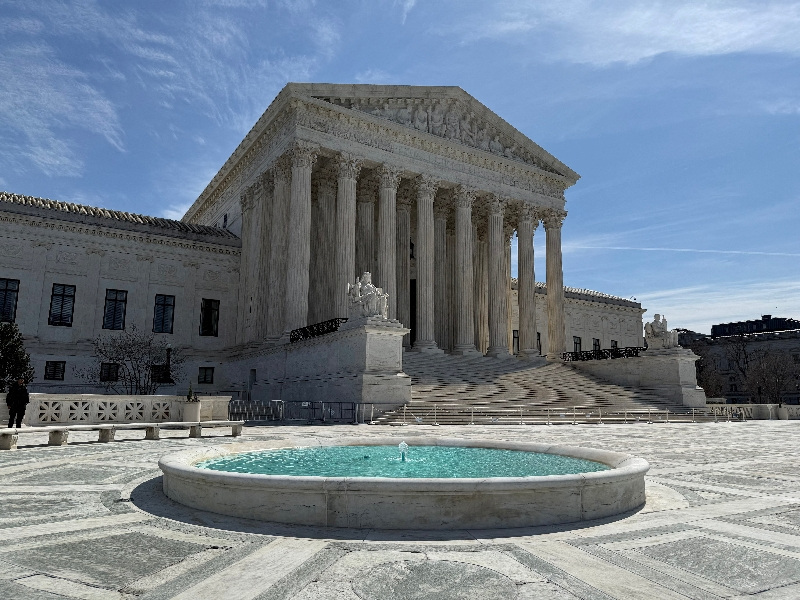

The Supreme Court‘s conservative majority handed Texas Governor Greg Abbott a win by reversing a lower court’s judgment in a case involving congressional maps.
An order list released on Monday stated that liberal Justices Sonia Sotomayor, Elena Kagan and Ketanji Brown Jackson dissented from the summary reversal. The justices did not file full written opinions in this case.
Texas Attorney General Ken Paxton praised the Supreme Court’s decision on X.
“Radical left-wing groups attempted to sabotage Texas’s lawful redistricting efforts, but the Supreme Court’s ruling is a clear rejection of these meritless attacks and a victory for the rule of law,” Paxton wrote. “Texas’s congressional map is lawful, constitutional, and reflects the will of our citizens, and I will continue to aggressively defend its use ahead of the 2026 midterm elections.”
The legal challenge stems from Texas’s attempt to redraw its congressional map ahead of the 2026 midterm election. Several non-profit organizations, including the League of United Latin American Citizens and Mi Familia Vota, challenged the map.
“The decision by the Supreme Court of the United States to allow Texas to move forward with its extremely gerrymandered map is deeply disappointing and dangerous for our democracy,” Héctor Sánchez, president and CEO of Mi Familia Vota, said in a statement sent to Newsweek. “At a moment when public trust in our institutions is already fragile, this ruling sends the wrong message: that politicians can pick their voters rather than voters choosing their representatives.”
The court previously stayed a preliminary injunction blocking the 2025 redistricting plan from taking effect for this year’s election cycle. Texas was then able to use the redrawn map for its primary election and will continue to use it for the remainder of the year.
The nonprofits asked the court whether proceedings should continue in this case and whether the district court properly issued the preliminary injunction.
The nonprofits argued Texas state legislators “made use of racial stereotypes when they described creating districts that would fulfill the political desires of Hispanic voters, but they had no information about how the Hispanic voters in those districts vote.”
Attorneys for the state argued that the district court was wrong in holding that an alternative-map requirement did not apply at the preliminary injunction stage and that it “failed to apply the presumption of legislative good faith.”
Why Did Texas Redraw Its Congressional Map?
Abbott called a special session of the state legislature in July 2025 for several reasons, including to pass legislation laying out a “revised congressional redistricting plan in light of constitutional concerns laid out by the U.S. Department of Justice.”
Earlier that month, the Department of Justice (DOJ) sent a letter to Texas stating it could seek legal action against the state for failing to fix “racial gerrymandering” in four districts. The agency cited a 2009 Supreme Court decision, which held that a minority group must constitute more than 50 percent of the voting population in a majority non-white district to be protected under the Voting Rights Act.
The nonprofits alleged the purpose of the new map was to “create Hispanic majority districts that would elect Republicans.”
“Even if Appellees were required to provide an alternative map (and they were not in light of the substantial direct evidence), Appellees demonstrated that the State could meet its partisan goals with alternative configurations that did not make predominant use of race,” attorneys for the nonprofits wrote.
The state’s attorneys argued the map was not a “racial gerrymander.”
“Neither the DOJ letter nor Governor Abbott’s statements, which Plaintiffs continue to misinterpret, constitute direct evidence of racial gerrymandering,” the attorneys wrote.
Lawmakers, Civil Rights Leaders React to Texas Redistricting Decision
Texas House of Representatives Minority Leader Representative Gene Wu said the Supreme Court “did not protect the Constitution” in its decision.
“It protected Greg Abbott’s racist map and gave Donald Trump exactly what he demanded from Texas Republicans: stolen seats, weaker Black and Latino voting power, and a rigged path to keep control of Congress,” Wu said.
Abbott replied on X, “Cry harder.” Wu responded with a screenshot of an article from The Texas Tribune calling the “redistricting war” a “wash,” and wrote, “Scoreboard.”
Republican Texas State Senator Mayes Middleton wrote on X, “The Big Beautiful Map stands! I’m proud to have fought to make this law and now let’s go elect those 5 additional Republican Congressional seats we drew!”
Damon Hewitt, president and executive director of the Lawyers’ Committee for Civil Rights Under Law, said the Supreme Court’s decision “added a profound insult to an already harmful injury.”
“The facts are very clear in this case. The Trump administration told Texas to take a wrecking ball to majority-minority Congressional districts, and that’s precisely what it did. This was an intentional effort to limit the power of people of color in a state known for going to extremes to suppress the vote,” Hewitt said in a statement sent to Newsweek.
Rob Weiner, director of the Voting Rights Project at the Lawyers’ Committee for Civil Rights Under Law, said that “the intent to discriminate was obvious.”
“The decision today casts doubt on the Court’s avowed commitment to race-neutrality in government decision-making,” Weiner said. “Apparently, that approach focuses on efforts to counter discrimination, and skims over discrimination itself. In Texas, the 40 percent of the population that is white controls 70 percent of Congressional districts. Something is wrong with this picture and with the Court’s indifference to the disparity.”
What Does This Mean for Redistricting in Other States?
While the court’s decision does not directly impact redistricting efforts in other states, it is a significant decision, as multiple states have committed to redrawing their congressional maps.
Republicans think they could win up to nine more seats under revised districts in Texas, Missouri, North Carolina and Ohio. Democrats think they could win as many as 10 additional seats under new districts in California, Utah and Virginia. Some states continue to face legal challenges to their redrawn maps.
Ahead of this year’s midterms in November, Republicans are looking to maintain their majority in Congress, while Democrats would like to flip several districts to establish a majority.
Virginia Supreme Court Redistricting Case: What We Know
The Virginia Supreme Court is considering whether the state’s Democratic-led legislature complied with constitutional requirements in a congressional redistricting plan sent to voters. The new districts, which could result in four additional seats for Democrats, were narrowly approved by voters last week.
A legal challenge by Republicans alleges that the General Assembly violated procedural rules by putting the constitutional amendment before voters to approve the mid-decade redistricting. If the court agrees, it could invalidate the amendment.
This article includes reporting by The Associated Press.
Do you have a story that Newsweek should be covering? Do you have any questions about this story? Contact LiveNews@newsweek.com.
Related Articles