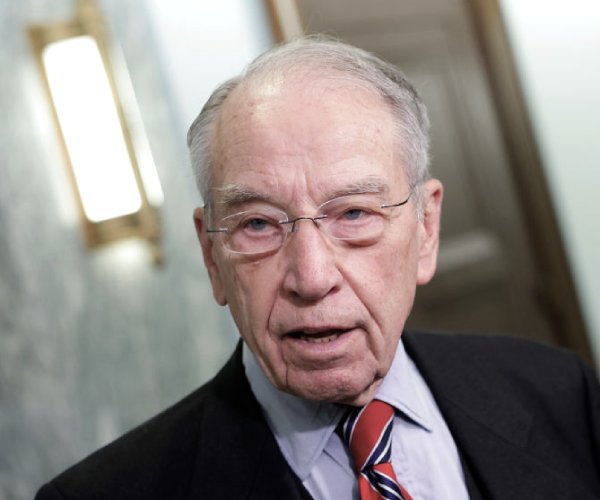
Sen. Chuck Grassley, R-Iowa, again called attention to what critics say is a long-running double standard at the Justice Department — this time with the release of an FBI document tied to the Clinton Foundation.
The newly disclosed 12-page "electronic communication" from the FBI's Washington Field Office shows that the bureau had enough information to open a preliminary investigation into the Clinton Foundation, including multiple allegations involving foreign money, political influence, and high-level government access.
In a Monday letter to acting Attorney General Todd Blanche and FBI Director Kash Patel, Grassley cited what he described as troubling patterns in the document, writing that it included "numerous allegations of foreign influence concerns that arose 'from speaking fees and donations to the [Clinton] Foundation.'"
Among the examples cited: $2.35 million in donations from the former head of Russia's Uranium One, a deal that has long drawn scrutiny. The FBI record also outlines donations tied to a Polo Resources executive, followed shortly thereafter by U.S. diplomatic involvement in Bangladesh on a mining issue connected to that company.
The document further details claims involving a Colombian timber deal and another Clinton Foundation donor, raising additional concerns about possible pay-to-play arrangements.
One of the more striking entries notes that Hillary Clinton traveled to Russia and allegedly encouraged "Russian officials to enter into a $3.7 billion aircraft purchase with Boeing." Just two months later, Boeing pledged $900,000 to the Clinton Foundation.
The EC also highlights a separate issue in Haiti, where Hillary Clinton's brother obtained a "rare 'gold exception permit' (the first issued in 50 years) … during the same time period in which 'billions of U.S. tax dollars had been spent in Haiti, following the Haitian earthquake in 2010.'"
Despite the scope of those allegations, the investigation never gained real traction, which Grassley and other Republicans say reflects institutional resistance at the DOJ.
Earlier documents released by Grassley showed that FBI field offices in New York, Little Rock, and Washington launched Clinton Foundation-related inquiries. But those efforts ran into pushback from the Justice Department's Public Integrity Section, led at the time by Ray Hulser.
Hulser later told Special Counsel John Durham that although he had "declined prosecution on behalf of the Public Integrity Section, he told the Office he 'made it clear, however, that his decision was not binding on the various U.S. Attorneys' Offices or FBI field divisions."
According to a Federalist report, he also argued the case presented by the FBI fell short, stating that "the FBI briefing was poorly presented and that there was insufficient predication for at least one of the investigations due to its reliance on allegations contained in a book."
But not everyone inside DOJ agreed. Another official said the department's "reaction to the Clinton Foundation briefing was 'hostile.'"
Even after President Donald Trump took office, the investigation appeared to stall. A March 6, 2020, "Investigative Update" memo revealed that key requests for investigative action remained unresolved nearly two years after they were first submitted.
For critics, the bigger issue is the contrast with how federal authorities handled Trump-related investigations.
While the Clinton Foundation probe remained at a preliminary level despite detailed allegations, the FBI launched the debunked Crossfire Hurricane as a full investigation into Trump's campaign based on comments attributed to George Papadopoulos regarding Russia and Hillary Clinton.
Grassley has been outspoken about what he sees as unequal treatment under the law.
"For too long, our Justice Department has chosen winners and losers instead of enforcing the law without regard to power, party or privilege," the senator said when releasing earlier documents.
© 2026 Newsmax. All rights reserved.