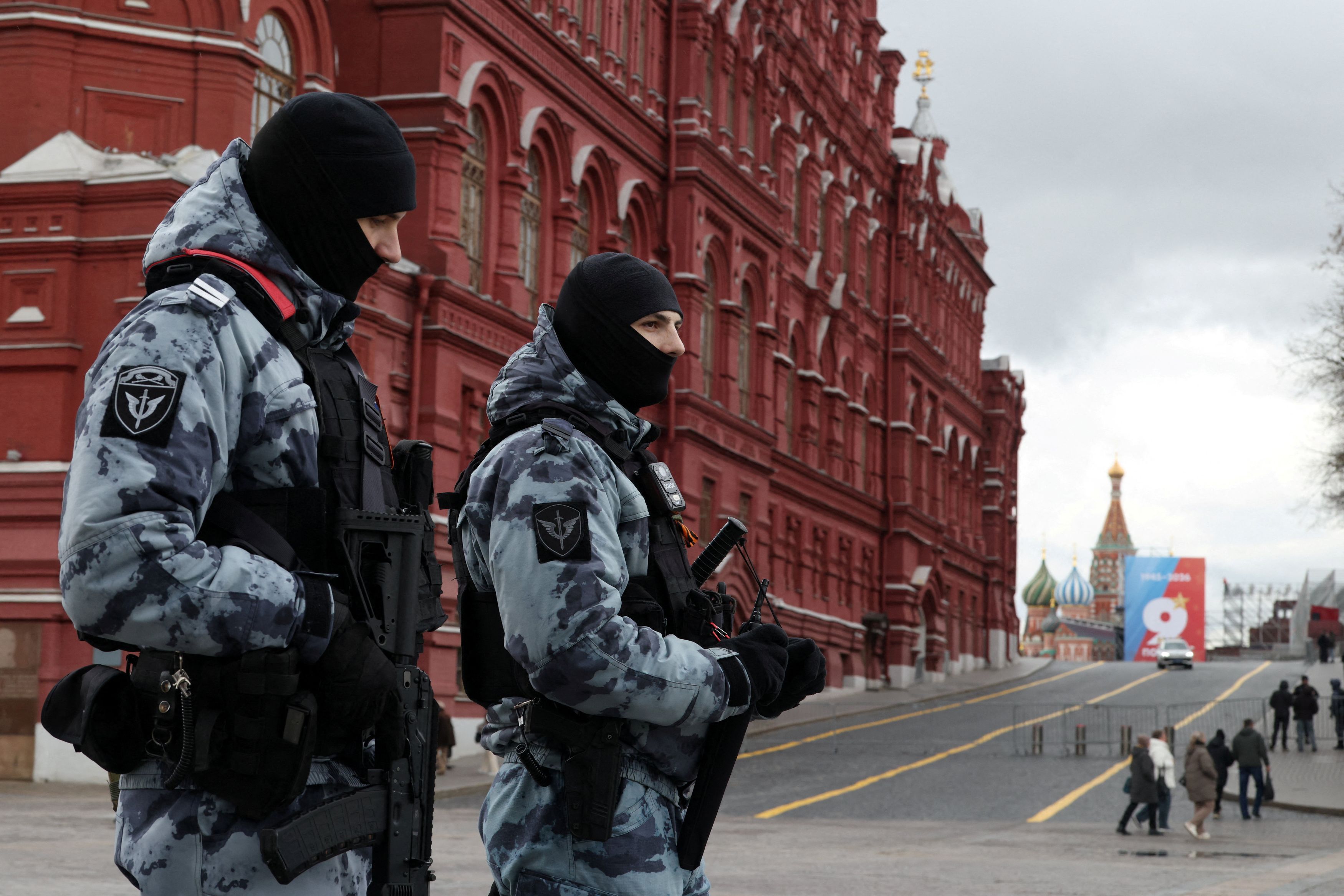
Russia’s Victory Day, its foremost national holiday, in commemoration of its defeat of Nazi Germany at unthinkable cost, also serves as a showcase of its military might. Last year, as the year before, tanks and missiles, including nuclear-capable weapons, rolled through Red Square. In 2024, Moscow staged an exhibition of captured war trophies: military hardware taken in Ukraine.
This year is set to look different. Russia is scaling back its upcoming Victory Day parade, to be held without a spectacle of armaments for the first time in nearly 20 years, amid fears of long-range Ukrainian strikes.
The May 9 event will proceed in a reduced format, with a smaller number of participants — several military schools and cadet corps are not to take part “due to the current operational situation,” the Russian Defense Ministry said in a statement posted to Telegram on Tuesday. An aerial display is still planned, with Su-25 jets expected to “color the skies of Moscow” with the Russian flag.
The parade and the broader symbolism of the Soviet toll in World War II have long formed the backbone of the hypernationalist, militaristic identity President Vladimir Putin has worked to forge over his more than quarter-century in power.
Since the full-scale invasion of Ukraine began in 2022, the event has taken on new purpose, with Putin and other officials using it to justify the war and stoke fervor by claiming that Russian soldiers are repeating the deeds of their ancestors in “denazifying Ukraine” — one of the stated goals used in Kremlin rhetoric to explain its ongoing pursuit of a war now entering its fifth year, already longer than Russia’s own account of Soviet participation in World War II.
The parades have been scaled back since 2022 to a varying degree, but last year’s event, which marked the 80th anniversary of Victory Day, saw about two-dozen world leaders, including Chinese President Xi Jinping, in attendance, as thousands of troops — some of whom had fought in Ukraine — marched alongside tanks and new drones.
The guest list for this year remains unclear, though Kremlin foreign affairs aide Yuri Ushakov confirmed that Slovak Prime Minister Robert Fico is expected to attend — one of the few remaining European leaders sympathetic to Putin, after Hungary’s Viktor Orban lost his parliamentary majority this month.
The Kremlin attributed the changes this year to “Ukrainian terrorist activity,” though Russian military bloggers and analysts have been more specific, suggesting Moscow fears Ukrainian long-range drone strikes could target hardware during the weeks of outdoor rehearsals that precede the event.
Ukraine’s reach inside Russia has expanded dramatically over years of war, as Kyiv has moved from largely reactive cross-border strikes to a sustained campaign targeting infrastructure hundreds of miles from the front powered in large part by a rapidly scaled domestic drone industry.
Russian military expert Ruslan Leviev, speaking to independent Russian-language TV Rain, said the decision probably comes down to the vulnerabilities that hardware creates in the run-up to the parade.
The equipment is usually staged for rehearsals and then for the parade itself on designated grounds outside Moscow — open areas that would be far easier to hit with drones or missiles. Troops and aircraft, by contrast, are much harder to target precisely: Soldiers will be surrounded by tourists and ordinary residents lining the route, making a pinpoint strike difficult.
The decision may also be shaped by attrition on both sides, Leviev said, with both Russia and Ukraine losing air defense systems at a significant rate, reducing Moscow’s ability to counter an already intensifying drone campaign.
Last year, Moscow shut down internet across the capital around the parade, citing security concerns, and similar measures are expected this year. Russia has made some of its most sweeping moves to isolate its domestic internet from global networks in recent months, with several regions experiencing rolling mobile blackouts and the introduction of whitelists that keep only government-approved websites and services accessible, while VPNs and other bypass tools face a renewed crackdown.
The announcement of scaled-down commemorations comes as Russia absorbs a wave of Ukrainian drone attacks on key infrastructure. Overnight, a major oil refinery in Tuapse, on the Black Sea coast, was struck for the third time this month, triggering a large fire and forcing the evacuation of nearby residents, a local official said.
Earlier strikes at the same facility caused a large oil spill, prompting a local environmental emergency. Local outlets and residents shared reports of “black rain” falling on the town and a nearby beach resort, leaving an oily residue. The Kremlin, in response, accused Kyiv of worsening global oil shortages and further destabilizing energy markets.
Ukrainian President Volodymyr Zelensky said Wednesday that Ukraine intends to increase pressure on Russia and extend the range and scale of its strikes into Russian territory, posting footage of what he described as an attack on a target more than 900 miles away.
Zelensky said on X that Ukraine’s security service had reported a successful strike deep inside Russia, calling it “a new stage in the use of Ukrainian weapons to limit the potential of Russia’s war.”
Most Read From The Washington Post
- Charles, Camilla and the Trumps put on a well-styled display of unity
- Trump’s ballroom is about money — not security or state dinners
- I cannot stop thinking about Cheryl Hines at the correspondents’ dinner
- Trump welcomes King Charles III and Queen Camilla for state dinner
- Guests at state dinner honoring King Charles III include Tim Cook, Robert Kraft