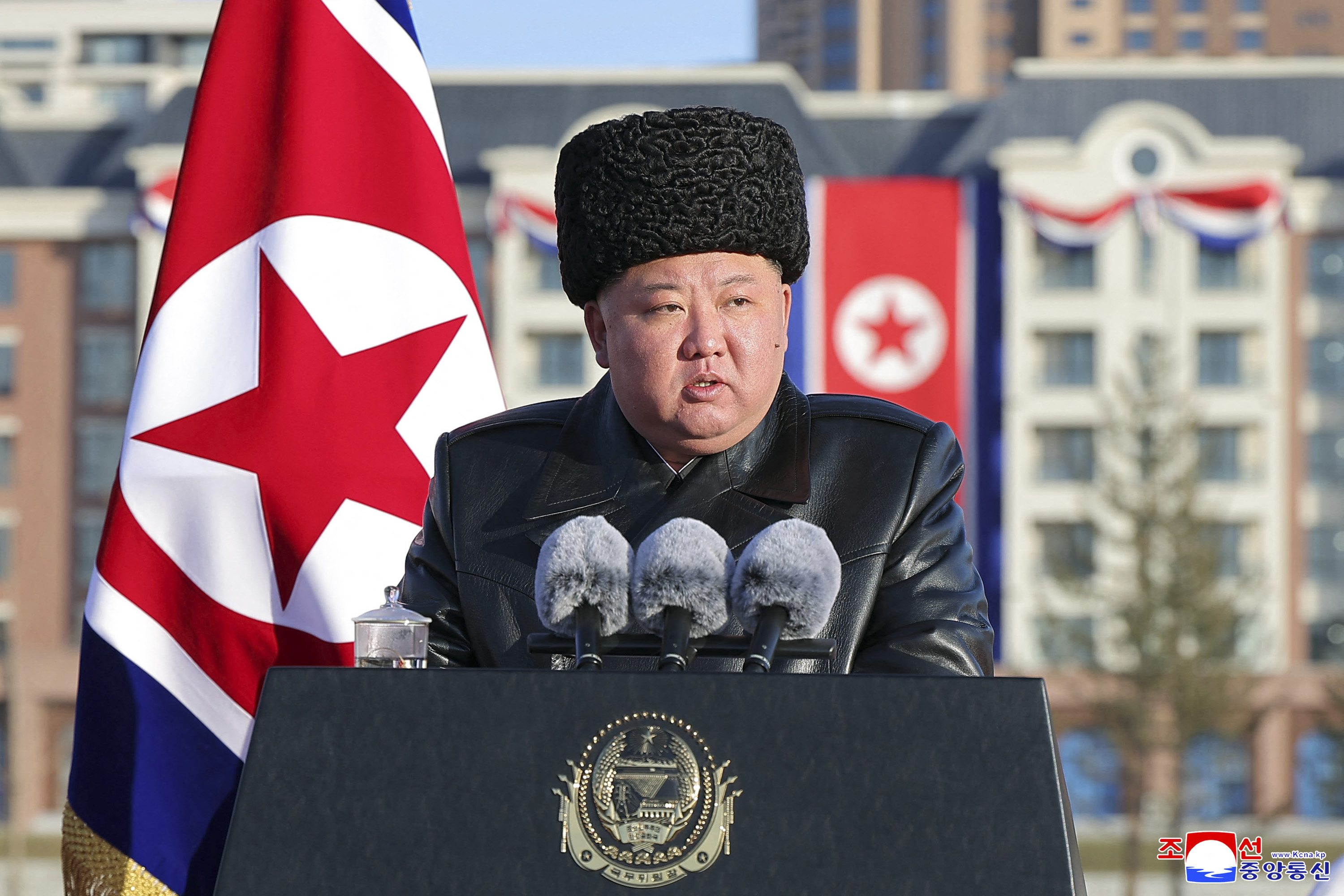
North Korea has removed references to reunifying with the south of the Korean peninsula signaling the latest push by the secretive state for a more hostile policy toward Seoul.
North Korea’s constitution had claimed authority over the entire Korean Peninsula as did South Korea’s own constitutional claim and reunification was Pyongyang’s stated goal for decades.
But a clause that North Korea sought the “reunification of the motherland” no longer appears in the latest version of the constitution, according to South Korean news outlet Yonhap.
The revision marks the first time North Korea has added a territorial clause to its constitution, according to Reuters, which said that it is believed to have been adopted at a meeting of the country’s legislature, the Supreme People’s Assembly in March.
The removal of reunification from the North Korean constitution has been long-expected, said Edward Howell, international relations lecturer at the University of Oxford, and author of the forthcoming book: ‘A New Axis of Upheaval: North Korea, Russia, China, Iran.”
He told Newsweek the news only reinforces North Korean rhetoric that South Korea is the North’s principal foe and ’most hostile’ adversary.
“In North Korea’s eyes, the two Koreas are now no longer part of the same ‘Korea’—and this perception is now permanent,” said Howell.
The new Article 2 of the constitution says North Korea’s territory includes land bordering China and Russia to the north and “the Republic of Korea to the south,” as well as territorial waters and airspace based on that land, according to the text.
The clause also says North Korea “will never tolerate any infringement” of its territory, but does not specify where its border with South Korea lies nor mention disputed maritime boundaries such as the Northern Limit Line in the Yellow Sea.
According to Howell, the revised constitution has seen a somewhat clear delineation of North Korea, although “the precise location of the border between North and South Korea—on land and maritime—is undefined, which leaves open the possibility for North Korean provocations.”
The revised constitution designates Kim Jong Un as chairman of the State Affairs Commission, North Korea’s head of state, replacing previous terms that listed the supreme leader as representing the state.
It also says command over North Korea’s nuclear forces rests with Kim, while a defense clause describes North Korea as a “responsible nuclear weapons state,” adding it will advance nuclear weapons development to safeguard the country’s survival.
“It is unsurprising that Kim Jong Un’s position as having command of North Korea’s nuclear forces has been consolidated, together with reference to North Korea’s self-declared status as a ‘responsible nuclear weapons state,'” added Howell.
What North Korea’s New Constitution Means for the U.S.
The constitutional revision comes as Pyongyang’s policy toward Seoul has become more hostile in recent years, rejecting repeated calls for dialogue from South Korean President Lee Jae Myung.
After the armistice that ended the Korean War in 1953, the U.S’s Korea policy was based on the idea shared by Seoul—that reunification, however distant, remained the goal for the peninsula. By codifying a permanent two‑state framework, Pyongyang is signaling it no longer sees integration, negotiation or reconciliation with the South as either desirable or inevitable.
For the United States, that shift complicates diplomacy in three key ways.
1) It hardens the dividing line that has underpinned the armistice since 1953. Reunification language has acted as a diplomatic safety valve, allowing dialogue during heightened tension.
Removing it also narrows the scope for engagement and makes any future agreement—whether on arms control, sanctions relief or crisis management—more transactional and potentially more fragile.
2) The revised constitution strengthens Kim’s authority over North Korea’s nuclear arsenal by explicitly placing command powers in his hands. This reinforces Washington’s view of Pyongyang as a permanent nuclear state, rather than a provisional one negotiating toward denuclearization. That could further entrench U.S.‑South Korea deterrence posture, including missile defense, joint military exercises and extended nuclear commitments.
3) The move carries regional implications for U.S. alliances. Japan and South Korea rely on U.S. security guarantees based on preventing war and managing eventual peace.
If North Korea legally defines South Korea as a separate state—rather than part of a divided nation—this could mean confrontation in the long-term, increasing the risk of miscalculation and raising pressure on Washington to demonstrate credible deterrence.
Update, 5/6/26, 9:05 a.m. ET: This article has been updated with comment from Edward Howell.
Related Articles