In the wake of a sudden and high‑stakes leadership shake‑up at the Pentagon, Hung Cao has been thrust into the spotlight as Acting Secretary of the Navy at a time of escalating U.S.–Iran tensions during a fragile ceasefire in the war.
The Pentagon abruptly announced on Wednesday that Navy Secretary John Phelan was leaving his job and that Cao, the Navy’s second-ranking civilian official and a 25-year Navy combat veteran, would be taking over immediately.
The shakeup is notable due to its timing, as the Navy is continuing to enforce a U.S. blockade of Iranian ports even after President Donald Trump said he would extend the two-week ceasefire with Iran.
A Baptism of Fire
Cao assumes the top civilian leadership of the Navy at a time when the service cannot afford turmoil, as it remains at the center of the United States’ pressure campaign on Iran.
Retired U.S. Navy Vice Admiral Robert Murrett, who is now a professor of practice of public administration and international affairs at Syracuse University, told Newsweek that even though Phelan’s responsibilities were largely administrative, “this latest shift does reflect a turbulent 15 months of turnover in the Pentagon.”
Cao’s immediate challenges “will be to establish good working relations with the rest of the Pentagon leadership, and to engage on the constructive basis with the Navy and Marine Corps.,” he said. “Morale and the operational tempo of both services (for which he had administrative responsibility) will require attention.”
Stress and the Ceasefire
As well as the maritime blockade in the Strait of Hormuz, the U.S is also targeting ships linked to Tehran around the world during a tenuous ceasefire in the war. The Navy has redirected or boarded multiple vessels during the blockade as Iran has fired on U.S. ships and seized at least two vessels—making it a high-stress debut in the role for Cao.
The Trump administration has said all the armed forces are poised to resume combat operations against Iran should the ceasefire expire.
The Navy has also maintained a heavy presence in the Caribbean, where it has been part of a campaign of strikes against alleged drug boats. It played a major role in the capture of Venezuelan leader Nicolás Maduro in January.
Behind the Shake-Up
Pentagon spokesman Sean Parnell said in a post on X on Wednesday that Phelan was “departing the administration, effective immediately.” No explanation was given.
Phelan’s departure stemmed from tension with Defense Secretary Pete Hegseth over shipbuilding priorities, CNN reported, citing six unnamed sources familiar with the matter. The outlet said multiple sources described months of tension between Phelan and Hegseth, who though Phelan was moving too slowly on implementing shipbuilding reforms and was annoyed by Phelan’s direct communication with the president.
Michael C. Horowitz, a professor of political science at the University of Pennsylvania and a senior fellow at the Council on Foreign Relations, told Newsweek that the Navy “faces enormous challenges when it comes to getting shipbuilding and maintenance in order for larger ships as well as the urgent need to scale smaller vessels.”
He said: “A key task for the next Secretary will be aggressively working to address the surface ship and submarine gaps that have existed across multiple administrations, and which the Trump administration is focused on addressing.”
Murrett also said how Cao handles shipbuilding reforms will be key.
“The current administration has placed a strong emphasis on reforming U.S. Navy shipbuilding capability, and there has been some level of dissatisfaction with how that was handled by Phelan as a mission for the Department of the Navy,” he said.
Phelan’s exit is the latest in a series of leadership shake‑ups at the Pentagon. Hegseth fired the Army’s top officer, General Randy George, earlier this month and has removed several senior generals, admirals and civilian officials.
Has a Navy Secretary Been Removed During Wartime Before?
There is no historical precedent for the removal of a Secretary of the Navy during a major war.
The closest case is the forced resignation of Fred Korth, who was head of the Navy under President John F. Kennedy, in October 1963, which was driven by conflict of interest allegations and bureaucratic clashes.
That came while the U.S. was military engaged in Vietnam but before the full-scale escalation after 1964.
Even after the attack on Pearl Harbor in 1941, Washington preserved civilian leadership and Navy Secretary Frank Knox remained in office. Instead, President Franklin D. Roosevelt’s administration relieved Admiral Husband E. Kimmel, who was commander in chief of the United States Pacific Fleet, of duty on Knox’s recommendation.
Who Is Acting Navy Secretary Hung Cao?
Cao was sworn in as Undersecretary of the Navy in October last year, according to his biography on the Navy’s website. It describes him as a decorated combat veteran and qualified special operations, explosive ordnance disposal, diving, parachutist, and surface warfare officer.
His Senate campaign biography said he arrived in the United States as a refugee from Vietnam in 1975. He has compared Vietnam’s communist regime during the Cold War to the administration of Democratic President Joe Biden.
Cao and his family lived in West Africa for a few years, before they moved to Virginia when he was 12. He later graduated from the prestigious Thomas Jefferson High School for Science and Technology in Alexandria, Virginia.
He entered the Navy in 1989 and was commissioned as a special operations officer before going on to serve with SEAL teams and special forces in Iraq, Afghanistan and Somalia before retiring at the rank of captain.
Cao also holds a bachelor’s degree in ocean engineering, a master’s degree in physics and had fellowships at the Massachusetts Institute of Technology and Harvard University, according to his Navy biography.
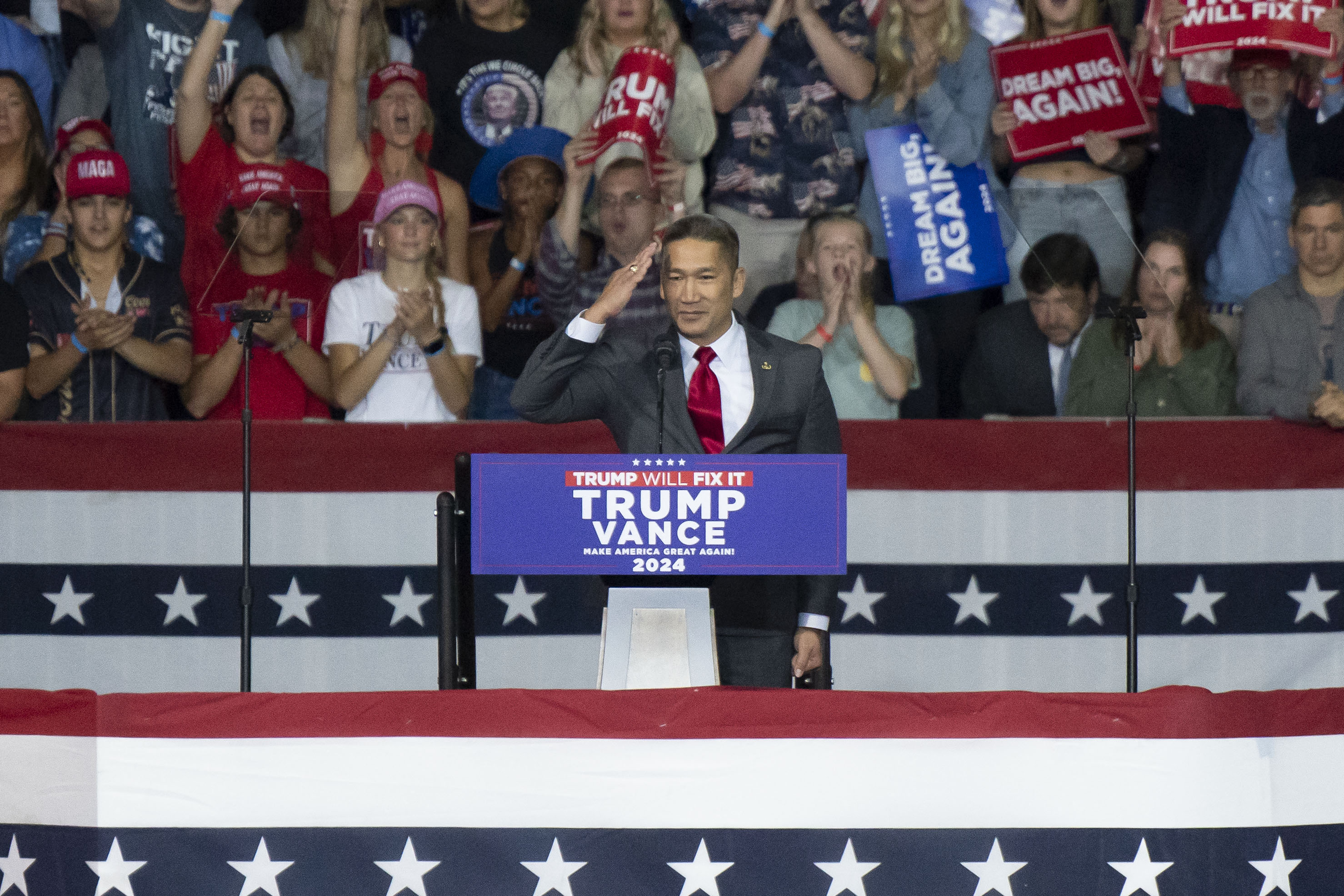
Cao ran a failed U.S. Senate bid in Virginia to try to unseat Democratic Senator Tim Kaine in 2024. He had Trump’s endorsement in the crowded Republican primary and gave a speech at the 2024 Republican National Convention.
During his one debate with Kaine, Cao criticized COVID-19 vaccine mandates for service members as well as the military’s diversity, equity and inclusion efforts.
“When you’re using a drag queen to recruit for the Navy, that’s not the people we want,” Cao said from the debate stage. “What we need is alpha males and alpha females who are going to rip out their own guts, eat them and ask for seconds. Those are the young men and women that are going to win wars.”
Since becoming Navy undersecretary, Cao has championed returning to duty service members that refused a Biden-era mandate to take the COVID-19 vaccine.
Update 4/23/26, 10:37 a.m. ET: This article has been updated with a comment from Michael C. Horowitz.
Related Articles