School meals are changing: pizza, sponge puddings, and fish and chips are off the menu as new government proposals limit foods and drinks high in fat, salt and sugar.
Kids’ favourites like sausage rolls and pizza will no longer be available every day, while fruit will be served instead of desserts for most of the school week. New, healthier meals will include spaghetti bolognese, Mexican-style burritos, cottage pie with root-veg mash, jerk chicken with rice and peas, and roasted chickpea, vegetable and mozzarella wraps.
It’s a change that campaigners like Jamie Oliver and Henry Dimbleby have been wanting for years, along with parents – 74 per cent of whom have at least one concern about their child’s nutrition, according to a new poll, from too much sugar (43 per cent) and too many fatty foods (24 per cent) to not enough fruit and vegetables (30 per cent).
“Today we have a rare chance to reset school food: wider access to free school meals, higher standards – with proper monitoring to help schools improve what ends up on the plate,” said Dimbleby, a former government food tsar, author of the “Independent National Food Strategy”, and co-founder of food chain Leon.
“September can mark the start of a new normal, where every child can count on a lunch that is both delicious and nutritious, and every parent can have real confidence in what’s being served. Done right, it will boost children’s health, their academic outcomes, and their chances of success in later life.”
Celebrity chef Oliver added: “Twenty years ago, dog food had higher standards than school dinners. I’ve been banging the drum ever since because I refuse to accept our kids being fed anything less than proper, nourishing meals.”
This shift is welcome news in England – but what about the rest of the world? At around £2.50 per child per meal, funding for school food in England still sits at the lower end of the scale internationally. In other European countries, public investment typically ranges between £5 and £8 per meal. Although funding models differ, with some systems combining national and local budgets, the overall picture is clear: countries that see nutrition as an important part of public health tend to spend significantly more per child than the UK.
School meals can differ vastly across the globe, from countries like Brazil and Japan, where nutritionists design school meals, to Mexico, where most children still bring in packed lunches, and France and Italy, where meals are three- to four-course affairs.
How do these school dinners compare?
France
‘Children were once allowed to drink small quantities of wine at school with their meals’
In France, school dinners are not just one plate – children are offered a starter, a main course, a vegetable side dish, a dairy product and a dessert. In true French style, bread is available as an addition, and the dairy products are often cheese. Sides can typically include pulses and cooked vegetables, while the proteins are normally fish, meat or egg, with typical meals including dishes like butter-parsley-baked sea bream and Toulouse sausage with polenta.
It is now also mandatory to have one vegetarian meal per week, while the products used in cooking must be 50 per cent sustainable and at least 20 per cent organic. As of 2025, it is prohibited to cook with plastic or serve food in plastic containers, meaning that France is well ahead in producing both environmentally friendly meals and toxin-free cooking.
But earlier in the 20th century, children were allowed to drink small quantities of wine at school with their meals. This changed in 1956, when it was forbidden to serve alcohol to children under the age of 14. It wasn’t until 1981 that the practice was banned entirely.
Today, school meals in France have a goal of “establishing social norms around eating” and “introducing [children] to culinary culture”, according to the School Meals Coalition. That means lunchtimes can last up to 90 minutes – something nutritionist Zoe Griffiths would love to see implemented in the UK.
“Our lunchtimes are really short, so children don’t have enough time to eat. Whereas in France, lunch is very much a social occasion where people sit and eat their food together. We need more time here.”
Japan
‘They eat together in a classroom setting to create more of a family feel’
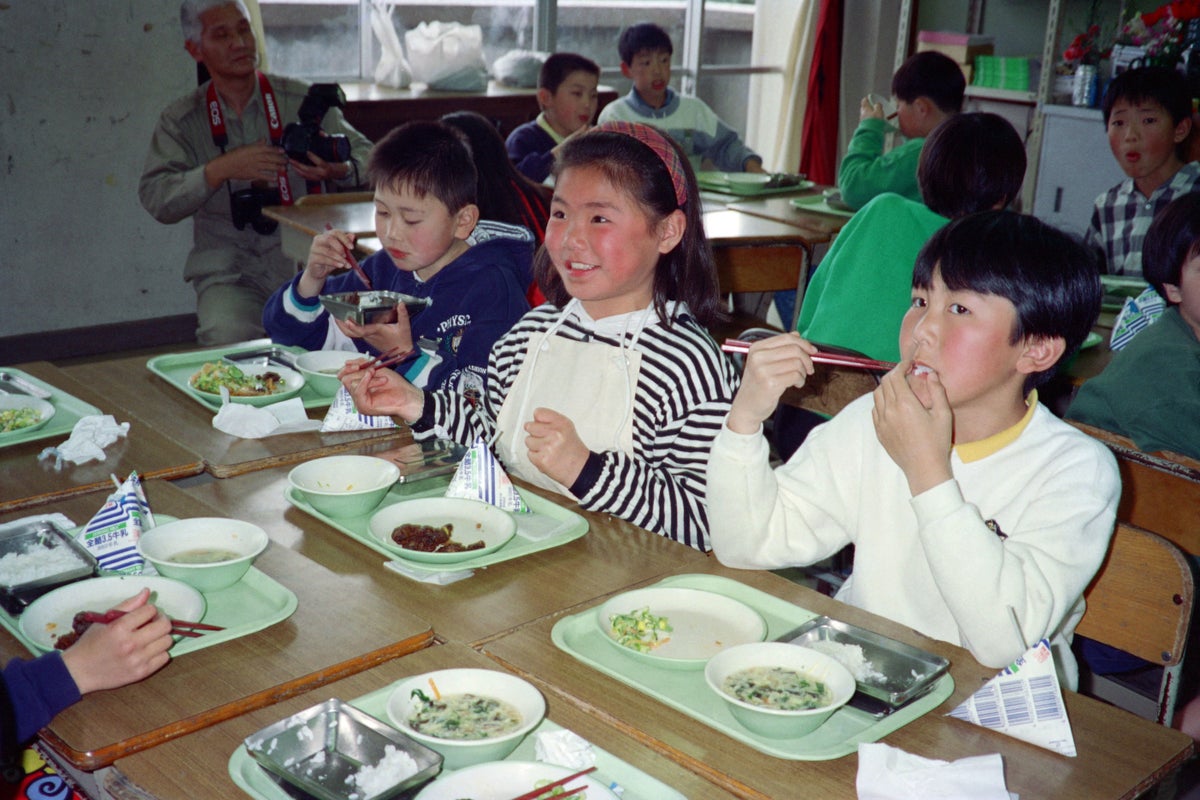
In Japan, 99 per cent of children eat school meals, and it’s no wonder why. School meals – or kyushoku – can look like bento boxes filled with rice, a protein (fish, tofu or meat), vegetables, and a soup like miso, and are made almost entirely from fresh ingredients. The set menu concept means there are no options for children to choose from, and dessert is only offered on special occasions.
But the best part is that almost every school has its own nutritionist to create bespoke lunchtime menus and work on an individual basis with any children who have allergies or eating issues. Having a nutritionist on hand also ensures that each school provides meals that adhere to government standards.
It’s not just about eating, either: the Japanese concept of shokuiku, which relates to food education and nutrition, has been integrated into the school curriculum. It is used to teach children about healthy eating and not wasting food at an early age, and children eat together in a classroom setting to create more of a family feel, instead of sitting in big canteens.
“In other countries [like Japan], the focus is on the children getting the nutritional needs they need to get through the day so they can learn and plan in a healthy way,” explains Griffiths. “In the past in the UK, that’s not really been the focus.”
USA
‘Food is frequently pre-made or frozen and reheated – images circulate of mystery meat’
In America, school meals are either hot or cold, and are typically served in cafeteria settings. The law states that they must include milk, fruits, vegetables, grains, and meat/meat alternatives. But there is nothing specifying that the fruit and vegetables have to be fresh, and as food is frequently pre-made or frozen and reheated in most schools, meals can end up being highly processed.
Food can differ between states, with some people on social media showing images of ultraprocessed “mystery meat”, chicken nuggets and tater tots, and others sharing the efforts of schools to try and cook healthier meals, such as a California school offering homemade traditional Mexican soup with fresh vegetables and tortilla chips.
Finland
‘One vegetarian meal every week’
Finland has offered free school meals to all children for more than 75 years, and the dinners have transformed from modest meals into “a multidimensional food education programme”, according to the School Meals Coalition.
Today, a school meal in Finland includes a warm main dish like kanakastike (creamy chicken) with salad, fibre-rich bread with margarine, and milk or a plant-based drink. As in France, it’s recommended that schools serve one vegetarian meal every week, and mealtimes are used as a chance to teach children food-related knowledge and skills.
Brazil
‘Qualified nutritionists are legally required to oversee school meals’
In Brazil, 50 million school meals are served daily, making it one of the largest school feeding programmes in the world. A typical meal includes the Brazilian staple of rice and beans, along with meat and vegetables or salad, with fruit for dessert. Schools are required to use fresh, local ingredients instead of offering processed food, with 30 per cent of food coming from local farms.
As a cornerstone of Brazil’s National School Feeding Programme, qualified nutritionists are legally required to oversee school meals. Not every school has its own nutritionist on hand, like in Japan, but each municipality or region will employ nutritionists to oversee multiple schools.
“British schools also have nutritionists working with school caterers to help plan menus,” says Griffiths, adding that, unlike in Brazil, it is unfortunately not a requirement. “We must do all we can to support caterers to provide the best menus they can.”
Mexico
‘Thirty per cent of food from local producers, particularly female farmers’
In Mexico, most children bring in a packed lunch instead of having a hot meal. They’ll typically bring in torta (a filled roll), elote (corn ribs), and spiced cucumber or fruit. Meanwhile, hot school meals consist of a drink such as atole (a masa-based drink), a main course that includes cereals, animal protein, legumes, healthy fats such as avocado, and a source of calcium, and preferably, fresh fruit and vegetables.
The government works with farmers to provide food such as eggs, poultry and vegetables, trying to buy at least 30 per cent of food from local producers, particularly female farmers. And in 2024, Mexico changed its guidelines, requiring schools to ban junk food and sugary drinks, and to promote whole grains and plain water instead.
India
‘Seven hundred calories and 20 grams of protein for upper primary students’
In India, school dinners are typically vegetarian. Protein comes from lentils, often in the form of a dhal, or legumes like chickpeas and beans, which are served with seasonal vegetables and rice or a roti.
As part of a new government scheme, one organisation – Akshaya Patra – feeds 2 million children a healthy vegetarian meal across 24,000 schools, tailoring it to local tastes. That could mean sukhdi (an Indian sweet) in Gujarat, or dalma, a dish featuring lentils with vegetables, in Odisha.
“Whether it’s biryani, khichdi, sambar, sabji, daal, kheer, roti or rice that’s on today’s menu, our meals are designed to provide hungry and growing children with generous portions and adequate quantities of micronutrients,” says the organisation. “This means 450 calories and 12 grams of protein for lower primary students, and 700 calories and 20 grams of protein for upper primary students.”
Italy
‘Menus are planned based on what is grown locally’
In Italy, school meals are not just one course: the first course will be a pasta or rice dish, followed by a second course of fish or meat, with a side dish (typically vegetables), bread, and fruit to finish.
“The school menu is usually changed two or three times a year to reflect the season,” writes one mum on her blog Eating Around in Italy. “Menus are planned based on what is grown locally and to embody the regional culinary traditions. This means that in Tuscany, my kids eat foods such as pici, pappa al pomodoro and ribollita. In Northern Italy, Italian kids eat foods like canederli, spaetzle and gnocchi more often.”
Meals are based on the Mediterranean diet, and are usually locally sourced.
Thailand
‘Breakfast can be a noodle dish with fish and soup’
In Bangkok, lunch typically includes rice with one or two side dishes and fruit/dessert, as well as milk. But because more than half of children come to school without having had anything to eat, many schools also provide breakfast, which could be pork congee, pork-fried rice, or a noodle dish with fish and soup.
Meals are designed to cover daily nutritional requirements, but research by the School Meals Coalition found that shortages of nutrition personnel and kitchen staff mean that sometimes teachers are forced to help prepare food.
Ghana
‘Meals must be varied, include a dark green leafy vegetable dish’
School meals were introduced in Ghana only in 2005, and were initially provided to just 1,900 pupils. They now feed more than 4 million pupils aged four to 12. The main objective of the meal is that it should be “hot and nutritionally adequate”, and use locally grown food.
Typical meals include rice, beans or cassava and maize meals, which are combined with groundnut soup, okra stew or tomato sauce. Nutritional standards mean meals must be varied, include a dark green leafy vegetable dish and a legume dish at least twice a week, and seasonal fruit is offered with meals at least once a week.
While the menus sound healthy and nutritious, a report from the School Meals Coalition warns that there are some challenges, including the low utilisation of locally grown food, and issues with keeping the meals fresh and hygienic.
The Independent is the world’s most free-thinking news brand, providing global news, commentary and analysis for the independently-minded. We have grown a huge, global readership of independently minded individuals, who value our trusted voice and commitment to positive change. Our mission, making change happen, has never been as important as it is today.