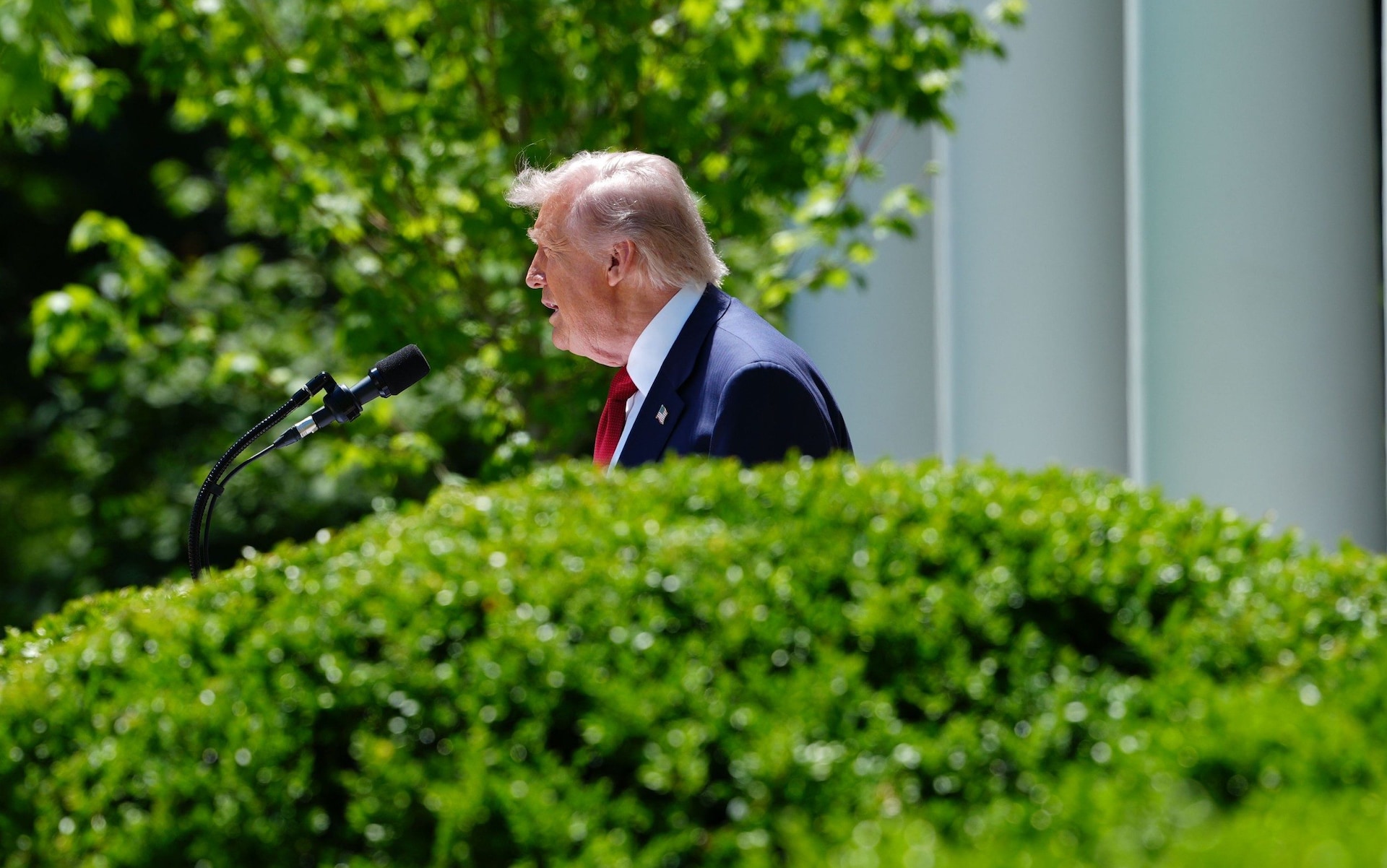
Donald Trump is trying to be blasé about the latest setback in his attempt to rewire global trade using tariffs.
“Nothing surprises me, so we always do it a different way. We get one ruling and we do it a different way,” he told reporters after America’s Court of International Trade (CIT) struck down his latest round of 10pc global tariffs on Thursday.
The CIT ruled that the mechanism Trump used to impose the levies was “invalid” and “unauthorised by law”.
On the surface, this seems manageable for the US president. The ruling only blocks Trump from charging the tariffs to a subset of the plaintiffs who brought the case – two businesses and Washington state – and it will not have an immediate effect on America’s tariff income. But it shows a rapidly growing fragility in Trump’s strategy.
“The implications should not be underestimated,” says Basil Woodd-Walker, a partner at the law firm Simmons & Simmons.
The ruling opens the door to both an influx of potential lawsuits from other businesses and a wider examination of Trump’s tariffs by higher courts.
‘The first step in the legal process’
Andrew Hale, a senior research fellow at US think tank Advancing American Freedom, says: “What you’re going to see now is more cases brought and also the issue progress to the US Court of Appeal for the Federal Circuit and then potentially the Supreme Court.
“This is the first step in the legal process. I expect the courts to rule that this is all illegal. Then, of course, there’ll be payouts, with interest.”
When Trump came into office last year, he conceived of tariffs on imports to the US as a way to not only rebalance global trade, but also fundamentally alter how the state funds itself.
Announcing sweeping “reciprocal” tariffs on America’s trading partners on April 2 last year, Trump proclaimed that the date “will forever be remembered as the day American industry was reborn, the day America’s destiny was reclaimed and the day that we began to make America wealthy again”.
Trump initially used the International Emergency Economic Powers Act (IEEPA) to impose tailored tariffs on countries around the world. But in February, the Supreme Court ruled that this was illegal.
Trump responded by immediately imposing a blanket 10pc tariff on America’s trading partners using Section 122 of the 1974 Trade Act, which allows the president to impose levies of up to 15pc for a maximum of 150 days.
At the same time, the White House accelerated investigations into 60 countries, including the UK, to find evidence of unfair trading practices that would mean Trump could impose tariffs on these nations under Section 301 of the same act.
But the bedrock of his economic agenda is crumbling. With it, so is his cash flow.
In April 2025, Citi calculated that Trump’s annual tariff haul would be $700bn (£514bn).
After a bond market revolt forced him to scale back, the Congressional Budget Office (CBO) said in November it was expecting Trump’s tariffs to bring in around $300bn a year.
Today, monthly revenues suggest Trump would net just $230bn a year from his remaining raft of tariffs, says Stephen Brown, the chief North America economist at Capital Economics.
At the same time, the US Treasury is now on the hook for some $166bn of refunds for tariffs paid under the IEEPA system struck down by the Supreme Court.
Section 122 levies account for about half of monthly tariff revenues, at around $12bn per month, according to Goldman Sachs. By the time they expire on July 24, they will have brought in some $60bn.
If a higher court imposes a broader ruling against them, that could pave the way for yet more refunds. Trump’s total tariff refund bill, including the $166bn for IEEPA, would climb to $226bn.
The CIT ruling against Trump’s use of Section 122 suggests his hopes of clawing back his lost IEEPA revenues through Section 301 investigations will also face big legal fights.
“It gives you a sense of what the administration will be up against when it tries to impose the next set of tariffs this summer. It is probably going to be very hard for the administration,” says Brown.
“That raises the risk that the Trump administration will eventually fail in its efforts to fully replace the lost revenue from IEEPA tariffs.”
Hale says: “They have to build a genuine legal argument. Under 301, you have to build a case that there is harm and unfair practices. They just want to replicate what they’ve lost under IEEPA and that’s not a legal argument.”
If the courts throw out Trump’s attempts to use Section 301, the effect on America’s public finances will be dire.
One big problem is that Trump has already spent more than the money he was expecting to receive from tariffs.
He claimed last year that the sweeping tax cuts in his One Big Beautiful Bill Act “will all be made up with tariffs”. This was only partly true.
The CBO expected tariffs to subtract $3tn from the national debt over a decade, while Trump’s tax cuts would add $4.7tn.
But the loss of tariff revenues will undoubtedly make America’s public finances worse.
The US deficit is already at 5.8pc of GDP, roughly double what it was a decade ago.
“We could be talking about a 7pc deficit over the next 12 months,” says Brown. This is unheard of in US history outside a recession.
A larger deficit risks higher government borrowing costs as investors baulk at US debt levels. In turn, this would mean higher mortgage rates and a bigger public debt interest bill, bringing fresh strain on the public finances.
Trump’s promise to “make America wealthy again” would go up in flames.
A White House spokesman said: “President Trump has lawfully used the tariff authorities granted to him by Congress to address our balance of payments crisis. The Trump administration is reviewing legal options and maintains confidence in ultimately prevailing.”