President Donald Trump’s approval index hit a new second-term low of -23 on May 5 in Rasmussen Reports’ daily tracking poll, driven by rising strong disapproval among likely voters.
The surveys of 1,500 likely U.S. voters shows 25 percent strongly approving and 48 percent strongly disapproving, with overall numbers at 41 percent approval and 57 percent disapproval—the widest negative gap in the dataset and the lowest index ever recorded for Trump in Rasmussen’s tracking series.
The shift is likely to affect Republican candidates and the White House’s political leverage, particularly among persuadable voters in swing districts, as the GOP faces intensifying scrutiny over foreign policy and economic pressures ahead of November’s midterm elections.
Notably, Rasmussen Reports traditionally leans toward Republican voters, making a sustained decline in this series particularly significant for understanding erosion within Trump’s own coalition.
Trump’s Approval Trends Down
Rasmussen Reports’ daily Presidential Tracking Poll surveys 1,500 likely U.S. voters per release, with a margin of error of plus or minus 3 percentage points. It uses an automated telephone and online methodology conducted daily, typically in the evenings, with demographic weighting applied to match the electorate.
Unlike many pollsters, Rasmussen surveys likely voters rather than registered voters or adults, and it offers four response categories—strongly approve, somewhat approve, somewhat disapprove and strongly disapprove—which are then aggregated into total approval and disapproval.
On Tuesday, Rasmussen recorded Trump’s approval index at -23, calculated as strongly approve minus strongly disapprove.
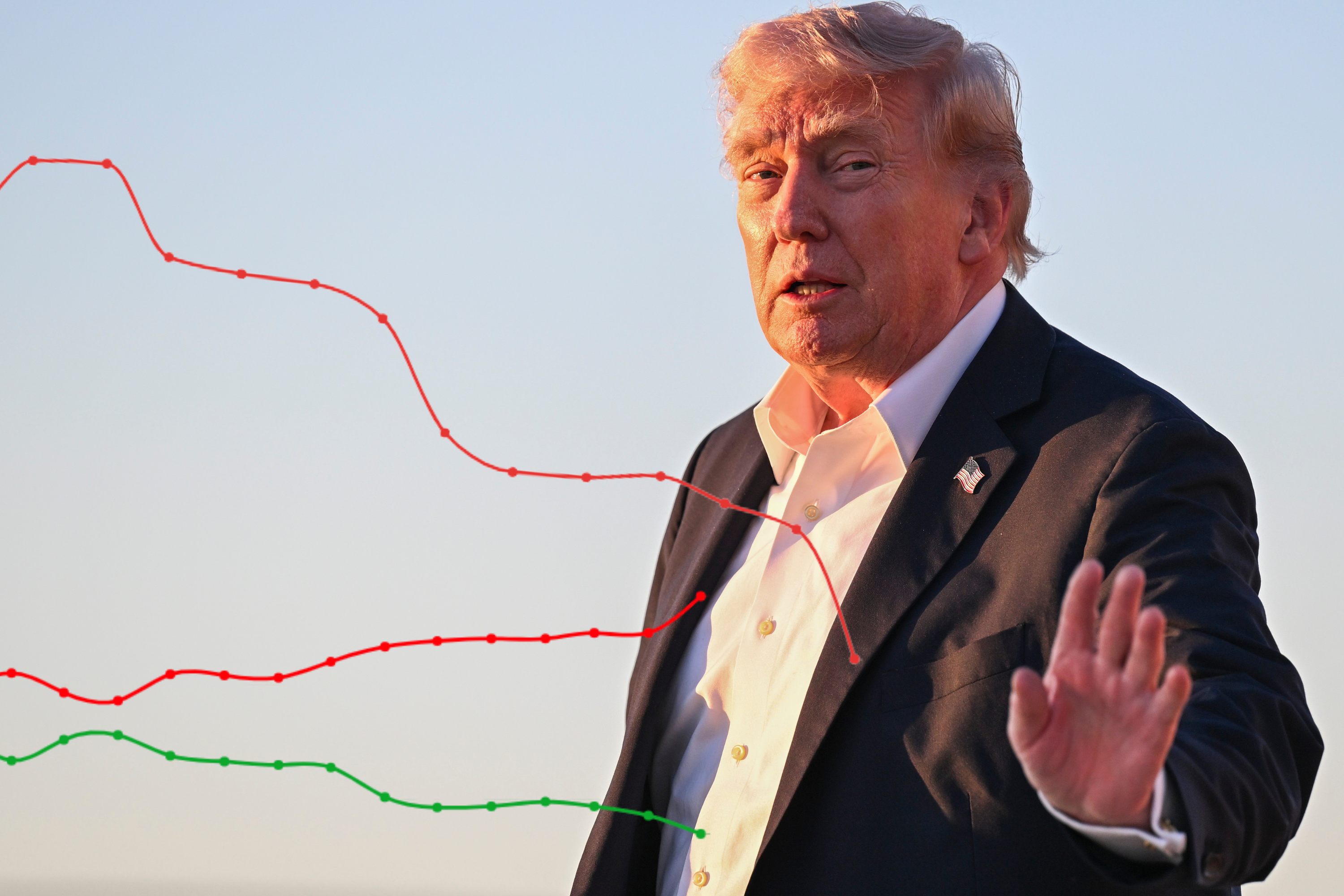
The chart shown above illustrates a clear directional trend rather than a sudden collapse. Trump returned to the White House on January 20, 2025, and over the year that followed, his position weakened gradually. In January 2025, the approval index remained positive, averaging +2.3, with strong approval at about 38 percent and strong disapproval at roughly 36 percent. That equilibrium did not hold.
By late spring and summer, the index had slipped into negative territory, averaging -3.4 in March and -6.6 in April, as strong disapproval began to outpace strong approval more consistently.
The divergence widened through the second half of the year: By October, the index averaged -8.6, and by December, it had dropped further to about -14.7.
The pattern is visually clear in the chart below: The green line (strongly approve) trends downward across the year, while the red line (strongly disapprove) steadily rises. What begins as a narrow gap in early 2025 becomes a persistent and widening deficit by year’s end.
Early 2026 saw relative stabilization, but at a lower baseline. From January through March, the index hovered between roughly -14 and -15, suggesting that losses had plateaued rather than reversed. Strong disapproval remained entrenched in the mid-40s, while strong approval struggled to recover meaningfully.
That equilibrium broke in late April and early May. The data shows a renewed deterioration, with the index sliding from -15 on April 13 to -18 by April 22, and eventually to -23 by May 5.
During this period, strong disapproval climbed to 48 percent, while strong approval fell into the mid-20s—its lowest sustained level in the dataset.
The significance lies not only in the topline decline but also in the intensity measure because “strong” sentiment is often viewed as more predictive of turnout and vote choice.
Here, the gap between strongly approve and strongly disapprove has widened sharply—from near parity in early 2025 to more than 20 points by May 2026.
What Polling Aggregates Say
Broader polling averages point in the same direction, reinforcing Rasmussen’s signal.
A recent CNN “poll of polls”—which aggregates surveys from outlets such as ABC News/Washington Post, Pew Research Center, Reuters/Ipsos and AP-NORC—shows Trump at 35 percent approval and 64 percent disapproval, a net rating of -29—also a low point.
The New York Times polling average similarly places Trump at 38 percent approval and 58 percent disapproval, a net of -20, which marks his weakest standing in that series.
Pollster Nate Silver’s Silver Bulletin average, updated on Tuesday, shows Trump at -18.4 net approval, following a recent dip to -18.8, with most new polls trending negative. Individual surveys cited in that average include Reuters/Ipsos (-30) and Economist/YouGov (-22), underscoring the breadth of the downturn across different methodologies.
Response From Trump and the White House
The president has, however, rejected negative interpretations of his polling numbers, telling Newsmax in a recent phone interview: “It is a problem I’m not on the ballot. Everyone says if I was on a ballot, we’d win in a landslide. I have some of the best poll numbers I’ve ever had.”
When approached for comment, White House spokesperson Davis Ingle told Newsweek: “The ultimate poll was November 5, 2024, when nearly 80 million Americans overwhelmingly elected President Trump to deliver on his popular and commonsense agenda.
“No other president in history has accomplished more for the American people than President Trump, who is working tirelessly to create jobs, cool inflation, increase housing affordability, and more. The president has already made historic progress not only in America but around the world, and this is just the beginning as his agenda continues taking effect.”
Related Articles