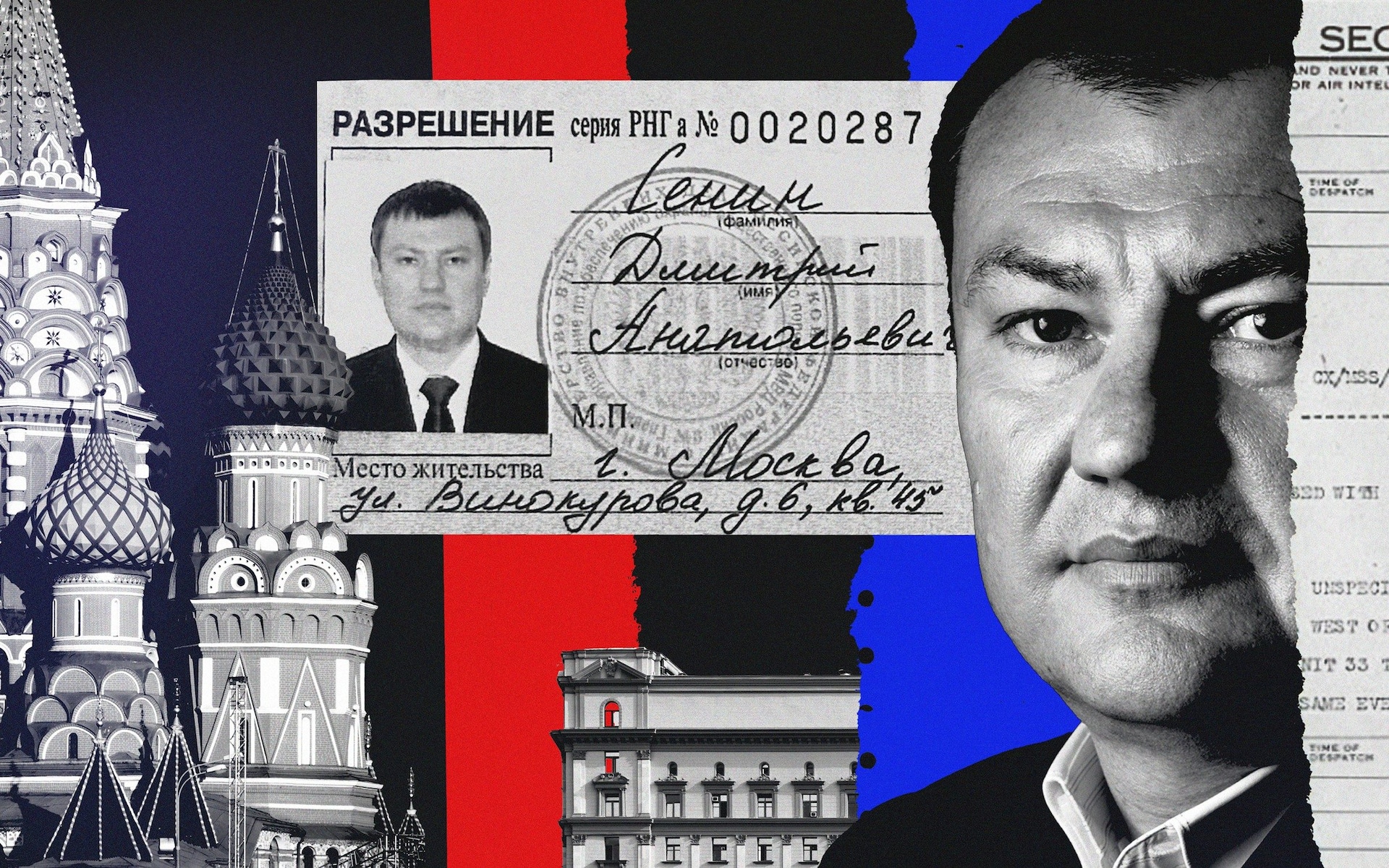
For an hour, Dmitry Senin lay still inside the carcass of the dead cow, making certain there was no sign of Russian border guards.
It was twilight in September, a date chosen carefully as it is a time of year when the temperatures drop below freezing on the border between Siberia and Kazakhstan but the snow is yet to arrive, allowing an escapee to take cover among the grasses and crops which carpet the frontier in the early autumn.
The high-flying Federal Security Service (FSB) agent, dressed in a gas mask, a rubber suit and wrapped in tin foil, was running for his life from Vladimir Putin’s death squads – populated by a number of his former colleagues.
His escape from the cow, over the border and onto the back of a motorcycle driven by a former Soviet KGB spy, played out in the shadows of two of the biggest espionage cases in European legal history.
But Senin, 47, is no defector. At least, not in his telling.
Instead, he is what screenwriters would call a rogue agent: an innocent man, he claims, framed for a crime he did not commit, using a very particular set of skills acquired over a long and highly decorated career to stay a step ahead of his own side while trying to clear his name.
It is a story almost too extraordinary to believe. But much of his tale, including how Russian agents have pursued him and his family across Europe, is corroborated by court records and investigations by European security services seen by The Telegraph. Senin’s account, told here for the first time, sheds light on how the Kremlin has dodged repeated rounds of security crackdowns and sanctions to keep a network of spies dotted throughout the Continent – including agents, Senin claims, who have acquired British citizenship.
And it demonstrates how Russia abuses international legal systems to search for those it wants to “liquidate”.
We meet in an indistinct office building in a “safe” European country, the location of which must remain a closely guarded secret.
Ever vigilant, Senin arrived two hours before us and scoped out the building from the shadows of the street opposite.
Smartly dressed – “as we had to be in Lubyanka” [the notorious building in Moscow that is home to the FSB] – he is relaxed and keen to tell his story. Before we start, he wants to make one thing clear: “I did not bring secrets to the West in exchange for protection,” says Senin, who spent 18 years in Russia’s main security agency.
“I am an officer who tried to fight corruption from inside the system – and whom the system decided to destroy precisely because of that.
“I left because I came to understand that the system I had served was not working in the interests of the state, but in the interests of specific individuals in power.”
This distinction – whether he is a defector or not – could be a matter of life and death. Sergei Skripal worked for MI6 before he was poisoned with Novichok in Salisbury eight years ago. He narrowly escaped with his life. Alexander Litvinenko, who worked as a paid consultant for the agency, was not so lucky – he was killed with radioactive polonium-210 in London, in 2006.
Asked why the FSB would believe him, Senin says this interview will prove it: no Western agency, after all, would let the press near a real defector. Senin wants Putin and his inner circle to read this article and cancel the “liquidation” order he believes has been issued against his name. One day, he hopes, they may even give him his old job back.
If what he is about to tell us is true, however, that seems unlikely to happen while Putin is still in office.
Senin joined the FSB in his home region of Kalmykia, a province in southern Russia, straight out of university in 2001, aged 22.
The choice was partly his personal response to a series of horrific terrorist attacks being carried out by Chechen separatists and Islamist militants then ripping across Russia.
But the FSB also represented a good career, with high standards.
“You had to show up in a smart suit and tie, clean shaven, and without peregar,” he says, using the Russian word for the smell of metabolising alcohol. In post-Soviet Russia, that set the FSB aside as a group with ambition and self-respect.
Senin did well, quickly making the move from Kalmykia to the bigger and more prestigious regional FSB department in Rostov-on-Don.
While he skirts the details of his rise through the agency, it is clear that he proved himself interrogating terror suspects in the North Caucasus in the aftermath of the second Chechen War in the early 2000s. Putin’s forces were fighting an often brutal counter-insurgency campaign in the region at the time.
Senin received Russia’s Suvorov Medal for bravery before being offered a job at the FSB’s Moscow headquarters in 2005, where he was later decorated again for his service in the North Caucasus, this time with the more senior Medal for Courage and by Putin himself.
In the capital, he served in the FSB’s Directorate M, the highly influential department responsible for combating corruption in the police and criminal justice system, before moving to the Control Department, the FSB’s powerful internal management arm.
By Senin’s account, being recruited to Control was a sign that a young officer was “being prepared for a leadership position”. By his mid-30s, Senin believed he was well on course to becoming an FSB general.
Then, in the autumn of 2016, a tip came across his desk. Senin is reluctant to go into the details of who he obtained the information from, or how, but says he was made aware of suspicions about a luxury Moscow apartment linked to a high-ranking police officer.
He then passed the tip on to his former colleagues in Directorate M and thought no more about it.
Others clearly did – a subsequent raid on the property revealed more than $120m (£90m) in US dollars and other currencies, one of the largest cash seizures in modern Russian history.
It was immediate headline news, with all of Russia’s major papers covering the case in detail.
The flat was reported to be the registered residence of the sister of Col Dmitry Zakharchenko, deputy head of the interior ministry’s economic security and anti-corruption office. More money was found in his car. Zakharchenko, who always denied any wrongdoing, claiming that the money was not his, is now serving a 13-year prison sentence for large-scale bribery and obstruction of justice.
While many of those involved in the case patted themselves on the back for stumbling on such a huge haul of cash, Senin began to sense that things were not quite right.
More senior officers quickly started asking where the tip regarding the flat had come from. Soon afterwards, Senin was outed as an FSB agent in the first of a number of newspaper articles about the case which alleged that he himself had suspicious links to Zakharchenko.
It was a clear sign, Senin says, that he had angered someone important: only someone very senior would dare to leak the identity of a security service officer, he claims.
In February 2017, with the scrutiny intensifying, he received another tip-off: within hours, his colleagues were going to arrest him.
“I did not understand what I had done wrong,” he says, but adds: “I understood one thing: if they arrested me then I wouldn’t be able to prove my innocence in any way from prison.” He suspected that he was about to be framed as punishment for blundering into something involving powerful people.
Senin had seen from the inside what happened to those the system wanted to destroy, so almost immediately he decided to run.
He scrambled to pack a bag before leaving behind his wife and three children – two girls, aged 10 and seven, and a two-year-old son – as he fled south behind the wheel of his car later the same day.
Senin drove for 120 miles without stopping as he headed for the Caucasus, after which he relied on a network of contacts to ferry him towards the border with Georgia in a number of different vehicles.
He eventually crossed the frontier using a false passport under the name Timur Kudasov – a nod to Col Leopold Kudasov, a fictional Soviet character who was the chief of the White Army’s counterintelligence unit in a series of films about the Russian civil war which aired in the 1960s and 1970s.
The same day he entered Georgia, Senin’s colleagues raided his house, and only then did he find out what he was accused of.
Claims were made that Senin and Zakharchenko were part of an informal group of corrupt FSB and police officers from Rostov-on-Don who were running an enormous, elaborate protection racket and that the pair were related by marriage – all of which Senin denies.
Prosecutors later accused Senin of helping Zakharchenko secure his high-ranking role in the interior ministry, and of acting as an intermediary between Zakharchenko and one of the individuals he was accused of taking bribes from. In 2023, Senin was sentenced in absentia to nine years in prison.
At the time he fled, Senin was a senior colonel who had the highest level of security clearance in Russia, with access to information of “special importance” – the final level, above even “top secret”. That classification is reserved for files, including details of covert operations overseas, that if released could cause damage to the entire Russian Federation.
In Russia, as in many countries, people with such clearance cannot freely leave the country. His sudden disappearance would therefore have set alarm bells ringing all the way to Putin’s office, raising fears that he was defecting.
Senin claims that such suspicions were unfounded. “I had no foreign intelligence assistance, no pre-planned route and a bag containing only basic personal necessities,” he says of his escape. “I stepped on to the path of a man living outside the law. It was the decision of someone who had reached a clear conclusion: to stay meant prison and after that death,” he insists.
What is known for certain is that shortly after Senin vanished, Russian intelligence services activated one of their most notorious foreign spies to hunt him down, in the process putting him in the path of some of Europe’s biggest ever espionage cases.
Austrian police documents seen by The Telegraph show that Egisto Ott, a former police officer who had worked at Austria’s Federal Office for the Protection of the Constitution and Counterterrorism, used his police and intelligence contacts both at home and abroad in 2017 to try to trace Senin after he fled Russia, running checks on a yacht they believed he was hiding on in Croatia.
Ott, who went on trial in Austria for espionage in January, is in turn accused of working for Jan Marsalek, the fugitive chief operating officer of the German tech firm Wirecard unmasked in 2023 as a prolific Russian spy.
Senin was just one of several targets that Ott ran searches on allegedly at Marsalek and Moscow’s request. Others include German Gorbuntsov, a Russian banker who has been granted asylum in the UK after he was shot with a sub-machine gun in Canary Wharf in 2012, and Christo Grozev, the Bulgarian investigative journalist who led Bellingcat’s reporting on the 2018 poisoning of Skripal. The fact that he was hunted by Marsalek also links Senin to a second, related, case: the spy ring the Austrian was running via a guest house in Great Yarmouth, Norfolk.
That case saw six Bulgarians convicted last year in one of Britain’s biggest espionage trials. Marsalek tasked the group, via its leader Orlin Roussev, with similar search missions to those entrusted to Ott, sometimes against the same targets. Ott, whose trial is due to continue later this month, denies working for Russia, claiming that all the searches he carried out were done on the orders of his superiors in Austria. His lawyer, Anna Mair, told the court when his trial opened that Ott had in fact been operating under the orders of a senior officer who had been contacted by an allied intelligence agency that hoped to recruit Senin.
Senin had been due to testify against Ott but refused at the last minute as Austria said it could only guarantee his safety while at court, which would have forced him to reveal his whereabouts, without the reassurance of a witness protection programme.
At the time all this was happening, in 2017, Senin had never heard the names Marsalek or Ott. But he knew he was being hunted, and that time was running out. “So I used the FSB’s logic against them,” he says. “I went back to Russia.”
Returning would not only confound his pursuers, who would never think to look for a fugitive traitor inside the country, but would also prove to his friends and superiors inside the FSB that “I am not a defector in the sense that word carries in England – not Skripal, not Oleg Gordievsky [the KGB double agent who defected to MI6 in 1985], not Litvinenko.”
While his return to Russia has been confirmed as part of the criminal proceedings against Ott, the next part of Senin’s story is difficult to verify. He says he lived undercover in Moscow for years while he tried to clear his name.
Senin showed The Telegraph what appeared to be a barely recognisable photograph of himself when he first returned, in which he resembled a slightly overweight heavy metal fan, with his normally short hair grown past his shoulders.
Other disguises, he says, included a wheelchair, then a set of crutches and a performative limp. To maintain his cover, he was unable to return to his wife and children, who had remained in Moscow following his decision to escape the country.
But he still had friends and supporters within both Russia and the FSB, some of whom knew he had returned and were helping him to communicate with his loved ones.
“I would go to the school where the children studied and watch them from afar. I was in a disguise, as they show in films – in a hood and a cap, so my face wouldn’t be caught on camera,” he says.
“I passed handwritten letters through dead drops and my people. The children also passed their wishes and drawings through agreed locations – these were the most precious parcels I received.”
But in the end, he says, he realised that his attempt to clear his name was futile. Reflecting on the case involving Zakharchenko, Senin concluded that the former interior ministry official was merely the custodian of profits from a large-scale corruption scheme involving some of the most powerful people in Putin’s Russia. He now believes that the cash discovered in the Moscow apartment was meant to be “passed upward to the very top of the country at the end of each year”.
“Once I understood that, my fate was sealed. I was not punished for what I knew – I was punished for acting on that knowledge without asking permission from those affected by it,” he says.
And so, for a second time, he began planning his escape. But the Russian invasion of Ukraine in February 2022 complicated things.
Russian authorities had tightened border security, and the unmarked steppe frontier with Kazakhstan – vast swathes of which is grassland or farmland – that he had intended to use this time around was now monitored by thermal-imaging cameras.
While he plotted his exit, another offer came through: his sins would be forgiven if he rejoined the FSB to serve in the war in Ukraine. He says he never had any intention of serving in that “stupid, unprofessional” conflict, but strung the FSB along while he thought of a way to thwart the thermal cameras, which are designed to alert guards to anyone – or anything – moving across the border.
The solution he settled on was simple, and thoroughly revolting.
Russia, like most countries, has strict regulations regarding the disposal of what farmers call “fallen stock” – animals that have died on a farm from disease or other causes, rather than being slaughtered in an abattoir.
But following the rules is costly and time-consuming. Instead, many farmers along the border with Kazakhstan take advantage of their geography and often carry carcasses “out on a tractor, and just dump them” in the no man’s land between the two countries, Senin says.
Thus, to slip out unseen, he would leave the country in the body of one such dead cow. It was his best bet.
Senin is vague about how he got from Moscow to the Kazakhstan border. But he says the operation, which again depended on a network of smugglers and contacts, took two months to organise.
Thus, one cold Siberian September day in 2022, he donned a gas mask and rubber suit to protect himself from the fumes of decaying flesh as he prepared to climb inside the cow he hoped would carry him to safety. The final step was for him to be wrapped in tin foil as an additional measure against the thermal cameras.
The timing was crucial. Autumn meant that the snows hadn’t yet arrived, but it was cool enough to avoid flies and maggots, and the time of day – twilight – meant that while the light was fading, it was still just about early enough that farmers spotted working in the fields would not arouse any suspicions.
And so local smugglers hauled the carcass containing Senin onto a tractor, drove over the border and then heaved it off into a ravine used as an animal “graveyard”. “I just needed to be thrown over the Kazakhstan border,” Senin tells The Telegraph with an air of understatement. He lay inside the animal for an hour, waiting for any border guards monitoring the area to lose interest.
Asked how he felt during the ordeal, Senin shrugs. “I’m a soldier,” he says matter-of-factly. “Where did I work? Fear is an emotion that you have to control, and I assessed the risk, and I knew that no one was going to shoot at the cow.”
Once he was sure he was safe, he took off the shiny foil and rolled out of the cow. He then clambered out of the ravine and into the grass of a nearby field, before crawling across rugged terrain for 300 metres. “I can still remember the smell of the earth I was crawling through,” Senin says.
Eventually, he stood and walked towards a prearranged pick-up spot, where a retired Kazakh KGB officer was waiting on a motorcycle.
From Kazakhstan, Senin flew to Montenegro.
Upon landing in the capital, Podgorica, he immediately applied for asylum, claiming political persecution in his home nation.
But he was instead arrested on an Interpol warrant issued by Russia, on charges of bribery and illegally crossing a state border. Senin was then held in prison, awaiting the outcome of the Russian extradition request.
There was one glimmer of light in the darkness. He was reunited with his family, who had fled to Montenegro in 2021, in the prison’s visitors’ room. It was the first time they had been together since he first left Moscow.
“Not the best place for a meeting. And I didn’t particularly want the children to see me being brought into the room and having my handcuffs removed,” he says, but the family was “happy in the moment”.
After Senin had spent five months in prison, in February 2023, Montenegro refused the Russian extradition request, declaring that he was facing political persecution at home, as he claimed. He was released and granted asylum.
Senin then set up home in the Balkan country with his family, but the threats to his life never stopped.
Relations between Montenegro and Russia are complex, and the political winds in the former nation frequently blow in Putin’s favour. The protections Senin received were fragile.
By 2024, he had received not one but two warnings from European security agencies that his life was in danger, a tracker linked to the Russian military had been found on his wife’s car, and details from his passport had been published in the local press.
Later that same year, with pressure building, Senin once again packed a bag and left his family behind, fleeing Montenegro for another European country, which The Telegraph is not naming to protect his safety.
There followed what Senin believes were a series of FSB operations designed to flush him out.
The first came in November 2024, on the same day a court hearing involving Ott was due to take place in Austria. Rumours began circulating in the Russian press that Senin had been killed in a gangland shootout in Montenegro. This was, he says, a clear FSB attempt to intimidate him and deter him from testifying against Ott. It was also, he claims, designed to “provoke me into breaking cover – to establish my whereabouts through the reaction of those close to me”.
Senin did not take the bait, choosing instead to let his family believe him dead. Earlier this year, however, he refused to appear in court as part of the case against Ott, fearing for his safety.
Around the same time that rumours of his death were spreading, Interpol received a second request for Senin’s arrest. This time, not from Russia but from Monaco.
Senin believes that the request was instigated by a Russian intelligence asset in the principality. As a member of the organisation, Russia has access to Interpol’s databases, meaning that the FSB would have been able to locate Senin should he have been arrested.
Secret service files from Austria, seen by The Telegraph, say: “It cannot be entirely ruled out that it [the request from Monaco] also serves to ascertain Dmitry Senin’s current whereabouts in matters of interest to the Russian Federation.”
Earlier this year, an Interpol whistleblower provided thousands of files to the BBC which showed the scale at which Russia is apparently using the international police agency to persecute critics abroad.
The warrant issued by Monaco is still standing. But Senin’s lawyer, Vadim Drozdov, is trying to get it struck down.
All these tactics, Senin says, are typical of the techniques Russia’s secret services use to hunt enemies in Europe and elsewhere.
Despite successive security crackdowns by Western countries following the Ukraine war, Moscow still has operatives working across the world. Senin says that the true scale of the Kremlin’s covert network is much bigger than agencies in the West realise. He claims that some of Russia’s overseas assets even possess British citizenship.
“What is being used against me is a classic multi-layered operation. First, technical surveillance: GPS trackers, queries run against Interpol police databases in Monaco through agent networks, publication of my personal data in European media,” says Senin.
“Russia is using Europe as an operational space,” he adds. “While Europe is still only learning how to respond to this.”
Senin now spends his life in hiding as he fights his legal battle while looking over his shoulder for the Russian hit squads he fears are pursuing him.
But he still believes that one day, perhaps within the next decade, he may be able to return to the country he loves. “There will be changes,” he says. “Putin is not eternal, he will leave.”
But what price does he pay while waiting for change? How much longer can he arrive at meetings two hours early, as he did for ours, and tense up whenever he hears Russian spoken? And how much longer can he live without his family? It has been two years since he last saw his wife and children in Montenegro. His eldest daughter is nearly 20. His son is quickly approaching his teenage years.
FSB officers do not typically display their emotions. But almost a decade on the run has taken its toll on Senin.
“In my family, it is not customary to speak about what we feel. But I see and feel the suffering from the separation,” he says.
“This always motivated me to the limit of my abilities. The fear was not for my own life. The fear was: what will happen to my wife and children if I fall into the hands of the FSB and my life is cut short?
“Who will walk with my children further through life? That is the fear that drives me. In protecting my family, I will go to the end.”
Recommended
Paranoid Putin's war is unravelling