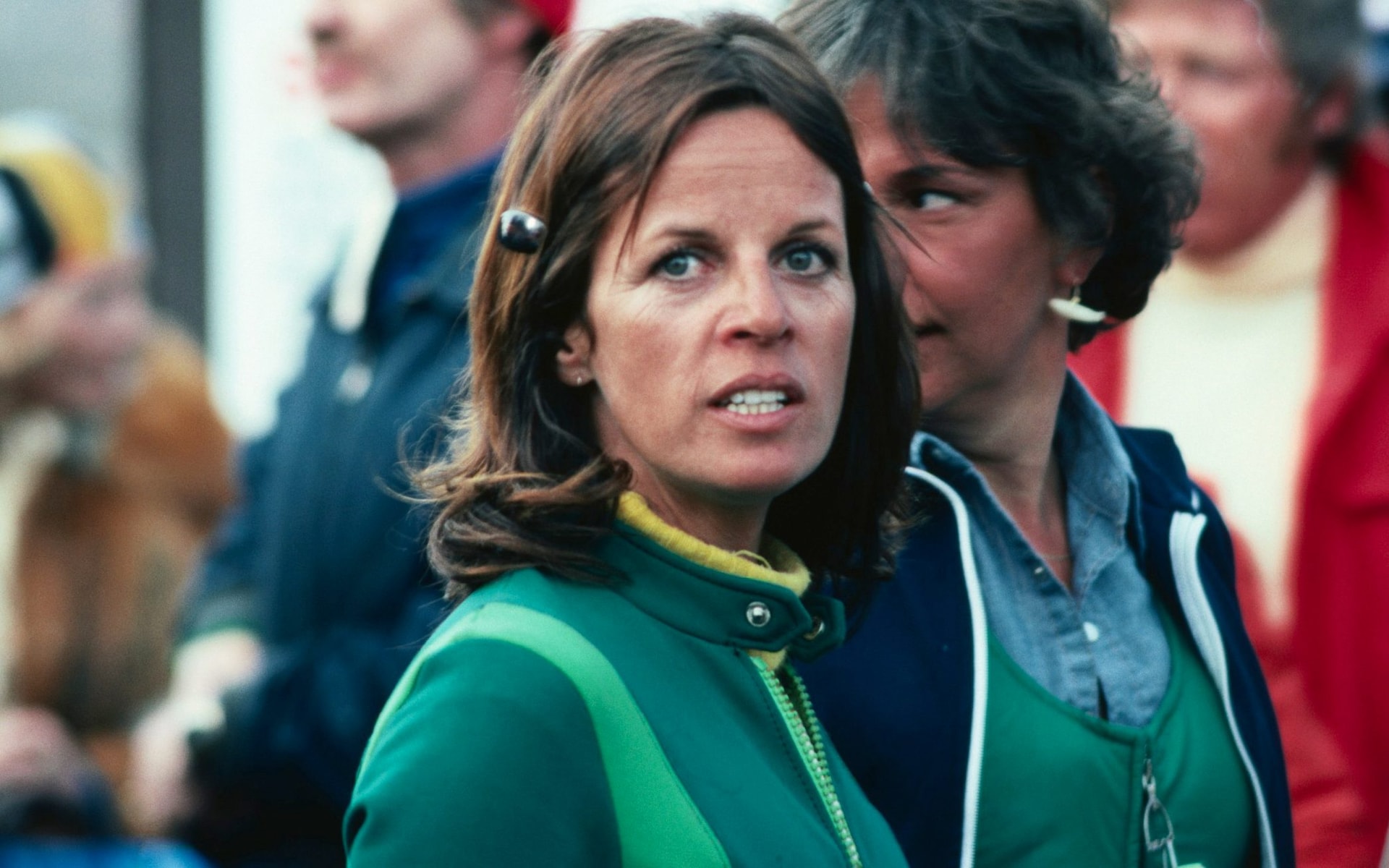
Claudine Longet, who has died aged 84, was an actress and chanteuse who became one of the few French female artists to have sold significant numbers of records in the US. But unlike compatriots such as Edith Piaf and Françoise Hardy, she was never acclaimed as a major figure in global popular music: her hits were anodyne cover versions of songs such as the Beatles’ Here There and Everywhere and Good Day Sunshine.
She played the female lead, opposite Peter Sellers, in Blake Edwards’s 1968 film The Party, but she was best known for her appearances on the weekly television show hosted by her husband, Andy Williams. She was, in Williams’s words, “a beautiful, athletic, slender, petite brunette with large doe eyes”.
From her spouse’s side, she radiated a mixture of glamour and wholesome domesticity. On the set of Williams’s famous Christmas specials, she would cast protective glances towards the couple’s young children as they unwrapped parcels under the studio tree.
But few stars have made the journey from idol to pariah quite so swiftly and irreversibly as Claudine Longet who, on the afternoon of March 21 1976, shot her lover, the champion skier Spider Sabich, with a .22 handgun at their chalet in Aspen, Colorado. The events of that Sunday afternoon shifted the emphasis so firmly from femme to fatale that even now, decades later, some residents of America’s most exclusive ski resort have yet to forgive her.
She inspired a mercilessly derisive song, Claudine, by the Rolling Stones. Originally destined for the 1980 album Emotional Rescue, it eventually appeared as a bonus track on the Some Girls re-release in 2011. “Now only Spider knows for sure,” one verse begins, “But he ain’t talkin’ about it any more/ Is he, Claudine?/ There’s blood in the chalet/And blood in the snow/[She] Washed her hands of the whole damn show/The best thing you could do, Claudine.”
In April 1976, before her case had even been heard, the first series of NBC’s satirical show Saturday Night Live featured a sketch called “The Claudine Longet Invitational” in which male skiers competed in a slalom competition, at the end of which they were “accidentally” shot by Claudine Longet. Threatened with legal action, the producers issued a public apology.
Vladimir “Spider” Sabich had won the slalom at the World Cup and the US Championship, but his popularity transcended skiing. He was one of America’s best-looking and most venerated sporting heroes, one of the models for Robert Redford’s character in Michael Ritchie’s 1969 film Downhill Racer. Even Aspen’s most notoriously dissolute resident, the writer Hunter S Thompson, likened the shooting to the ski resort’s having “fouled its own nest”.
The outrage related not only to Claudine Longet’s perceived culpability, but to the nature of her trial and sentence. Despite admitting that she was holding the gun when it killed Sabich from close range in his bathroom, the singer said the weapon went off by accident, and she was charged not with homicide but with reckless manslaughter.
She was sentenced to 30 days in Aspen’s Pitkin County Jail, a term to commence on a date of her own choosing. Before sentencing, her defence co-counsel Ronald Austin had reportedly said that he hoped she would escape with a fine. Upon her release, Austin left his wife and two children and moved with Claudine Longet to a large property on nearby Red Mountain. The singer, who married Austin in 1986, lived there until her death.
Sensationalist accounts of the trial communicated Aspen’s reputation as drug-fuelled and hedonistic (a perception already well-established in America) to an international public. “Aspen,” the Daily Mirror declared, “is the modern Sodom and Gomorrah.”
Claudine Longet and Williams had divorced, after a five-year separation, in 1975, but their mutual affection endured until his death in 2012. When Sabich was shot, the Williams’s three young children were playing outside the chalet.
Claudine Longet had met Sabich at a skiing event in California in 1972. His Aspen home was in an exclusive gated community overseen by security guards, Starwood Complex.
In the late afternoon of March 21 1976, patrol officer William Baldridge was called to Sabich’s chalet; the skier’s body was slumped on the bathroom floor. Doctors at Aspen hospital pronounced him dead on arrival. Sabich had a single small wound; the bullet had traversed his stomach and pancreas.
Sabich’s coach, Bob Beattie, who had been with him an hour before he died, affirmed that Sabich had said his relationship with Claudine was about to end. Her 12-year-old daughter stated in a deposition that she heard Spider shout: “Claudine! Claudine!”, and then found her mother calling 911.
Claudine Longet astonished many when she showed up at a memorial service. Pictures show her standing in the front row, holding a flower. Released on a $5,000 bond, she headed for Palm Springs.
The charge of reckless manslaughter required proof that the accused exhibited “conscious disregard” of a “substantial risk” that the action could have resulted in death; the maximum sentence was 10 years. The jury accepted Claudine Longet’s claim that the gun discharged accidentally while she was asking Sabich for a tutorial on how a safety-catch worked.
Two arresting officers stated that Claudine Longet told them that she pointed the gun at Sabich and said: “Bang, bang!” before the firearm discharged. The evidence of a policewoman who testified that Claudine Longet, on being taken into custody, uttered the words: “I killed him” was ruled inadmissible as no attorney had been present.
Claudine Longet was born in Paris on January 29 1942. Her father was an industrialist specialising in X-ray technology, her mother a doctor. Claudine became a show dancer at 17; one evening in 1960, the impresario Lou Walters, father of the broadcaster Barbara, saw her on French television and hired her to perform at the Tropicana casino in Las Vegas. It seems to have been there that she caught Williams’s eye. The couple married in Los Angeles in December 1961.
She began her recording career as a protégée of A&M Records’ co-founder Herb Alpert, who met her at a New Orleans nightclub in 1966. Claudine Longet recorded five albums for A&M between 1966 and 1970; the first of them, Claudine, peaked at No 11 on the Billboard chart in 1967 and sold more than 500,000 copies.
“Unlike most girls who liked to unwind after the midnight show,” Claudine Longet once told a reporter, “I went straight back to my apartment, to wake up in good shape to go skiing. I fell in love with Andy through sport.”
Williams and Claudine Longet were close friends of Robert and Ethel Kennedy, and were at the senator’s bedside in the Good Samaritan Hospital in Los Angeles while doctors tried in vain to save his life following his shooting at the Democratic Convention in June 1968.
Footage survives from the Grammy awards ceremony of 1975, in which Williams, the host, introduces the nomination for best song. At his side are Paul Simon and John Lennon.
“Hello,” Lennon says. “I’m John. I used to play with my partner, Paul.” Simon addresses the audience. “Hello,” he says. “I’m Paul. I used to play with my partner, Art.” “Hallo,” Williams announces, “I’m Andy.” And then – to laughter – “I used to play with my partner, Claudine.”
Radically differing accounts of Claudine Longet’s character went to the heart of the case. The deputy DA Ashley Anderson, prosecuting, revealed that a neighbour of Sabich and Claudine Longet’s had declared that Andy Williams informed him the morning after the shooting that Claudine was “a crazy type of gal that liked to ski fast, drive fast and take chances”. Williams denied making the remark, but the neighbour’s wife described Claudine Longet as “a crazy chick”.
The head of security at Starwood, who affirmed that he had seen Claudine twice on the day of the shooting, said that he warned the sheriff’s lieutenant William Baldridge, as he approached the crime scene, with the words: “Watch it. This gal is a little ringy today.”
The trial revealed oversights by the local justice department worthy of another of director Blake Edwards’s creations, Inspector Clouseau. Evidence in her diary was ruled inadmissible as it had been seized without the correct warrant. The 225-page journal, since assumed to have been destroyed, is believed to have contained passages describing her intimate life and was described by one officer who saw it as “explosive”.
On the day of the shooting, Claudine Longet had been drinking in a fashionable bar in Aspen, but blood tests for alcohol and other substances were administered without regard for due process. Consequently, the prosecution’s submission that Claudine Longet had tested positive for cocaine could not be used in evidence. The firearm – a cheap imitation of a Luger – was mishandled by the authorities after being seized.
The trial proper began in January 1977. Some Aspen citizens’ enthusiasm to be chosen as jurors was so intense as to be problematic, and many were rejected on the grounds that they believed her to be guilty. One juror was excused on the grounds that he had once asked Spider Sabich to judge a wet T-shirt competition. When asked to elaborate, the man explained that this was “a social event where a lot of women take their clothes off”.
“When they heard this,” wrote David Chamberlain, court reporter for The Aspen Times, “members of the British press, previously somnolent, became suddenly conscientious.”
Claudine Longet testified that Spider had been standing in the bathroom and that she had told him: “I would like you to tell me more about the gun and what the safety means,” just before the gun discharged. According to the prosecution, the position of the body – prone, and facing away from the weapon – and the distance from which the shot was fired (around three feet) rendered this explanation implausible.
“Did you jokingly point the gun and go, ‘Bang, bang’?” Anderson asked. “I do not joke with guns,” replied the singer. He reminded her that two police officers had sworn that she had said exactly those words. Untrue, she insisted.
The defence claimed that the gun’s safety catch was defective and could have been fired without the trigger being touched, while conceding that in forensic tests nobody had managed to replicate this effect.
Anderson’s closing statement lasted 22 minutes, while Claudine Longet’s co-counsel Charles Weedman spoke for an hour and a half, quoting John Donne and asserting that Claudine Longet “never believed that this tiny little bullet could hurt anybody”.
“This is not an inanimate object over here,” Weedman declared. “This is a woman who is living, breathing, and suffering. Mentally hold her hand. And ask yourselves: Guilty? Or not guilty?’
The district judge George Lohr instructed the jury that they had the option of finding her guilty of reckless manslaughter or of the lesser charge of criminally negligent homicide. The latter is a misdemeanour with a maximum sentence of two years and a $5,000 fine.
The jury found Claudine Longet guilty on the less serious charge. Sentencing her to 30 days, Lohr told the singer she could serve the time whenever she liked as long as it was before September 1. Once in custody, Prisoner C 1590 was allowed to repaint her cell in the Pitkin County jail, whose decor she found depressing, in bright colours. A $780,000 civil suit brought by Sabich’s parents never got to court.
Some were surprised that Claudine Longet and Austin should have continued to live in Aspen for so many years. An ex-girlfriend of Sabich’s was found to have filled Claudine Longet’s car with manure and poured paint-stripper on to the bodywork. When the singer ventured out to local restaurants, there were stories about drinks being spilled into her lap. Latterly she moved to Hawaii.
Claudine Longet’s professional activities following the shooting were restricted to the occasional album release. She spoke to the press only once, as part of a television documentary on Williams. Her contribution was restricted to audio, broadcast over still photographs. “To this day,” she remarked, “people stop me in the street to tell me how much they loved the Christmas specials.”
Claudine Longet, born January 29 1942, death announced May 14 2026