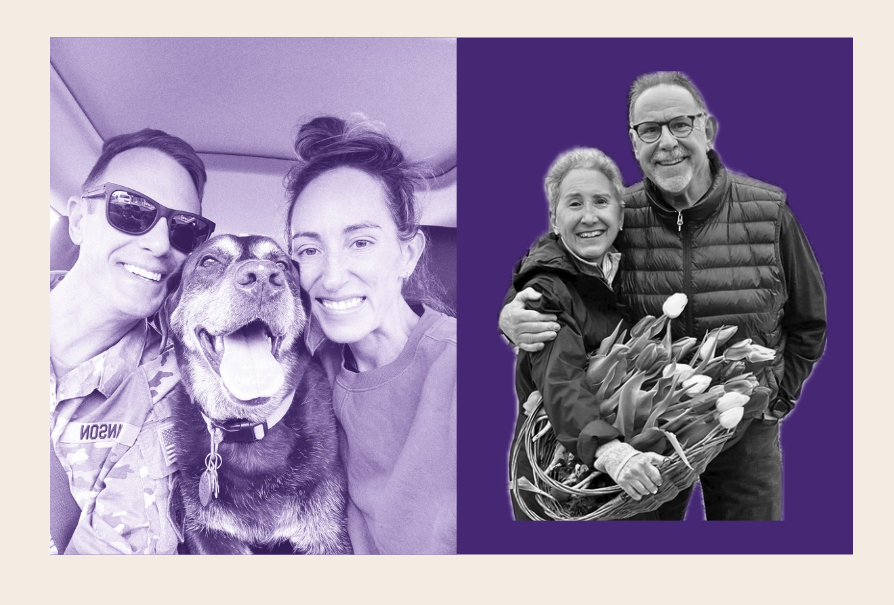
I never expected that grief would be the thing that made a new place feel like home.
As a military couple, my husband, Dane, and I have learned how to leave one place and arrive somewhere new with optimism. You get really good at starting over—new streets, routines and faces, figuring out your new grocery store and hair salon—all things that impact your everyday life in both big and little ways. But our most recent move felt different from the start, because we arrived carrying something heavier than boxes.
We had just lost our younger dog, Bill, to cancer after a 14-month battle, and our senior Labrador Judy was rapidly declining. A few months after moving into our new house, just as we were getting our footing, we lost her to cancer, too.
Judy had been with us through so many chapters, including a yearslong infertility struggle that ultimately ended in the realization our family would not grow like we once imagined, that her absence felt disorienting. For so long, our days were shaped around her routines and the comfort of her presence, and then, all at once, there was nothing to tend to.
One day, while sitting on my porch crying, I noticed a man walking a yellow Lab with the slow and unmistakable gait of a senior pet. I knew it instantly and for reasons I still can’t explain, said hello. That’s how I met Bob. He introduced me to Zuzu, his senior dog, and everything about the way he stood there, completely unhurried, felt so familiar. It was the patience of someone who knows time with a dog like this is measured differently.
Eventually, between scratching Zuzu’s velvety ears and telling her she was a good girl, I told him about Judy. There was no awkwardness in it, because Bob understood immediately that grief, especially the kind that comes from loving an animal deeply, doesn’t need much explanation between people who have lived it.
He nodded. “They leave a big hole,” he said. And just like that, we had something beyond a one-time hello.
From then on, our conversations became a kind of ritual. Dane and I would run into Bob and Zuzu on our walks around the neighborhood, sometimes commenting on the quirks of senior pets or the fickle weather of Virginia. In some ways, getting to see Zuzu kept a small part of Judy alive for me, so seeing them out walking always brought the biggest smile.
One afternoon, we saw Bob out with Zuzu and he told us of his upcoming trip with his wife: “We’re heading to Boston to visit our kids.”
We smiled and told him to have a great trip. “We’ll see you when you get back,” I said, without thinking, because of course we would. That’s how these things work, I assumed; people leave, and then they return.
About a week later, another neighbor stopped us.
“Did you hear about Bob?” he asked. I remember feeling momentarily confused. “Bob?” I said. “Who?”
He hesitated, then said, “You know, the one who walks Zuzu.”
In that instant, the world rearranged itself again. Bob had died suddenly while visiting his kids in Boston.
The grief came quickly and with a force that didn’t seem to match the length of our acquaintance. I had barely known him and I was embarrassed to admit I knew only his dog’s name and not his. I didn’t know his last name, I had never even met his wife, and I couldn’t tell you the names of his kids—but what I knew for sure was what he had given us.
In a moment when the world felt hollowed out by Judy’s absence, Bob had met us there. He hadn’t tried to fix it or soften it, or make it less than because she was a dog. He had simply understood, and in doing so, he had made that emptiness feel less lonely. Learning of his sudden death felt like losing something all over again.
When his wife, Nancy, returned home, Dane and I felt an insistent pull to reach out, but what could we possibly say?
“Hi, we knew your husband because we talked about our dead dog,” felt impossibly inadequate, and yet, it was the truth. So we knocked on her door and told her who we were. We told her about Judy, about Zuzu, about the walks and the conversations and the kindness her husband had shown us without ever making a big deal about it.
There’s no right way to enter someone else’s grief, but I’ve learned that honesty has a way of finding its place. Over the past year, Nancy has become something we never expected. A companion in grief, yes, but also in life. Our connection is threaded with loss, but it is defined by something so much bigger—the simple act of showing up.
Losing Judy taught me how deep love can go, meeting Bob taught me how that love doesn’t disappear, and losing him, too, taught me something I’m still trying to understand: that even the briefest connections can alter you in lasting ways. Senior dogs know something about this. They live close to the edge of time, whether we want to admit it or not. They move slower, notice more, don’t rush past what’s in front of them, and if you let them, they teach you to do the same.
Nancy has become an unexpected gift in our lives, just like Bob. She has taught me to play mahjong at her dining room table with a level of patience and kindness I aspire to have one day, we’ve shared dinners and slow breakfasts, and Dane has helped around her house with small fixes that turn into longer conversations. In these ordinary moments, we’ve found our way into each other’s lives and I hope she feels, in some small way, that we have been that for her, too.
The first anniversary of Bob’s death fell on Mother’s Day, a day already heavy with meaning about love, family and the ways we show up for one another, but also one dog-eared by grief for both of our families in very different ways. That night, after spending the day celebrating with my own mom, I found myself back at Nancy’s dining room table alongside her children, all of us carrying a different kind of absence—theirs, the loss of the man who should have still been sitting there with us, and mine, the quiet pain of the children I never got to have. Separate heartbreaks, somehow gathered around the same table.
What remains after loss is often quiet and rarely arrives as one singular thing. More often, grief becomes a steady companion, woven into the fabric of ordinary days, and it is not something that announces itself, or asks to be understood. It simply settles into the corners of a life and stays there, and sometimes, as I’ve learned, it’s in that shared silence that we find each other.
Kait Hanson is a Washington, D.C.-based writer and photographer whose work has been featured by TIME, Vanity Fair, Glamour, CNN, and more.
All views expressed in this article are the author’s own.
Do you have a personal essay you want to share with Newsweek? Send your story to MyTurn@newsweek.com.
Related Articles