
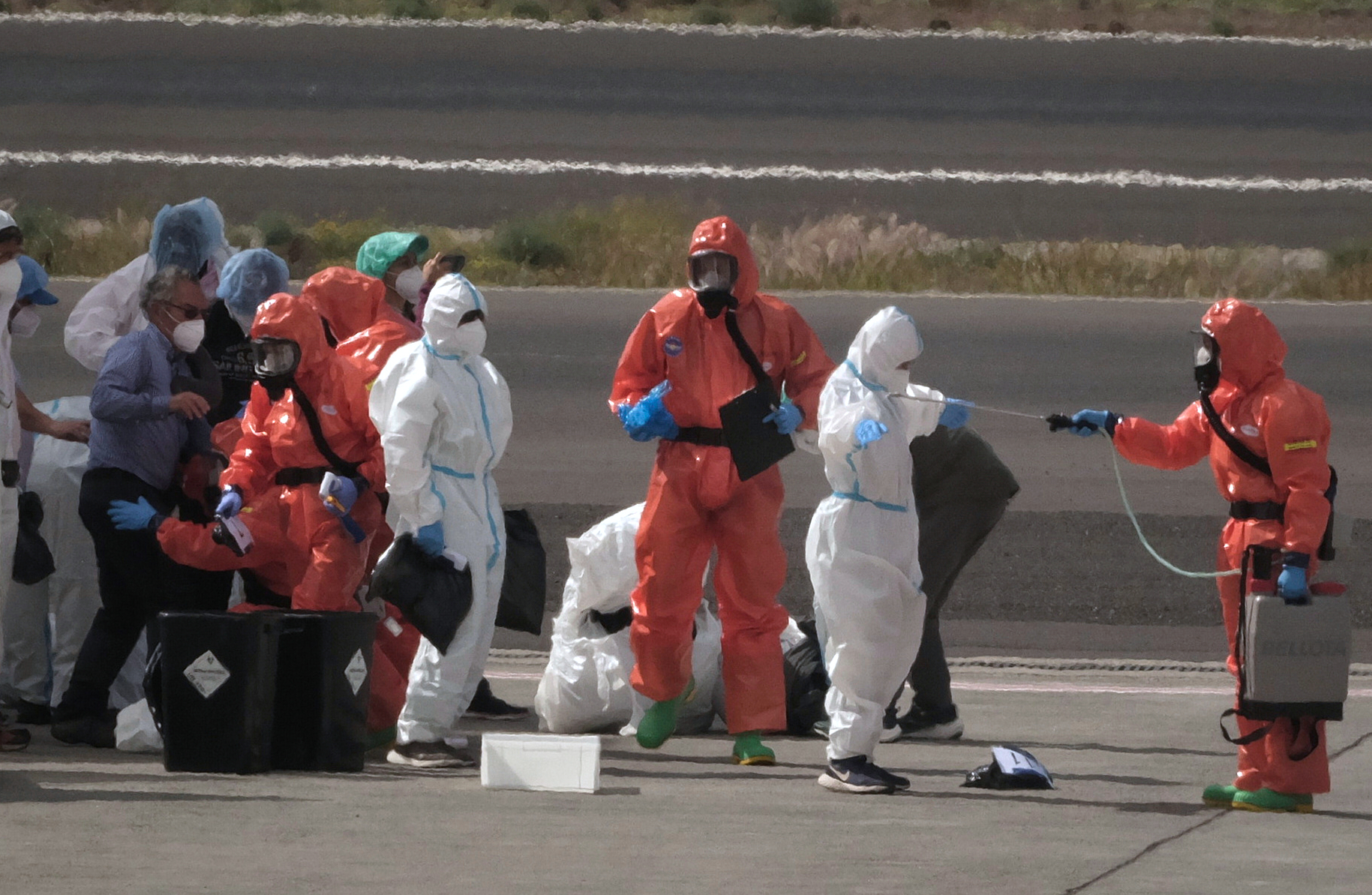
One of the 17 American passengers evacuated from the MV Hondius has tested positive for the Andes-variant of hantavirus, health officials have said.
The passenger, who was on a repatriation flight that landed early Monday in Omaha, Nebraska, tested mildly PCR positive for the virus and was being held in a biocontainment unit on the aircraft along with another passenger who has mild symptoms, the Department of Health and Human Services (HHS) said in a statement.
They were evacuated from the cruise ship that had anchored on Tenerife in Spain’s Canary Islands after a hantavirus outbreak left three people dead, and five others who had earlier left the ship infected.
The World Health Organization (WHO), Spanish Health Ministry, and cruise company Oceanwide Expeditions had earlier said none of the more than 140 people who were then on the Hondius had shown symptoms of the virus.
But since leaving the ship, a French passenger also developed symptoms of the virus while on a flight home to France, French Prime Minister Sébastien Lecornu said. French Health Minister Stéphanie Rist confirmed on Monday that the passenger, a woman, had tested positive for hantavirus.
Rist said four other French passengers from the ship tested negative, but will be retested. Health authorities said they have so far identified 22 hantavirus contact cases in France.
HHS said passengers on the aircraft that landed in Omaha on Monday would be transported to the ASPR Regional Emerging Special Pathogen Treatment Center (RESPTC) at the University of Nebraska Medical Center (UNMC).
The medical school’s special unit for treating people with highly infectious diseases was used for COVID-19 patients early in the pandemic and previously for Ebola patients.
The passenger with mild symptoms will be transported from the RESPTC at the University of Nebraska Medical Center to a second as yet unnamed RESPTC, HHS said.
“Upon arrival at each facility, each individual will undergo clinical assessment and receive appropriate care and support based on their condition,” a statement from HHS posted on X read.
Kayla Thomas, a spokesperson for the UNMC, said in a statement provided to Newsweek: “One passenger will be transported to the Nebraska Biocontainment Unit upon arrival, while other passengers will go to the National Quarantine Unit [at the UNMC] for assessment and monitoring. The passenger who is going to the Biocontainment Unit tested positive for the virus but does not have symptoms.”
Why Are Passengers Being Taken to Nebraska?
The National Quarantine Unit, run by Nebraska Medicine and the University of Nebraska Medical Center, is the only federally funded quarantine unit in the country, designed to house and monitor people who may have been exposed to highly contagious and deadly infections.
It has 20 rooms that “employ individual negative air pressure systems, are single occupancy with en suite bathroom facilities and contain exercise equipment and Wifi connectivity for patients requiring longer stays,” according to the UNMC website.
UNMC is also home to the Nebraska Biocontainment Unit (NBU), a highly specialized facility designed to care for those with high consequence infectious diseases.
The NBU is separate from all other units in the hospital, with a secured access main entrance that features pressure-controlled doors. Staff can only enter by security access through a separate entrance. The unit has its own air filtration system to ensure that no infectious particles escape the patient rooms. The NBU was used in the fall of 2014 to receive U.S. citizens with Ebola virus who were evacuated from Africa and again in 2020 to care for U.S. citizens with COVID-19.
Hantavirus usually spreads when people inhale contaminated residue of rodent droppings, and the disease is not easily transmitted between people. But the Andes virus detected in the cruise ship outbreak may be able to spread between people in rare cases. Symptoms usually show between one and eight weeks after exposure.
WHO Director-General Tedros Adhanom Ghebreyesus has reiterated that the general public should not be worried about the outbreak.
“We have been repeating the same answer many times,” he said. “This is not another COVID. And the risk to the public is low. So they shouldn’t be scared, and they shouldn’t panic.”
Where Are Passengers Being Evacuated To?
Planes arrived in Tenerife to fly out passengers from more than 20 countries in an evacuation effort expected to last until Monday, The Associated Press reported.
All of the passengers were escorted from the ship by personnel in full-body protective gear and breathing masks.
Spanish passengers were the first to leave, and were flown to Madrid and transported to a military hospital. Hours later, a plane that evacuated the French passengers landed in Paris, where it was met by emergency vehicles. French Prime Minister Sébastien Lecornu said after Sunday’s flight that the five passengers would be kept in the hospital “until further notice.”
In the U.K., authorities have said passengers will be hospitalized for 72 hours of quarantine, followed by six weeks of self-isolation. Japan’s Foreign Ministry said a Japanese national arrived in Britain on a chartered flight arranged by the British government and will be under health monitoring by British authorities for up to 45 days.
Greece’s health ministry said a Greek male evacuee would spend 45 days in mandatory hospital quarantine in Athens.
A Dutch evacuation plane landed in the city of Eindhoven late Sunday. The 26 passengers aboard included eight Dutch citizens, as well as people from India, Germany, Argentina, Belgium, Greece, Portugal, Ukraine, Guatemala, the Philippines and Montenegro, the Dutch Foreign Ministry said.
The Dutch citizens were being taken home by medical transport and will self-quarantine for six weeks. Local health services were arranging quarantine locations for the others.
Australia is also sending a plane, expected to arrive Monday, said Spanish Health Minister Mónica García, who added that the evacuation flight was expected to be the last to leave Tenerife.
Some crew, as well as the body of a passenger who died on board, will remain on the ship, which will sail on to Rotterdam in the Netherlands, where it will undergo disinfection, Spanish authorities said.
U.N. Secretary-General Antonio Guterres commended the Spanish government and those of other countries for their efforts to manage the outbreak.
“While the current public health risk from the virus remains low, it’s important that international health efforts ensure the safety of all, including passengers & crew of the MV Hondius,” Guterres wrote on X.
Which US States Are Monitoring Returned Passengers?
Health officials are monitoring seven Americans who returned home after being on the cruise ship in five states—Arizona, California, Georgia, Texas and Virginia.
Dr. Jay Bhattacharya, the acting director of the Centers for Disease Control, said on CNN’s State of the Union on Sunday that the Americans who earlier left the cruise ship have been in the U.S. for roughly two weeks.
“There are already, as you know, Jake, seven Americans that already flew back home I think two or three weeks ago, and are in various states,” Bhattacharya told host Jake Tapper.
How the outbreak unfolded
Early in April, a 70-year-old Dutch man, identified last week as ornithologist Leo Schilperoord, developed a feverish illness while traveling on the Hondius in the South Atlantic. He died less than a week later.
More people became sick, including Schilperoord’s wife, Mirjam Schilperoord. She disembarked the ship with her husband’s body at St. Helena on April 24 and deteriorated on a flight to South Africa, where she died on April 26.
A German woman died onboard the ship on May 2.
That same day, hantavirus was first identified in the outbreak after South African health authorities received a positive for the virus from tests performed on a British man in intensive care there.
Related Articles