Red states in the South are seeking to advance the GOP’s goal of keeping the House majority this fall by redrawing their congressional maps in the wake of a landmark Supreme Court ruling that reignited the redistricting arms race.
Tennessee Republicans approved a new map on Thursday that threatens to unseat the state’s lone House Democrat after the high court’s ruling, which declared Louisiana’s map an illegal gerrymander and gave the greenlight for more states to redraw ahead of the midterms. Other states in the South are eyeing their own changes.
The GOP-friendly moves come as Democrats suffer a setback in their own redistricting efforts in Virginia. The state’s Supreme Court on Friday invalidated a redistricting plan approved by Old Dominion voters last month, which would’ve expanded Democrats’ edge by four seats in the state’s House delegation.
The redistricting schemes underscore both parties’ efforts to do everything they can to minimize their losses and gain pickup opportunities as the midterms approach.
Here’s where redistricting efforts stand in the Southern states we’re tracking:
Louisiana
The Supreme Court ruled late last month that Louisiana’s addition of a second majority-Black congressional district was an unconstitutional racial gerrymander, a decision that weakens Section 2 of the Voting Rights Act that has long enabled new majority-minority districts.
The justices upheld a prior federal court’s decision that barred Louisiana from using a Legislature-drawn 2024 map, which included a district stretching from Shreveport to Baton Rouge. It’s currently represented by Rep. Cleo Fields (D), one of just two Democrats in the six-member House delegation.
Louisiana officials have already delayed House primaries — initially set to start May 16 — until July 15 or “such time as determined” by the state Legislature. All other primary races on the ballot, including for the U.S. Senate and state Supreme Court, will proceed as planned.
A committee in the state Senate on Friday began hearing public comment on redistricting, and the Legislature is expected to vote on new maps next week.
“There are very real constitutional problems with stopping an election in progress,” Justin Levitt, a constitutional law professor at Loyola Law School who maintains the website All About Redistricting, said.
“In Louisiana in particular, the governor sort of declared an emergency, but only for some races on the ballot, which shows you that there isn’t an emergency, because if there were a real emergency, you wouldn’t stop the voting for just some of the races.”
Any changes to congressional maps and primary dates months before November’s general elections present significant logistical hurdles for candidates, election officials and voters alike.
Still, the Louisiana decision has supercharged new plans to redistrict in other states as the fight for control of Congress ramps up, injecting more uncertainty into an already turbulent election landscape.
“I think it gets worse before it gets better,” Levitt said of the redistricting tit-for-tat that launched with a Trump-backed map in Texas last year.
“I think we haven’t seen the worst of it yet, and I think there are a lot of other states that are feeling enormous amounts of pressure to join the race to the bottom.”
Alabama
On Friday, Alabama Republicans approved legislation directing the governor to schedule new primary elections this year under a GOP-friendly map — if the courts agree to lift an injunction requiring the current map to stay in place until after the 2030 Census.
The legislation would have no effect unless the courts lift a previous ruling requiring Alabama to have a second district where Black voters make up close to a majority, leading to Rep. Shomari Figures’s (D-Ala.) election in 2024.
Geoffrey Skelley, Decision Desk HQ chief elections analyst, said it seems “up in the air” whether the court will move to lift that injunction.
Republicans are hoping the courts will allow the state Legislature to implement a 2023 map — which was previously rejected by a federal court — that would give the GOP a chance to target Figures’s seat and create another pickup opportunity in November.
The bill, which legislators sent to the governor’s desk on Friday, would allow the governor to ignore the May 19 primary date for some congressional districts and hold a new congressional election.
The effort has met fierce resistance from state Democrats and Black lawmakers, who joined demonstrators outside the Alabama Statehouse, shouting, “Fight for democracy!” and “Down with white supremacy!” according to The Associated Press.
“This is not just a one-election issue. This is, from a historical perspective, your Republican legislators are effectively trying to get rid of Black representation in Congress, and that is going to have some serious implications that go beyond any one election,” Jared Leopold, a Democratic strategist in Virginia, said.
Tennessee
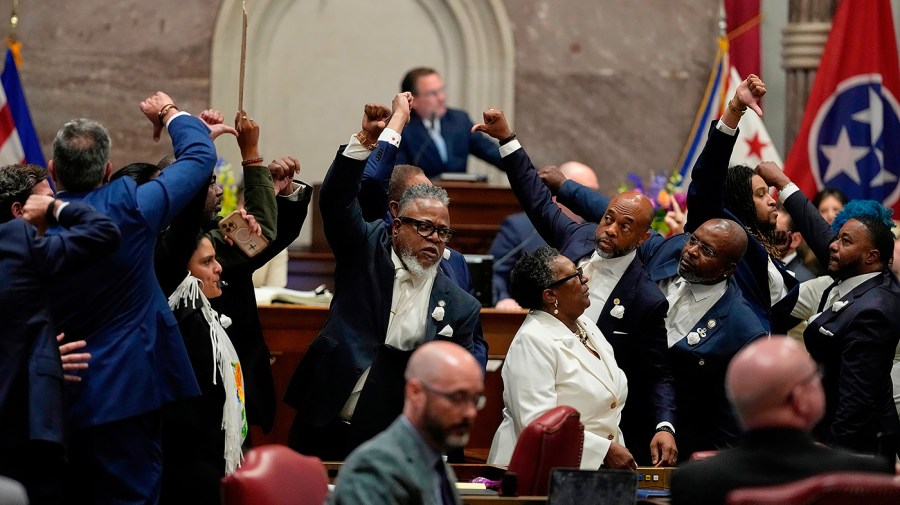
Tennessee lawmakers successfully shepherded through a new congressional map this past week that carves up the state’s only majority-Black district and threatens the lone Democrat in the nine-member House delegation.
The new map splits Rep. Steve Cohen’s (D) Memphis-based 9th Congressional District into three congressional districts, while further dividing the city of Nashville into five districts.
Cohen — who testified before state lawmakers this week as they considered the new map — has vowed to fight against the effort to redraw his district, which he has represented in Congress for nearly two decades.
“And just like that, the TN GOP voted to enforce a racial gerrymander of Memphis and strip our city of effective representation for decades,” Cohen wrote on social media Thursday.
“Trump knows he HAS TO rig the game to keep his majority in November. And the TN GOP was willing to go along with it. It’s shameful,” he continued. “Next stop is the courts.”
The Tennessee Democratic Party sued on Friday to prevent the state from using the new districts until after this year’s elections, making a case based on the tight time frame.
Tennessee Gov. Bill Lee (R), who signed the map into law on Thursday, called a special session on redistricting the previous week. This special session came after President Trump touted the governor for agreeing to “work hard to correct the unconstitutional flaw in the Congressional Maps of the Great State of Tennessee,” in a post on Truth Social.
South Carolina
Republicans in South Carolina this week stepped closer to redistricting, when state House lawmakers voted to extend their legislative calendar and leave the door open to drawing new lines in light of the Supreme Court’s ruling.
The extension must also pass the state Senate, which adjourned on Thursday without taking up the matter and is expected to consider it next week.
Rep. James Clyburn, the lone Democrat representing South Carolina in the House, ripped Republicans over the push on Thursday, arguing that “we cannot let them succeed.”
Clyburn represents the majority-Black 6th Congressional District, which sprawls around Columbia and Charleston. If the Palmetto State successfully redistricts, the changes are likely to push him out and give Republicans a 7-0 advantage in the state’s U.S. House delegation.
“Republicans in the South Carolina state legislature began the process of extending their session to allow for the redrawing of the state’s congressional map — with one goal in mind: eliminating the state’s only Democratic House district that is occupied by a Democrat,” Clyburn said in a series of posts on the social platform X.
“Republicans are trying to break apart South Carolina’s 6th District. Not because voters demanded it, but because Donald Trump requested it.”
Trump has reportedly called South Carolina lawmakers to urge them to redistrict, a signal that Republicans are seeking every opportunity to minimize their losses as they fight to hold onto their narrow House majority.
Skelley pointed to Indiana, where a slate of state senators who voted against a Trump-backed redistricting plan for the Hoosier State last year lost their primaries to challengers backed by the president.
“Especially after what we just saw in Indiana, with the state senators mostly losing renomination — that figures in the South Carolina State legislature are going to be more reticent to cross President Trump on this,” Skelley said.
The redistricting rumblings throughout the South come as Democrats grapple with the fallout from a ruling this week by the Virginia Supreme Court, which struck down a voter-approved plan to redistrict that would have given Democrats as many as four pickup opportunities.
The development doesn’t totally deflate Democrats’ chances of flipping the House this fall, but it is a significant setback as more Republicans eye changes ahead of the midterms and beyond.
“This redistricting conflict is far from over,” Skelley said. “Knowing exactly how it’s going to play in 2028 is hard to say, but I do think that for Democrats, it had been a lot more certain that they would have long-term gains from Virginia. Now that’s gone.”
Copyright 2026 Nexstar Media, Inc. All rights reserved. This material may not be published, broadcast, rewritten, or redistributed.For the latest news, weather, sports, and streaming video, head to The Hill.