Here’s what you’ll learn when you read this story:
- A 13-year-old boy discovered a small bronze coin from Troy in a field in Berlin.
- The student’s curiosity over the find prompted him to bring it along on a school trip to the PETRI Museum, sparking research into its provenance.
- It’s the first time an ancient Greek artifact has been found in Berlin, and how the coin made its way there 2,300 years ago is a mystery.
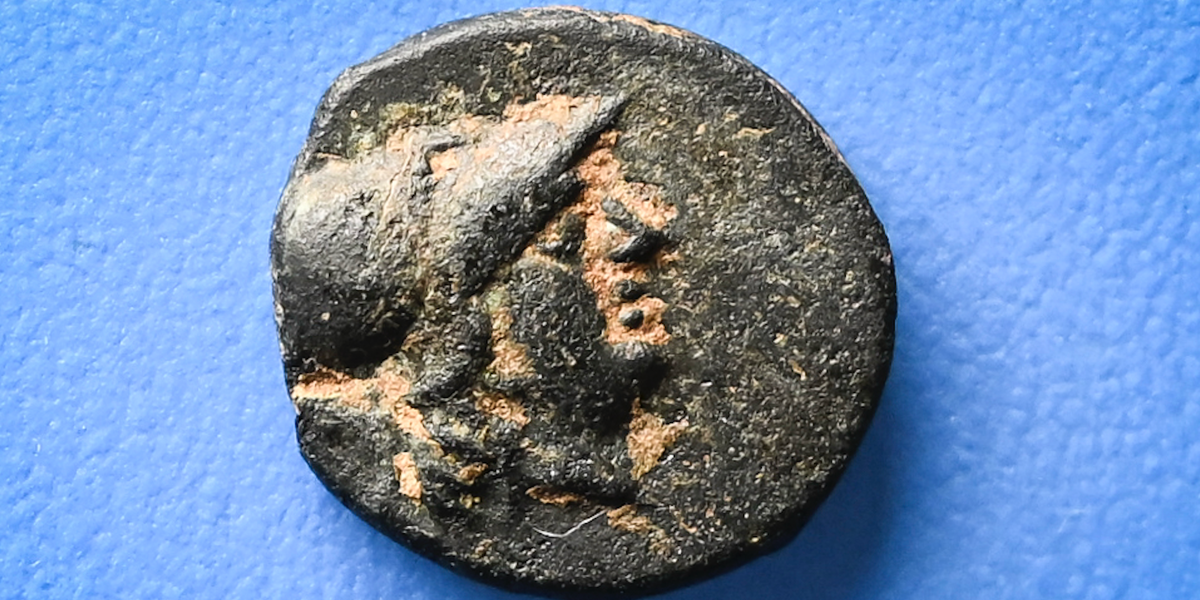
A 13-year-old boy taking a stroll in Berlin unearthed something nobody has ever found in the city before: an ancient Greek artifact. The student somehow managed to spot a relatively small third-century B.C.E. bronze coin that was simply lying on the ground. At just .5 inches in diameter, the tiny find has massive cultural implications.
The coin was minted in Troy (present-day northwestern Turkey) between 281 and 261 B.C.E.—according to a translated statement from Berlin’s PETRI Museum—but it remains a mystery just how it ended up in a Berlin field. That said, excavations at the site where the coin was found (the Spandau district of the city) have revealed that the spot was once a burial ground.
The student’s fascination with the coin prompted him to bring it on a school trip to the museum. “This young boy realized he had found something interesting, and he wanted to know more about it,” Jens Henker, archaeologist at the Berlin Heritage Authority, told German news site DW. “My colleague looked at it and said, ‘Oh, this is quite interesting.’”
The Hellenistic design on one side features the head of the goddess Athena wearing a Corinthian helmet. The other side depicts Athena Ilias wearing a headdress, raising a spear in her right hand, and holding a spindle in her left.
Once turned over to experts at the Berlin State Monuments Office, the question was whether the coin—now on display at PETRI Museum—was truly an artifact found in an archaeological context, or simply a lost collector’s item. Since the boy remembered clearly where he’d discovered the coin, closer examination of the find site “yielded clear evidence indicating that the area had been utilized as a burial ground over a prolonged period,” according to the museum. Archaeologists located ceramics, a double-lobed bronze button, and cremated human remains at the site, all of which could be tied to a Bronze Age or Early Iron Age cemetery. Additional finds from the Roman Imperial period included a Slavic knife-sheath fitting.
Henker said the location was well known, having been surveyed in the 1950s, the 1970s, and again later. “Every time they discovered a few distinct finds that made them say, ‘Okay, there’s probably more in the ground here,’” he said.
Weighing just .25 ounces, the bronze in the coin wouldn’t have held much economic value in its day, so museum experts believe burial in a grave would have represented something symbolic. That symbolism tied Northern Europe to Greece, but just how it might have happened 2,300 years ago is rather murky.
“The Greeks don’t write about us in Germany; they considered us barbarians,” Henker said. “And the people here didn’t write at all, so we really depend on these finds to learn more about potential connections.”
Historical records show that the first Greek navigator and geographer to visit and describe the British Isles and the Baltic Sea, Pytheas, made his trip around 330 B.C.E.—although his fellow Greeks dismissed his account, believing he’d concocted the story of his voyage from Marseille to the north for attention. Pytheas was likely in search of amber from northern Europe. Since the amber road was already well-established at that time, it is one possible route for the coin to have taken. Experts believe the coin may have also been buried with a mercenary hired by the Greeks or Macedonians, who later returned home to Germany.
“All of these potential explanations of how the Greek coin came here are just guesses,” Henker said. “If this coin could tell its story, it would probably be a crazy one with a lot in it.”