Here’s what you’ll learn when you read this story:
- An early manuscript of what is now known as Codex H, written in the 6th century, was repurposed by monks at Mount Athos during the Middle Ages.
- Researchers were able to observe the original text with multispectral imaging, even though corrosive ink had caused some damaged.
- 42 pages of re-inked parchment, which were scattered throughout several countries, have now been translated and transcribed.
Looking out over the hills of northeastern Greece from one side and the cerulean waters of the Aegean Sea from the other stands the monastery of Megisti Lavra. Mount Athos’ oldest monastery—which has existed since it was founded by the Byzantine monk Athanasius the Athonite in 963 C.E.—also served as a medieval center for printing and preserving religious manuscripts, one of which nearly vanished. But recently, it emerged from unlikely shadows.
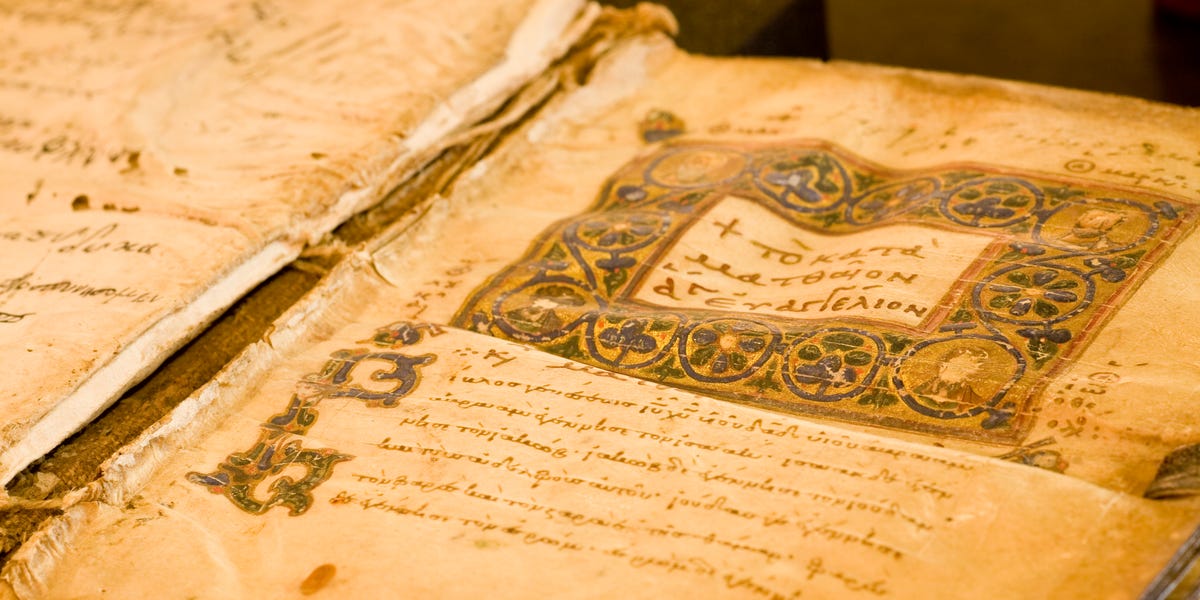
As the monk Markarios was restoring a copy of biblical commentary at Megisti Lavra in 1218, he reached for the unbound remains of a sixth-century manuscript of Paul’s Letters, plastering them onto the cover to strengthen it before it fell apart. The book, which had contained the Epistles of Paul, had been previously unbound by other monks who thought it was not worth preserving (it may have deteriorated past the point of restoration, or been seen as irrelevant for some reason). Pages of what is now known as Codex H of the Bible were dispersed through several other tomes—some of which journeyed as far as Paris, Torino, Kyiv, Moscow, and St. Petersburg—and the document seemed to have vanished for five hundred years.
Codex H began to reemerge in the Parisian abbey of Saint-Germain-des-Prés, when French aristocrats asked Benedictine monk Bernard de Montfaucon to catalog its collection of texts. Curiously, he found fourteen leaves of parchment from the Epistles in the bindings of some of these books, all of which belonged to the lost codex. Centuries later, theologian Garrick Allen of the University of Glasgow has now managed to recover 42 pages of what is seen today as one of the most significant New Testament manuscripts. Allen and his team of researchers collaborated with the Early Manuscripts Electronic Library (EMEL) to analyze the reused and re-inked pages, and found an entire text that time and ink had nearly erased.
“We knew that at one point, the manuscript was re-inked,” Allen said in a recent press release. “The chemicals in the new ink caused ‘offset’ damage to facing pages, essentially creating a mirror image of the text on the opposite leaf—sometimes leaving traces several pages deep, barely visible to the naked eye but very clear with the latest imaging techniques.”
Some of these pages had already been reconstructed in Mount Athos and Paris, based on the evidence of visible ink transfer. Allen and his team were able to isolate the invisible text through multispectral imaging, revealing the earliest known chapter lists for the Epistles, along with corrections, annotations, and other notes from scribes who composed the text during the sixth century. Despite the corrosive ink having caused the parchment to partially deteriorate, the researchers were able to make out enough imprints from transfers to transcribe them and piece together a readable version of the text as part of the Annotating the New Testament project. (Allen also used digital images to recover ink transfer from otherwise unavailable pages in Ukraine and Russia.) Additionally, the researchers found evidence for how and why the text was repurposed, and were able to confirm with radiocarbon dating that traced it back to the sixth century.
Frustratingly for Allen, research on the Bible often emphasizes how the text came together as a whole instead of the origins and preservations of its manuscripts, as he mentions in his earlier paper, The Story of Codex H. The manuscript’s entire history (and its current relevance) are often ignored in favor of studying its earliest iteration. Often overlooked is that the New Testament did not stop evolving in late antiquity, but went through many phases and translations to become what it is today. Manuscripts that traveled through different regions also carry cultural records that may involve undercurrents of political and colonial opinions, along with questions surrounding how they were acquired—and the potentially corrupt dealings that might lie beneath.
“Given that Codex H is such an important witness to our understanding of Christian scripture,” said Allen, “to have discovered any new evidence—let alone this quantity—of what it originally looked like is nothing short of monumental.”